Peenemünde Research Facility
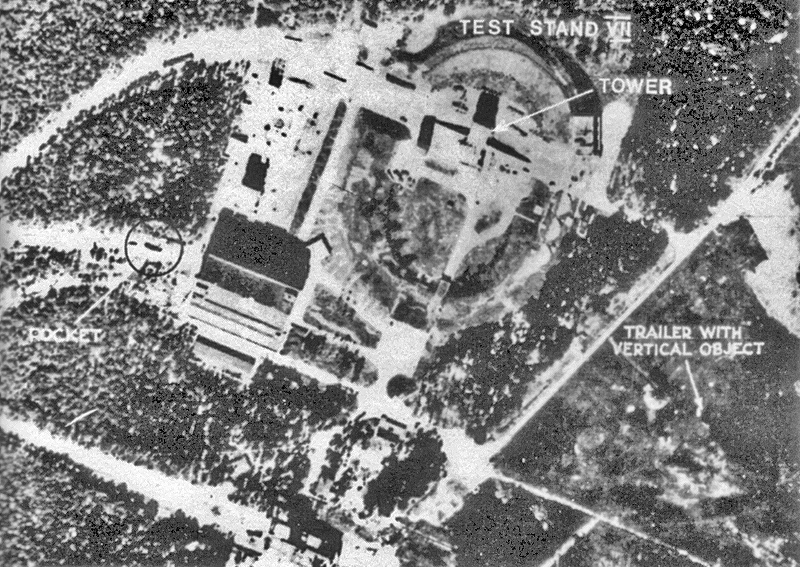
Photo: British Sortie N/853[2] by Flight Lieutenant R. A. Lenton and Sergeant R. S. Haney[3] took this photograph of Peenemünde, which shows 'a thick vertical column about 40 feet high' southeast of the 'buttresses': Flight Lieutenant Andre' J. A. Kenny's Industrial Section[4] enlarges the photos and initially fails to identify the rocket. Over a year later on August 4, 1944, Dr. R. V. Jones obtained a private set of the June 12, 1943 Peenemünde photos from the Medmenham commander, Group Captain P. G. Stewart, the 'thick vertical columns' were measured again and confirmed as vertical rockets, and Jones identified the rocket image to Duncan Sandys.[4][5][6], Public domain, via Wikimedia Commons
Peenemünde Army Research Center was a massive experimental rocket facility established in 1937 on the Baltic island of Usedom in northwest Germany. The complex covered approximately 25 square kilometers and housed over 12,000 personnel at its peak, including scientists, engineers, and technical staff. Today, visitors can explore the remains of launch pads, test stands, and the Historical Technical Museum housed in the former power plant. The site's remote coastal location provided the secrecy and safety margins needed for testing revolutionary rocket technology that would eventually propel humanity into space. Some theorists suggest that Wernher von Braun's rapid advances in rocket propulsion and guidance systems at Peenemünde may have involved extraterrestrial knowledge or recovered artifacts channeled through Nazi occult networks. However, historians and engineers point to well-documented factors: von Braun's exceptional talent, the massive resources of the Nazi state, collaboration with hundreds of skilled personnel, and incremental innovations built upon existing aeronautical research—a trajectory consistent with other major technological breakthroughs of the era.
Timeline
German Army establishes Peenemünde Army Research Center under General Walter Dornberger
First successful V-2 rocket launch reaches altitude of 100 kilometers, becoming first man-made object to reach space
Allied bombing raid Operation Hydra targets facility, killing key personnel and damaging infrastructure
Soviet forces capture facility; Wernher von Braun and key scientists surrender to Americans
Historical Technical Museum opens in former power plant building
What the Show Claims
- ›Von Braun's extraordinary advances in propulsion, aerodynamics, and guidance systems occurred too rapidly to be explained by conventional science aloneS10E02
- ›Possible alien technology or recovered extraterrestrial artifacts were channeled through the Nazi Ahnenerbe organizationS10E02
- ›The rapid technological breakthroughs suggest extraterrestrial assistance rather than human innovationS10E02
Theorist Takes
“You have to ask yourself, where would they have gotten that kind of knowledge so quickly? One of the possible reasons is that the Ahnenerbe, with their researches, had actually discovered technology through some of their expeditions to find ancient relics, and their search, really, for ancient technology.”
From the Transcripts
“Himmler tapped von Braun as its technical director at Germany's large-scale experimental research facility at Peenemunde in Northwest Germany.”
What Archaeology Says
Archaeological investigations and historical research at Peenemünde have revealed the true scope of Nazi Germany's rocket program. Excavations have uncovered extensive underground facilities, concrete test stands, and the remains of manufacturing areas where the world's first operational ballistic missiles were developed. The site's layout demonstrates the systematic approach taken by the German Army Weapons Office, with separate areas for research, testing, and production.
Historians and researchers like Michael Neufeld have documented how the facility operated through extensive archival research and survivor interviews. The evidence shows that Wernher von Braun led a team of hundreds of engineers and scientists who built upon decades of earlier rocket research by pioneers like Hermann Oberth and Konstantin Tsiolkovsky. The rapid progress resulted from massive state funding, forced labor, and the concentration of Germany's brightest aerospace minds in one location.
The scientific consensus attributes Peenemünde's achievements to conventional engineering excellence rather than exotic technology. The V-2 rocket, while revolutionary, represented a logical progression from earlier liquid-fueled rockets developed by researchers like Robert Goddard. Technical documents captured after the war detail the methodical development process, including thousands of test failures that preceded each breakthrough.
What remains genuinely debated among historians is the full extent of cooperation between different Nazi organizations at Peenemünde, particularly regarding exotic research projects that may have been conducted alongside mainstream rocket development. Some wartime reports reference unconventional propulsion experiments, though concrete evidence for such programs remains elusive.
Mysteries & Fun Facts
The V-2 rocket developed at Peenemünde was the direct ancestor of both the rockets that launched Sputnik and the Saturn V that carried humans to the Moon
Wernher von Braun was only 25 years old when he became technical director of the world's most advanced rocket facility
The facility used forced labor from concentration camps, with an estimated 20,000 prisoners working on V-2 production
After the war, both the US and Soviet space programs were built around scientists and technology captured from Peenemünde
Planning a Visit
The Peenemünde Historical Technical Museum is generally accessible to visitors and offers guided tours of the former power plant and outdoor exhibits featuring rocket replicas and historical displays. The site includes walking trails to various historical locations including launch pads and test facilities, though some areas remain restricted due to unexploded ordnance.
Greifswald, approximately 50 kilometers southeast
Late spring through early fall offers the best weather for exploring the outdoor exhibits and historical sites. Summer months can be crowded with tourists, while winter visits may have limited access to outdoor areas.
Related Sites
White Sands Proving Ground
White Sands became the American testing ground for captured V-2 rockets and former Peenemünde scientists after World War II
Roswell
Roswell was among the locations where former Nazi rocket scientists worked on advanced aerospace projects in the post-war period
Germany / Western Europe (Foo Fighters theater)
The Foo Fighters phenomenon over wartime Germany has been linked by some researchers to secret advanced propulsion experiments conducted at facilities like Peenemünde