Koryak Mountains, Siberia
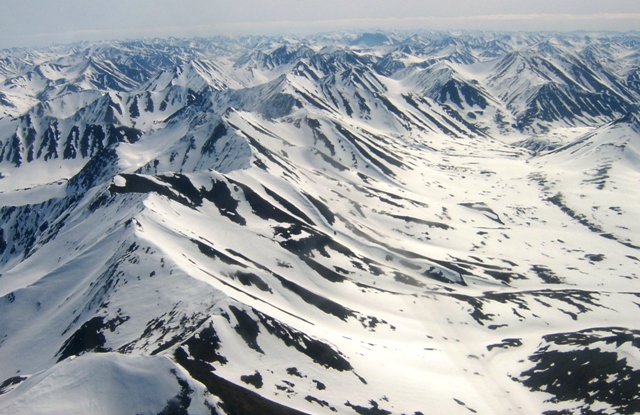
Photo: Vladimir Yu. Arkhipov, Arkhivov, CC BY-SA 3.0, via Wikimedia Commons
The Koryak Mountains stretch across the remote Kamchatka Peninsula in far eastern Siberia, forming a rugged volcanic landscape where temperatures can plummet to -40°F in winter. In 1979, a meteorite crashed into this desolate region, creating what would become one of the most scientifically significant impact sites of the modern era. The meteorite itself measured approximately 10 centimeters in diameter and contained within it a revolutionary discovery that would challenge our understanding of atomic structures. Today, the crash site remains largely inaccessible due to its remote location in the Siberian wilderness, preserved much as it was following the impact over four decades ago. Ancient astronaut theorists have suggested that the quasicrystal discovered within the meteorite—featuring an unprecedented 60-point rotational symmetry never before observed in nature—may represent extraterrestrial technology deliberately delivered to Earth, pointing to its exotic atomic structure as evidence of intentional design. However, in 2016, an international team of researchers from institutions including the University of Florence, Caltech, and Princeton announced that the quasicrystal, while extraordinarily rare, represents a naturally occurring atomic arrangement that could form under the extreme conditions present during meteorite formation and impact. The discovery remains scientifically significant regardless of its origin, as it expanded our understanding of how complex atomic structures can emerge through natural processes in space.
Timeline
Meteorite impact occurs in the remote Koryak Mountains of Siberia
Researchers begin systematic analysis of meteorite fragments containing unusual atomic structures
International team announces discovery of first natural quasicrystal with 60-point rotational symmetry
What the Show Claims
- ›A quasicrystal recovered from the 1979 meteorite crash features 60-point rotational symmetry in an aluminum-copper-iron formation never found in nature, possibly representing extraterrestrial technologyS12E02
- ›Whistleblower reports suggest that crashed alien craft surfaces are made of quasicrystal alloys similar to those found in the Koryak meteoriteS12E02
- ›The quasicrystal may have been intentionally delivered to Earth to advance human scientific understandingS12E02
Theorist Takes
“quasicrystal alloys violate the known laws of physics completely, but what we have heard from whistleblowers is that the surfaces of extraterrestrial vehicles, such as the one that crashed in Roswell, are made of quasicrystal alloys.”
From the Transcripts
“Siberia, Russia. 1979. A meteorite crashes into the Koryak Mountains. Nearly four decades later, in December 2016, researchers studying pieces of the meteorite at the University of Florence, Caltech and Princeton announce that it has brought with it an incredible, rare metal formation called a 'quasicrystal.'”
What Archaeology Says
Unlike traditional archaeological sites, the Koryak Mountains meteorite impact represents a unique intersection of geology, materials science, and astrobiology. The 1979 crash site was initially studied by Soviet researchers, though systematic analysis of the meteorite fragments didn't begin in earnest until decades later when international scientific collaboration became more feasible.
The groundbreaking research was conducted by an international team that included scientists from the University of Florence, Caltech, and Princeton University. Their painstaking analysis revealed the presence of icosahedrite, a naturally occurring quasicrystal with a complex aluminum-copper-iron composition exhibiting 60-point rotational symmetry. This discovery was particularly significant because quasicrystals had previously only been synthesized in laboratory conditions, with their existence in nature being purely theoretical.
The scientific consensus, published in peer-reviewed journals in 2016, confirms that this quasicrystal represents a rare but naturally occurring atomic structure formed under the extreme conditions present during the early formation of our solar system. The meteorite itself is believed to be a fragment from the asteroid belt, carrying within it materials that formed billions of years ago under conditions that cannot be replicated on Earth.
What remains genuinely intriguing to researchers is how such complex atomic structures could form and remain stable over geological timescales. The quasicrystal's properties challenge conventional understanding of crystalline structures, and its discovery has opened new avenues of research into both materials science and our understanding of cosmic processes that occurred during the solar system's formation.
Mysteries & Fun Facts
The quasicrystal discovery marked the first time such a complex atomic structure was found occurring naturally in the universe
Quasicrystals exhibit properties that seem to violate traditional rules of crystallography, including rotational symmetries that were once thought impossible
The meteorite that created this site traveled through space for approximately 4.5 billion years before reaching Earth
The aluminum-copper-iron quasicrystal is so rare that finding it naturally was considered less likely than discovering life on Mars
Planning a Visit
The Koryak Mountains crash site is extremely remote and generally inaccessible to casual visitors due to harsh Siberian conditions and lack of infrastructure. Access would require specialized expedition planning and potentially research permits from Russian authorities.
Petropavlovsk-Kamchatsky, approximately 300 miles southeast
If access were possible, the brief summer months of June through August would offer the most favorable weather conditions, though temperatures would still be challenging.
Related Sites
Tunguska explosion site
Another significant meteorite impact site in Siberia that has attracted theories about extraterrestrial origins
Allen Hills, Antarctica (ALH 84001 meteorite find site)
Location where controversial meteorite ALH 84001 was discovered, claimed by some to contain evidence of ancient Martian life
Roswell
Famous crash site associated with UFO theories and claims of recovered extraterrestrial materials