Mariana Trench
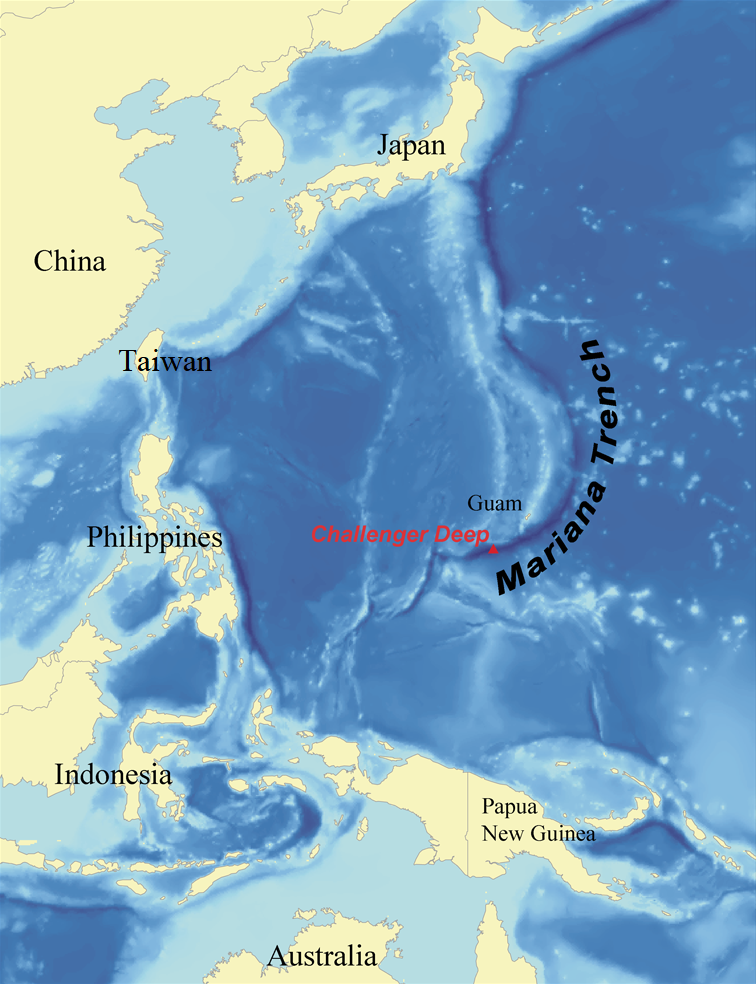
Photo: wallace, CC BY 2.5, via Wikimedia Commons
The Mariana Trench is an oceanic trench located in the western Pacific Ocean, approximately 200 kilometers east of the Mariana Islands. This crescent-shaped geological formation measures about 2,550 kilometers in length and 69 kilometers in width, making it the deepest oceanic trench on Earth. The maximum known depth reaches 10,984 ± 25 meters at the Challenger Deep, which is more than 2 kilometers farther from sea level than Mount Everest is tall. At these crushing depths, the water pressure reaches 1,086 bar, over 1,000 times greater than atmospheric pressure at sea level, while temperatures hover between 1 to 4°C. In 2015, researchers detected unusual acoustic signals emanating from the Challenger Deep, which some theorists have speculated could indicate an extraterrestrial installation on the ocean floor. However, marine scientists from the Hatfield Marine Science Center identified these sounds as anomalous biological activity, consistent with the known behavior of deep-sea organisms in an extreme environment where sound travels differently and creatures produce vocalizations rarely encountered by surface research.
Timeline
Formation begins as Pacific Plate subducts beneath the Philippine Sea Plate
HMS Challenger expedition first measures deep ocean depths in the region
Trieste bathyscaphe reaches Challenger Deep, first human descent to deepest point
Mariana Trench established as US National Monument
What the Show Claims
- ›Unidentified eerie sounds detected at the Mariana Trench in 2015, which could not be attributed to any known whale species, may originate from an extraterrestrial base still in operation at the ocean floorS12E08S14E05
- ›The extreme depths and isolation of the trench could harbor secret underwater alien bases beyond human detectionS14E05
Theorist Takes
“If we analyze the signal that's coming out of the depths of the Mariana Trench, and realize that it's more technological in nature... could this be coming from some base that could still be in use by some extraterrestrial race?”
From the Transcripts
“Researchers from the Hatfield Marine Science Center scan the deepest part of the world's oceans with a hydrophone, listening for whale calls. But suddenly, they pick up something unexpected: Eerie sounds booming from the depths.”
What Archaeology Says
While the Mariana Trench is primarily a geological rather than archaeological site, scientific exploration has revealed remarkable discoveries about life in Earth's most extreme environment. The deepest known single-celled organisms, called monothalamea, have been found at record depths of 10.6 kilometers below the sea surface by researchers from the Scripps Institution of Oceanography. These findings challenge our understanding of where life can exist on our planet.
Modern deep-sea exploration began with the HMS Challenger expedition in 1875, which first measured the profound depths of this region. The most famous descent occurred in 1960 when the Trieste bathyscaphe, piloted by Jacques Piccard and Don Walsh, reached the bottom of Challenger Deep. More recent expeditions have used remotely operated vehicles and advanced submersibles to study the trench's unique geology and biology.
Scientific consensus attributes the trench's formation to tectonic plate subduction, where the Pacific Plate slides beneath the Philippine Sea Plate. This ongoing geological process, which began approximately 180 million years ago, continues to deepen the trench today. The extreme pressure and near-freezing temperatures create conditions unlike anywhere else on Earth's surface.
Despite decades of study, much about the Mariana Trench remains genuinely unknown. The 2015 detection of unidentified sounds by researchers from the Hatfield Marine Science Center demonstrates that the deepest parts of our oceans still hold mysteries. While these sounds have been attributed to possible biological sources, their exact origin remains unconfirmed, fueling both scientific curiosity and alternative theories about what might exist in Earth's most inaccessible depths.
Mysteries & Fun Facts
The pressure at the bottom of Challenger Deep is equivalent to having about 50 jumbo jets pressing down on every square meter
If Mount Everest were placed in the Challenger Deep, its peak would still be over 2 kilometers underwater
The trench is home to unique life forms including giant single-celled organisms called xenophyophores that can grow larger than 10 centimeters
The water temperature at the bottom remains just above freezing despite the immense pressure that would normally generate heat
Planning a Visit
The Mariana Trench itself is not accessible to general visitors, as it requires specialized deep-sea submersibles that cost millions of dollars to operate. However, visitors can learn about the trench at the Mariana Trench Marine National Monument visitor center and related facilities in Guam and the Northern Mariana Islands.
Guam, approximately 200 kilometers to the west
Since the trench is an underwater feature, weather conditions above affect research operations year-round. The dry season from December to June generally provides the best conditions for any surface operations related to trench research.
Related Sites
Roswell
Both sites are associated with unexplained phenomena and potential extraterrestrial activity in remote locations
San Clemente Island, California
Another site where Ancient Aliens theorists suggest underwater alien bases might be hidden beneath the ocean
Tunguska explosion site
Like the Mariana Trench sounds, the Tunguska event involved mysterious phenomena that some attribute to extraterrestrial causes
Featured In2 episodes
Historical data sourced from Wikipedia