White Sands Missile Range
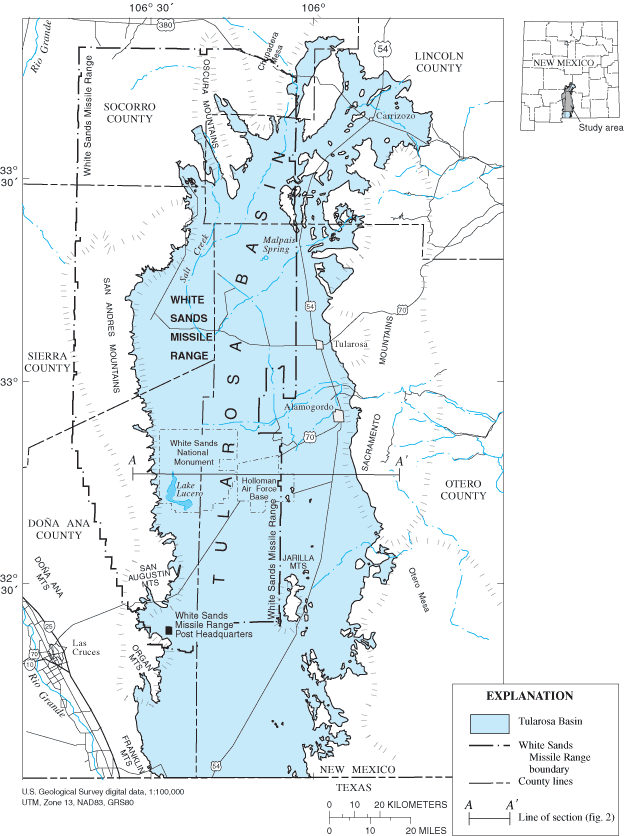
Photo: Huff, Glenn F. (United States Geological Survey), Public domain, via Wikimedia Commons
White Sands Missile Range is a vast U.S. Army military testing facility covering approximately 3,200 square miles of the Chihuahuan Desert in New Mexico. Established in 1945 as the White Sands Proving Ground, this remote installation encompasses the historic Trinity test site where the first atomic bomb was detonated. The range includes portions of the stunning white gypsum dunes of White Sands National Park, creating a unique landscape where cutting-edge military technology testing occurs alongside pristine desert wilderness. Today, WSMR continues to serve as America's premier missile and rocket testing ground, with restricted access due to ongoing classified operations. Ancient astronaut theorists have pointed to a 1970 Athena missile launched from nearby Green River, Utah, as evidence of anomalous forces in the region, noting that the missile deviated significantly from its intended White Sands target and crashed in Mexico's Zone of Silence. However, aerospace engineers and military records attribute the deviation to standard trajectory miscalculations and fuel depletion, with the missile's overshoot consistent with documented launch parameters of that era. The incident remains a notable example of how unexplained military test failures have sometimes been reinterpreted through the lens of extraterrestrial intervention theories.
Timeline
Originally established as the Alamogordo Bombing and Gunnery Range
Renamed White Sands Proving Ground
Athena missile launched from Utah overshot the range and crashed in Mexico's Zone of Silence
What the Show Claims
- ›A 1970 U.S. Air Force Athena missile was mysteriously pulled hundreds of miles off course from its intended White Sands target and drawn into the Zone of Silence, suggesting an anomalous attractive force in the regionS02E01
Theorist Takes
“Not only did it go off course, it way overshot, as if it had been picked up or yanked or dragged or pulled into it.”
From the Transcripts
“the U.S. Air Force launched an Athena missile from its military facility in Green River, Utah. The missile was programmed to land 700 miles away at the White Sands Missile Range in New Mexico. But for some unexplained reason, the Athena missile flew hundreds of miles past the White Sands Range towards the Zone of Silence.”
What Archaeology Says
While White Sands Missile Range is primarily a modern military installation, the area contains significant archaeological and historical sites within its boundaries. The northern portion of the range includes the Trinity test site, where the world's first atomic bomb was detonated on July 16, 1945, marking a pivotal moment in human history and the beginning of the nuclear age.
The range encompasses portions of ancient Native American territories, and archaeological surveys have documented prehistoric sites and artifacts throughout the area, though detailed studies are limited due to the facility's restricted military status. The unique gypsum landscape of the region has preserved some archaeological materials unusually well due to the desert's dry climate.
The 1970 Athena missile incident remains one of the most intriguing events in the range's history. According to official records, the missile was launched from Green River, Utah, as part of a routine test but dramatically overshot its intended target at White Sands, ultimately crashing approximately 400 miles south in northern Mexico's Mapimí Silent Zone. Military and NASA officials have acknowledged the incident but have not provided a definitive explanation for the missile's extreme deviation from its programmed flight path.
The scientific consensus attributes such incidents to potential equipment malfunctions, atmospheric conditions, or guidance system errors rather than anomalous forces. However, the extreme nature of the deviation and the missile's ultimate destination in an area already known for alleged electromagnetic anomalies continues to generate discussion among researchers interested in unexplained phenomena.
Mysteries & Fun Facts
White Sands Missile Range covers an area larger than the state of Delaware
The Trinity test site within the range was where the first atomic bomb was detonated in 1945
The range includes portions of White Sands National Park, famous for its brilliant white gypsum dunes
The facility has been used for testing everything from captured German V-2 rockets to modern space exploration vehicles
Planning a Visit
Access to White Sands Missile Range is strictly restricted due to ongoing military operations and classified testing activities. The range is generally closed to civilian visitors except for special events or guided tours of the Trinity Site, which are offered only twice a year.
Alamogordo, New Mexico, approximately 30 miles southeast
Trinity Site tours are typically offered in April and October when weather conditions are most favorable for desert travel.
Related Sites
Zone of Silence
The destination where the mysterious 1970 Athena missile crash-landed after deviating from White Sands
Tunguska explosion site
Another location associated with unexplained phenomena and potential electromagnetic anomalies
Green Bank, West Virginia (Drake's Radio Telescope Site)
A facility dedicated to detecting signals from space, representing humanity's search for extraterrestrial contact
Featured In1 episodes
Historical data sourced from Wikipedia