Peenemünde Research Center
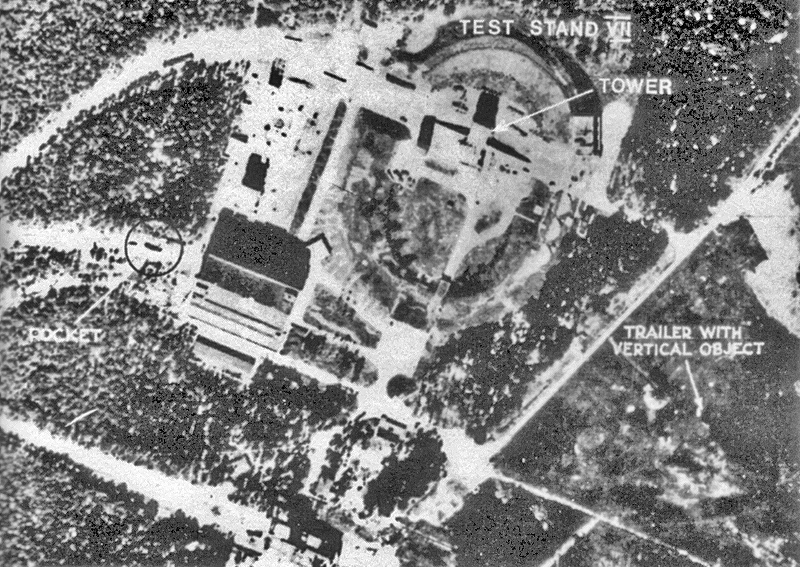
Photo: British Sortie N/853[2] by Flight Lieutenant R. A. Lenton and Sergeant R. S. Haney[3] took this photograph of Peenemünde, which shows 'a thick vertical column about 40 feet high' southeast of the 'buttresses': Flight Lieutenant Andre' J. A. Kenny's Industrial Section[4] enlarges the photos and initially fails to identify the rocket. Over a year later on August 4, 1944, Dr. R. V. Jones obtained a private set of the June 12, 1943 Peenemünde photos from the Medmenham commander, Group Captain P. G. Stewart, the 'thick vertical columns' were measured again and confirmed as vertical rockets, and Jones identified the rocket image to Duncan Sandys.[4][5][6], Public domain, via Wikimedia Commons
Peenemünde Army Research Center operated as Germany's premier rocket development facility on the Baltic Sea island of Usedom from 1937 to 1945. The complex covered approximately 25 square kilometers and housed cutting-edge laboratories, test stands, production facilities, and launch sites where the world's first operational ballistic missiles were developed. Today, visitors can explore the restored Historical-Technical Museum housed in the former power plant, view remaining concrete bunkers and test facilities, and walk through exhibitions detailing the site's pivotal role in space exploration history. The facility's remote coastal location provided ideal conditions for testing rockets over the Baltic Sea, while its isolation offered security for Germany's most classified weapons program. Some Ancient Astronaut Theorists suggest that Wernher Von Braun's remarkable success in developing advanced rocket technology may have involved extraterrestrial assistance, pointing to alleged later statements by Von Braun himself about receiving "help from them." However, mainstream historians and aerospace engineers attribute Peenemünde's innovations to Von Braun's own brilliant engineering mind, combined with German industrial resources, captured scientific data from other nations, and the intensive collaboration of thousands of scientists and technicians working within the facility's extensive research complex.
Timeline
German Army establishes Peenemünde Army Research Center under Walter Dornberger
First successful V-2 rocket test launch achieves spaceflight altitude
Allied bombing raid Operation Hydra targets the facility, killing hundreds
Soviet forces capture the site; Wernher von Braun and key scientists surrender to Americans
Peenemünde Historical-Technical Museum opens to preserve the site's complex legacy
What the Show Claims
- ›Germany's advanced rocket program may have benefited from extraterrestrial technology transferS02E05
- ›Wernher von Braun allegedly told a UFO researcher 'we had help from them' when developing rocket technologyS02E05
- ›The rapid advancement of German rocket technology suggests non-human assistanceS02E05
Theorist Takes
“And I said to him, 'how did you develop that much technology so fast?' And he looked down the rows of ufo files. And he said, 'we had help from them.'”
From the Transcripts
“The most important and influential of these former German scientists was Dr. Wernher Von Braun, the commander of Germany's Peenemunde space research center.”
What Archaeology Says
Archaeological investigations at Peenemünde have focused on preserving and documenting the extensive concrete infrastructure that survived Allied bombing and Soviet occupation. Researchers have catalogued over 200 remaining structures including test stands, bunkers, production halls, and residential buildings that housed thousands of scientists, engineers, and forced laborers. The most significant archaeological work has centered on the massive Test Stand VII, where the V-2 rockets underwent their final preparations before launch.
Historical research led by museum curators and international scholars has revealed the complex dual nature of Peenemünde's legacy. While the facility produced devastating weapons that killed thousands in London and Antwerp, the same research laid crucial groundwork for peaceful space exploration. Excavations have uncovered personal artifacts, technical blueprints, and documentary evidence that illuminate daily life at this secretive installation. The presence of concentration camp prisoners and foreign workers has been thoroughly documented through archaeological evidence and survivor testimonies.
The scientific consensus holds that German rocket development at Peenemünde represented the culmination of decades of theoretical work by pioneers like Hermann Oberth and practical experimentation by von Braun's team. The V-2's liquid-fueled engine, gyroscopic guidance system, and aerodynamic design emerged from methodical engineering progress rather than revolutionary breakthroughs. However, some aspects of the program's rapid acceleration between 1942 and 1944 continue to intrigue researchers, particularly given the wartime resource constraints Germany faced.
What remains genuinely debated among historians is the full extent of technological collaboration between different Axis powers and the complete scope of research conducted at Peenemünde beyond the well-documented V-weapon programs. Classified projects and destroyed documentation mean that some aspects of the facility's work may never be fully understood, contributing to ongoing speculation about the sources of German technological advancement during this period.
Mysteries & Fun Facts
The V-2 rocket developed at Peenemünde became the first human-made object to reach space in 1944
Wernher von Braun's team at Peenemünde later developed the Saturn V rocket that carried astronauts to the Moon
The facility employed over 12,000 people at its peak, making it one of the largest research installations in Europe
Allied intelligence initially dismissed reports about German rocket development as impossible propaganda
Planning a Visit
The Peenemünde Historical-Technical Museum is generally accessible to visitors year-round, with guided tours available in multiple languages through the restored power plant and outdoor historical sites. Visitors can explore authentic rocket engines, examine surviving bunkers and test facilities, and view multimedia exhibitions that contextually present both the technological achievements and human costs of the program. The museum grounds include walking trails that connect various historical structures across the expansive site.
Greifswald, approximately 40 kilometers southeast
Late spring through early autumn offers the most pleasant weather for exploring the outdoor historical sites and coastal setting. Summer months provide extended daylight hours ideal for comprehensive site tours, though this is also the busiest tourist season.
Related Sites
White Sands Proving Ground
White Sands became the primary testing ground for captured V-2 rockets and German rocket technology after the war
Roswell
Roswell is connected through UFO theories about advanced aerospace technology and government secrecy
Tunguska explosion site
The Tunguska event represents another mysterious technological phenomenon that some theorists connect to advanced propulsion systems