Tiwanaku: Gateway of the Sun
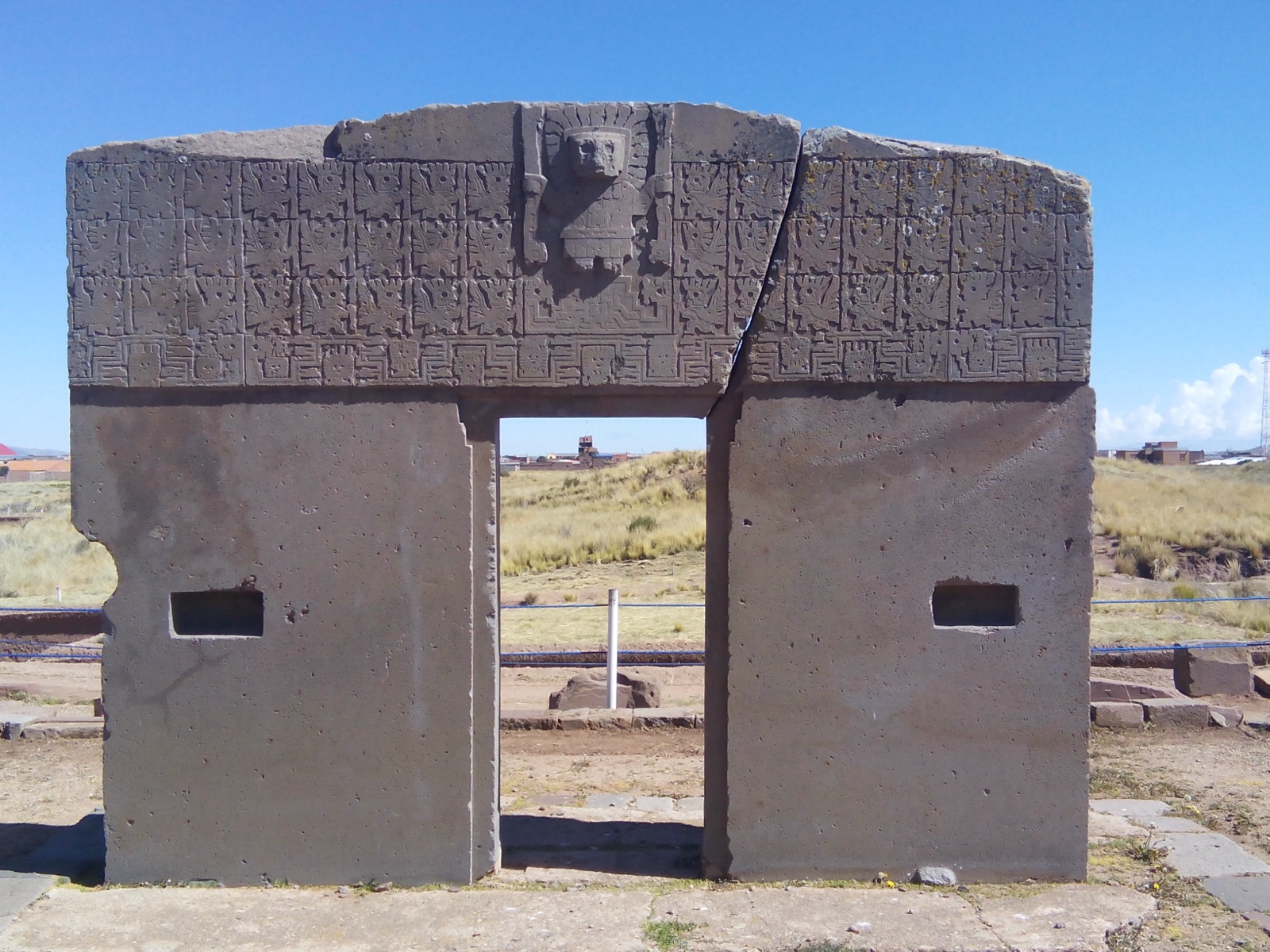
The Gateway of the Sun was carved from a single block of grey andesite. It weighs approximately 10 tons. It stands roughly three meters tall and nearly four meters wide. Its upper frieze is covered with 48 carved figures arranged in three rows, all of them running toward a central deity — winged, staff-bearing, with a face that radiates like a sunburst. The carving is precise enough that the figure's headdress details can be counted.
This gateway sits at 12,500 feet above sea level in western Bolivia, on an Altiplano so windswept and cold that clouds form at eye level. The society that carved it — the Tiwanaku — built one of South America's most important pre-Columbian empires, and then essentially vanished from the archaeological record around 1000 AD.
Nobody who sees the Gateway of the Sun in person forgets it.
The Place
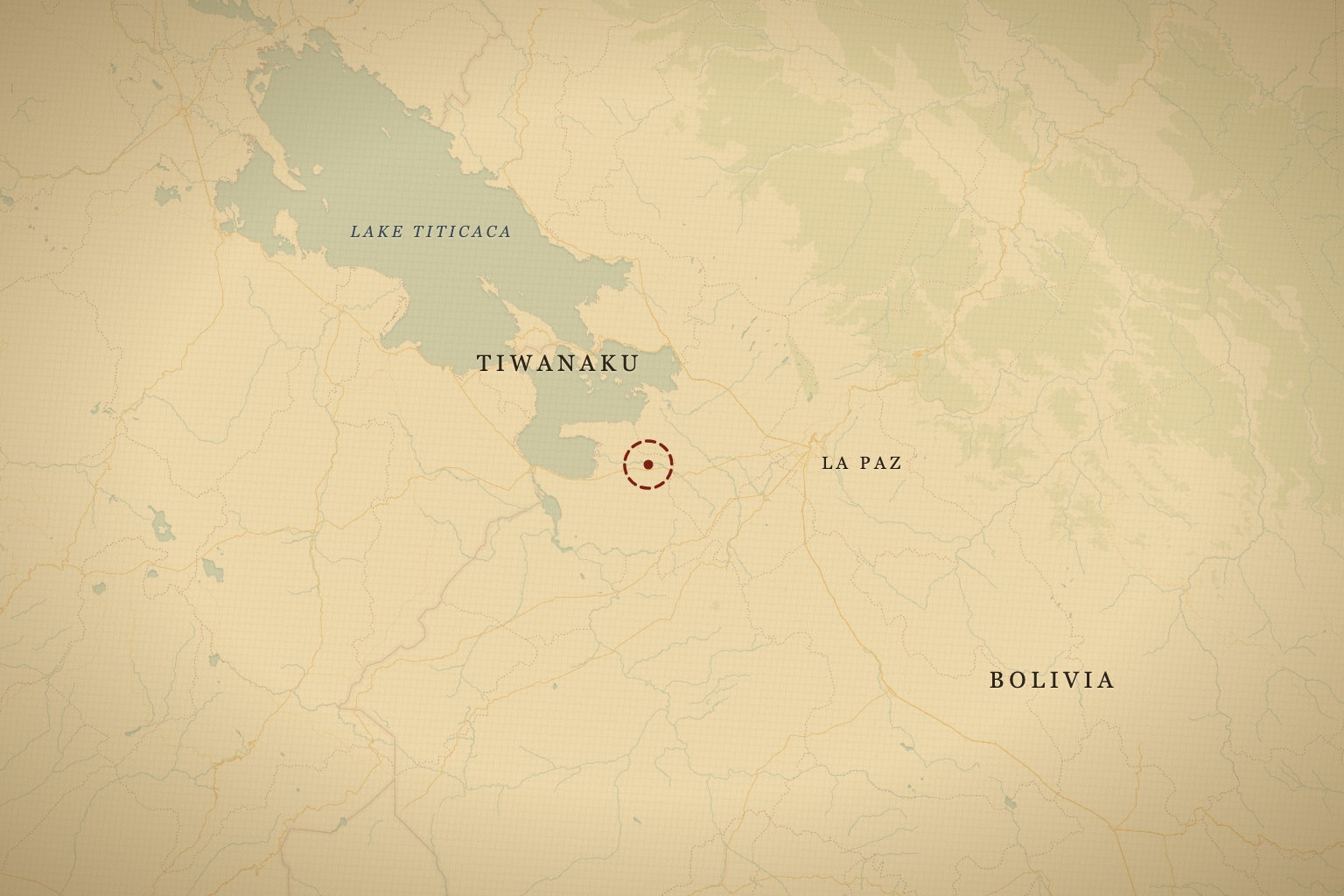
Tiwanaku sits about 45 minutes west of La Paz by road, near the southern shore of Lake Titicaca at an elevation of 12,549 feet. The archaeological zone covers several square kilometers and includes a cluster of major monuments: the Akapana pyramid, the Kalasasaya temple platform, the Pumapunku complex (about a kilometer southwest), and the Subterranean Temple with its gallery of carved stone heads protruding from the walls.
The Gateway of the Sun stands at the northwest corner of the Kalasasaya — though it was found lying on its side when the site was first systematically studied in the 19th century. Early explorers like Arthur Posnansky proposed that the Gateway was originally located elsewhere in the complex, a question that archaeologists are still debating.
At its height between 300 and 800 AD, Tiwanaku was the capital of a major empire. The city may have housed between 20,000 and 40,000 people — a substantial urban center by any ancient standard. Tiwanaku influence extended across modern Bolivia, southern Peru, northern Chile, and northwestern Argentina through a combination of trade networks, religious authority, and political control.
The site's modern archaeological story begins in earnest with Wendell Bennett's 1932 excavations, which uncovered the largest sculpture ever found at Tiwanaku: a 7.3-meter, roughly 20-ton sandstone monolith now known as the Bennett Monolith. It was hauled to La Paz and stood for decades in a city plaza, weathering traffic and exhaust, before being returned to Tiwanaku in 2002 — where it now dominates the site museum. From 1957 onward, the Bolivian archaeologist Carlos Ponce Sanginés led decades of state-sponsored excavation and reconstruction, establishing the ceramic chronology still used to sequence the site and uncovering the Ponce Monolith that stands inside the Kalasasaya today. His reconstructions of the Kalasasaya's walls remain controversial — later archaeologists argue he rebuilt too freely — which means even the site you walk through today is partly a 20th-century interpretation layered over the original ruin.
The site is accessible year-round. The on-site museum houses artifacts including carved monolithic figures that cannot be fully appreciated from photographs. The altitude affects most visitors — allow time to acclimatize in La Paz before making the trip.
What the Show Claims
Ancient Aliens visited Tiwanaku most directly in Season 4, Episode 6 ("The Mystery of Puma Punku"), the episode built around the adjacent temple complex, and has returned across later seasons.
The show's primary focus is the Gateway of the Sun's central figure. This deity — generally identified by archaeologists as Viracocha, the Tiwanaku sun god and creator figure — is shown holding two staffs. The show's theorists argue that these staffs are not ceremonial objects but functional alien technology: possibly energy weapons, communication devices, or tools for manipulating physical forces. The god's complex headdress, radiating beams, and overall iconography are presented as the depiction of an actual extraterrestrial being in powered flight or equipped with advanced technology.
The show also challenges Tiwanaku's accepted dating. Arthur Posnansky, working in the early 20th century, proposed — based on astronomical alignments of the Kalasasaya's cardinal orientations — that Tiwanaku was built as early as 15,000 BC or even 17,000 BC, making it far older than any known civilization. This claim is cited in the show as evidence that the site predates human civilization as we understand it.
Finally, Tiwanaku's hydraulic engineering gets attention: sophisticated drainage canals, raised agricultural fields around Lake Titicaca, and what the show presents as advanced water management beyond the capabilities of the era.
What Archaeology Says
Archaeologists read the same stones differently — and what they've found is its own kind of astonishing. Take the dating. Arthur Posnansky's ultra-ancient estimate of 15,000 BC came from the Kalasasaya's astronomical alignments, but it assumed a rate of change in Earth's axial tilt that later calculations revised; with corrected values, that early date dissolves. Radiocarbon, stratigraphy, and ceramic analysis instead cluster Tiwanaku's major construction between roughly 300 and 900 AD. Younger than the show proposes — but that makes the achievement stranger, not tamer: everything here was raised in a few centuries, at 12,500 feet, without metal tools, without wheels, without draft animals larger than llamas.
The radiant, staff-bearing figure has cousins, too. The same deity recurs across Andean cultures for centuries, from Chavín de Huantar in northern Peru to Tiwanaku and beyond — a lineage Rebecca Stone-Miller of Emory University has traced in detail, reading the staffs as emblems of cosmic authority, with condors and raptors perched on their ends to connect the god to the sky. It's a documented symbolic tradition. Whether that fully explains the figure — or simply gives a name to what we still don't understand about him — is the question the carving keeps open.
The transport question has been tested in the field, not just argued. The grey andesite came from quarries near the Ccapia volcano, across Lake Titicaca — and in 2002, archaeologist Alexei Vranich, working with expedition organizer Paul Harmon, tried the leading hypothesis directly: moving a multi-ton stone on a totora reed boat of the kind Aymara communities around the lake still build. The experiments were instructive precisely because they were hard — boats swamped, the stone had to be hauled up the shore by teams of people, and everyone involved came away with a sharpened respect for how nontrivial "they floated them across the lake" really is. Jean-Pierre Protzen and Stella Nair's 2013 study The Stones of Tiahuanaco arrived at a similar posture from the other direction: the cuts and surfaces are achievable with stone and bronze tools, but the system of shared templates and standardized joinery implies an architectural discipline — drawings, models, some way of holding a design constant across workshops — that we have not found direct evidence of. Vranich has since taken that problem digital, 3D-printing miniature replicas of Pumapunku's blocks to test-fit reconstructions that could never be attempted with the multi-ton originals. The buildings can now be virtually reassembled. What they were for is still argued.
And the hydraulics remain genuinely uncanny. Alan Kolata's long-term excavations mapped an extensive system of suka kollus — raised fields threaded with water channels that buffered the frost and stretched the growing season on a plateau that should not have been able to feed a city. When Kolata's team worked with local Aymara communities to rebuild them in the 1980s, crop yields jumped. A thousand-year-old climate-control system — and it still works. All of it, the canals and the quarried stone alike, accomplished in a climate where the growing season is short and frost can strike any month of the year.
The end, too, has a documented signature. Ice cores drilled from the Quelccaya glacier in Peru record a sustained drying of the Altiplano beginning around 1000 AD — and Kolata and his colleagues have argued that this is what finally broke the raised-field system, and with it the city. Not invasion, not catastrophe: rainfall. A civilization that had engineered its way around frost at 12,500 feet for seven centuries met the one variable its canals could not buffer.
The Verdict
Archaeology has given us better questions, not final answers. We can date the andesite, trace the iconography across a thousand years of Andean cultures, and even rebuild the fields that fed the city — and still the Gateway's central question stays open: who is the radiant, staff-bearing figure that 48 carved runners race toward, and why did a people pour their finest engineering into fixing him in a single 10-ton block at the edge of the breathable world? Around 1000 AD, after seven centuries, sustained drought undid the raised fields and the city emptied — but the monuments were left standing, and the figure kept facing the dawn.
The Gateway of the Sun is still there. The 48 running figures still converge on their central deity. Whatever the staffs meant to the people who carved them, the object itself is one of the most powerful things any culture ever made from stone. Go stand in front of it. Let it ask you its questions directly.
Track the 1 site from this post on your map.
Free account · mark visited sites · build your bucket list.
Start tracking