The Mystery of the Serapeum of Saqqara
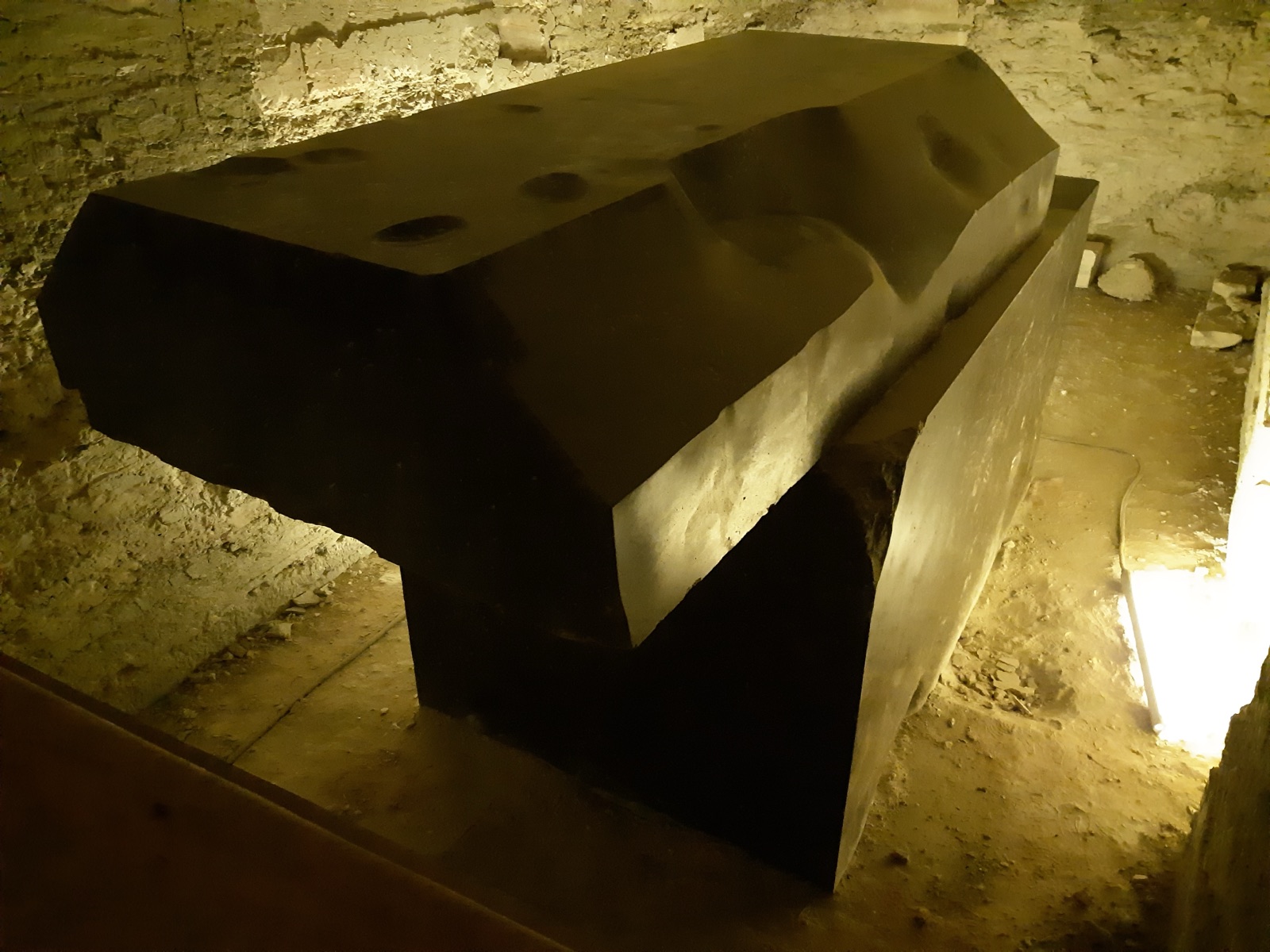
Imagine a stone box the size of a small bus, weighing as much as a fully loaded tractor-trailer, cut from a single block of some of the hardest stone on earth. Now imagine its inside surfaces polished so flat and so square that a modern engineer, pressing a precision straightedge against the granite, claimed he could not slide a feeler gauge between the two. Then imagine lowering that box down a stairway, threading it through a tunnel barely wider than the box itself, and sliding it into a niche cut into the bedrock — and then doing it twenty-three more times.
That is the Serapeum of Saqqara. The boxes are real, the polish is real, and the most unsettling detail of all is real too: when archaeologists finally pried the lids off, most of them were empty.
The Site
The Serapeum sits beneath the sand at Saqqara, the vast necropolis south of Cairo that served the ancient capital of Memphis for more than three thousand years. Aboveground, Saqqara is famous for Djoser's Step Pyramid, the oldest large stone monument in the world. Belowground, in a network of tunnels carved into the limestone bedrock, is something stranger.
The Serapeum was the burial place of the Apis bulls — sacred animals worshipped as living manifestations of the Memphite god Ptah, and later linked to Osiris. When an Apis bull died, it was mummified and entombed with the ceremony of a king. The complex grew over centuries. The earliest individual Apis burials trace back to the reign of Amenhotep III in the 14th century BC. Later, Khaemweset — a son of Ramesses II, and arguably history's first archaeologist — had a long tunnel with side chambers cut for the bulls, the section now called the Lesser Vaults. A second and grander gallery, the Greater Vaults, was begun under the pharaoh Psamtik I in the 7th century BC and extended into the Ptolemaic period.
The bulls chosen for this honor weren't picked at random. Egyptian priests searched the countryside for a calf bearing a precise set of markings — a white triangle on the forehead, the outline of a vulture's wing across its back, a scarab-shaped mark beneath its tongue, a white crescent on its flank, and doubled hairs on its tail. Once found and installed at Memphis, the living Apis was treated as a god made flesh: given its own herd of cows, paraded through the city on feast days hung with jewelry and garlands, and consulted as an oracle whose movements priests read as prophecy. Its breath was said to cure the sick. At its death, the bull became Osorapis — a fused Osiris-Apis — and the search began again for a successor calf bearing the same signs.
It is in those Greater Vaults that the famous boxes wait. Twenty-four of them, lining a long subterranean gallery, each set into its own carved alcove. They were cut mostly from Aswan granite and other hard stones quarried far up the Nile, hauled hundreds of kilometers, taken underground, and fitted into place with their lids — some boxes and lids together estimated in the range of 70 to 100 tons.
The site was lost for two millennia. In 1850, the French archaeologist Auguste Mariette noticed a sphinx head poking from the sand at Saqqara, followed the buried avenue of sphinxes, and broke through into the tunnels the following year. He found a few intact Apis burials and thousands of objects — much of which traveled to the Louvre, where it remains.
What the Show Claims
To Ancient Aliens and the broader alternative-history community, the Serapeum is one of the most compelling exhibits in the entire catalogue of "impossible" Egyptian engineering — and it's easy to see why.
The argument centers on precision, not size. The pyramids are about mass; the Serapeum boxes are about tolerances. The interior surfaces are described as machined flat, the inner corners cut crisp and square where a chisel would naturally leave a radius, the whole interior finished to a mirror polish on a stone that resists carving. The engineer Christopher Dunn, who has written extensively on what he calls the "lost technologies" of ancient Egypt, examined two of the boxes with precision instruments and reported flatness on the order of two ten-thousandths of an inch — a tolerance he compares to the granite surface plates used in modern machine shops. In the show's framing, you do not reach that kind of flatness by hand with copper and stone pounders. You reach it with machines.
Then there is the logistics problem stacked on top. Each box was apparently carved from a single block, including the hollowed-out interior — meaning tons of granite had to be removed from inside a closed-ended container without cracking the walls. The finished boxes then had to be maneuvered down stairs and through tunnels with, in places, only inches to spare. And finally, the empty boxes: if these were sarcophagi for sacred bulls, where are the bulls? The show suggests the official explanation strains against the evidence — that the precision, the hard stone, the empty interiors, all point to a purpose we have not yet correctly guessed, and perhaps to a technology, or a teacher, that the Egyptians themselves inherited rather than invented.
What Archaeology Says
Here is where the story is supposed to settle down. It doesn't — it gets more interesting.
Egyptologists are clear about what the boxes were for. The Serapeum is documented across centuries as the cemetery of the Apis bulls, with inscribed stelae left by the priests and officials who buried them, dated dedication plaques, and a recorded cult that the Greeks and Romans wrote about while it was still operating. These are sarcophagi. The reason most were found empty is not a mystery of lost technology but a mystery of ordinary human history: the catacombs were robbed in antiquity. Bull mummies were destroyed, lids were heaved aside, and the contents were scattered or stolen long before Mariette arrived. He did find intact burials elsewhere in the complex — bulls wrapped and entombed exactly as the texts describe.
But notice what that explanation leaves standing. It tells us why the boxes were made and what went in them. It does not, by itself, account for the flatness. And mainstream archaeology has not produced a fully documented, reproduced account of exactly how Saite-era and Ptolemaic workshops achieved interior tolerances on granite this fine, by hand, in the dark. The conventional answer is that skilled craftsmen using stone pounders, copper and bronze tools fed with abrasive sand, wooden straightedges, and enormous patience could grind hard stone to a remarkable finish — and Egyptian stoneworkers demonstrably did extraordinary things with exactly those methods for three thousand years. That is almost certainly the right neighborhood. What's missing is the experiment that closes the gap completely: someone reproducing a Serapeum-grade interior with period tools and measuring the result against Dunn's numbers.
And the dating cuts against the easy alien framing in a way that should make you sit up. The most precise boxes belong to the later periods — the Saite, Persian, and Ptolemaic eras, the 7th century BC and after. This is not the dawn-of-time, lost-Atlantis horizon. It is comparatively late Egypt, a literate, well-documented civilization with named priests and dated inscriptions. Which means the right question is not "what forgotten god taught them this?" but the stranger one: how did craftsmen of the historical period, whose tools we think we know, work granite to tolerances that make a trained modern engineer reach for the word machined?
The Verdict
The boxes are real. The polish is real. The empty interiors have a human explanation, and the religious purpose is genuinely settled — these were tombs for sacred bulls, built by a civilization that left us its receipts.
What is not settled is the hand that did the work. We can name the pharaohs who ordered the galleries. We can read the stelae the priests left behind. We can explain the missing mummies. And we still cannot fully reconstruct how someone, working hard stone in a tunnel by lamplight, brought the inside of a 70-ton box to a flatness an engineer measures in ten-thousandths of an inch — and then did it two dozen times, and threaded each one through a passage that barely allowed it to pass.
Archaeology hasn't dissolved that question. It has sharpened it, and handed it back. Go down into the Greater Vaults at Saqqara if you ever can, press your own hand flat against one of those cold granite walls, and feel how true it is after twenty-six centuries underground. Then ask yourself who made it that way — and how — and notice that the best answer we have still ends in a question.
Track the ancient sites you've visited on the interactive map.
Free account · mark visited sites · build your bucket list.
Open the tracker