The Kailasa Temple: Carved Down, Not Built Up
Most buildings are assembled. Stone on stone, bottom to top, mistakes correctable as you go.
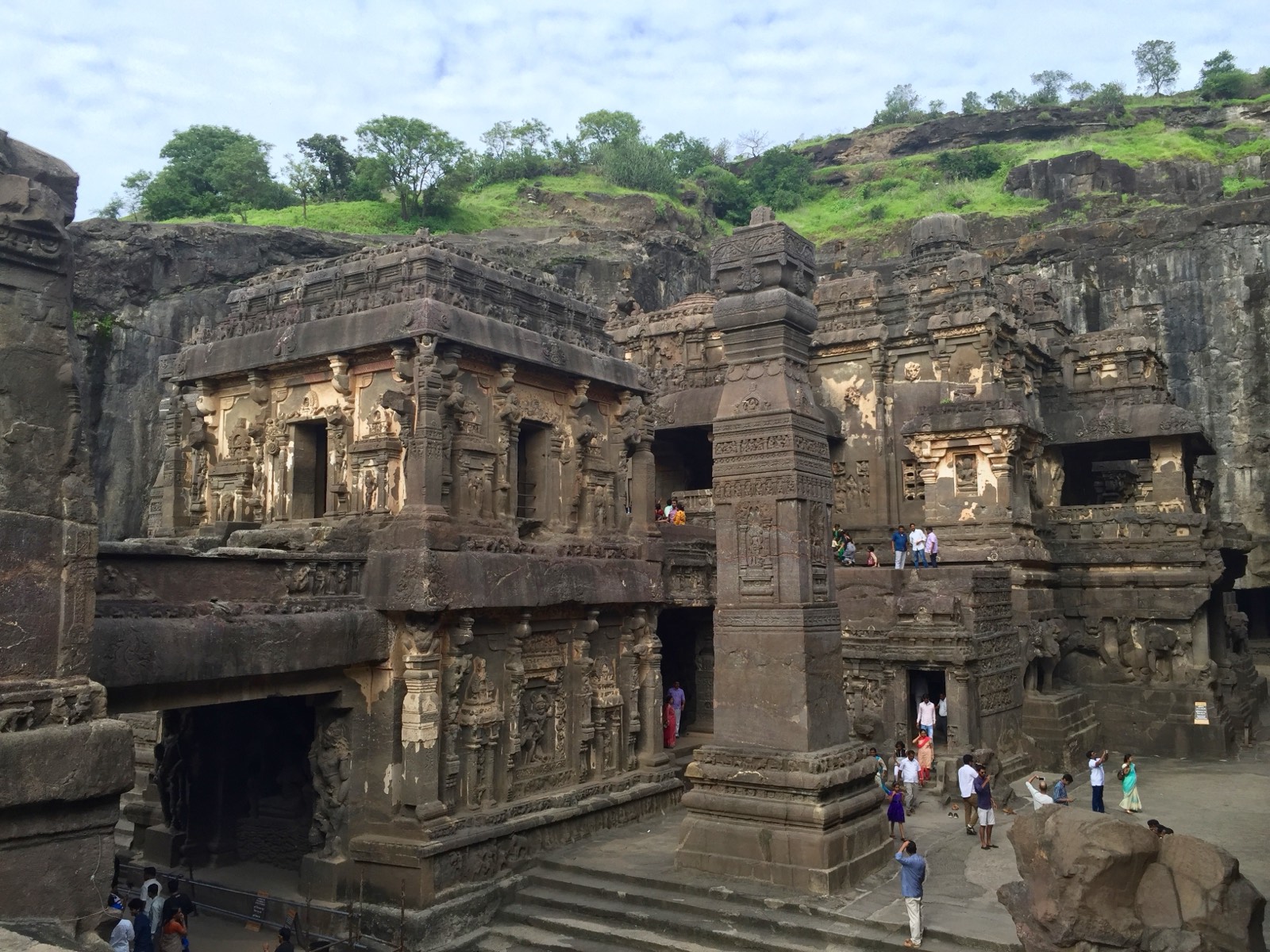
The Kailasa Temple was revealed. Sometime in the 8th century, workers stood on top of a basalt cliff in the Deccan plateau of India and began cutting straight down into the living rock. When they stopped, an entire temple complex stood free of the hillside — a tower roughly 30 meters tall, galleries, shrines, pillared halls, bridges, obelisks, and life-size stone elephants, all of it one continuous piece of the mountain. Nothing was built. Everything that isn't temple was carried away, one chisel stroke at a time — by most estimates, some 200,000 tons of rock, with some estimates running double that.
There was no adding material back. A single major miscalculation, cut too deep in the wrong place, could not be repaired. And the people who pulled this off left us no record of how they did it.
The Place
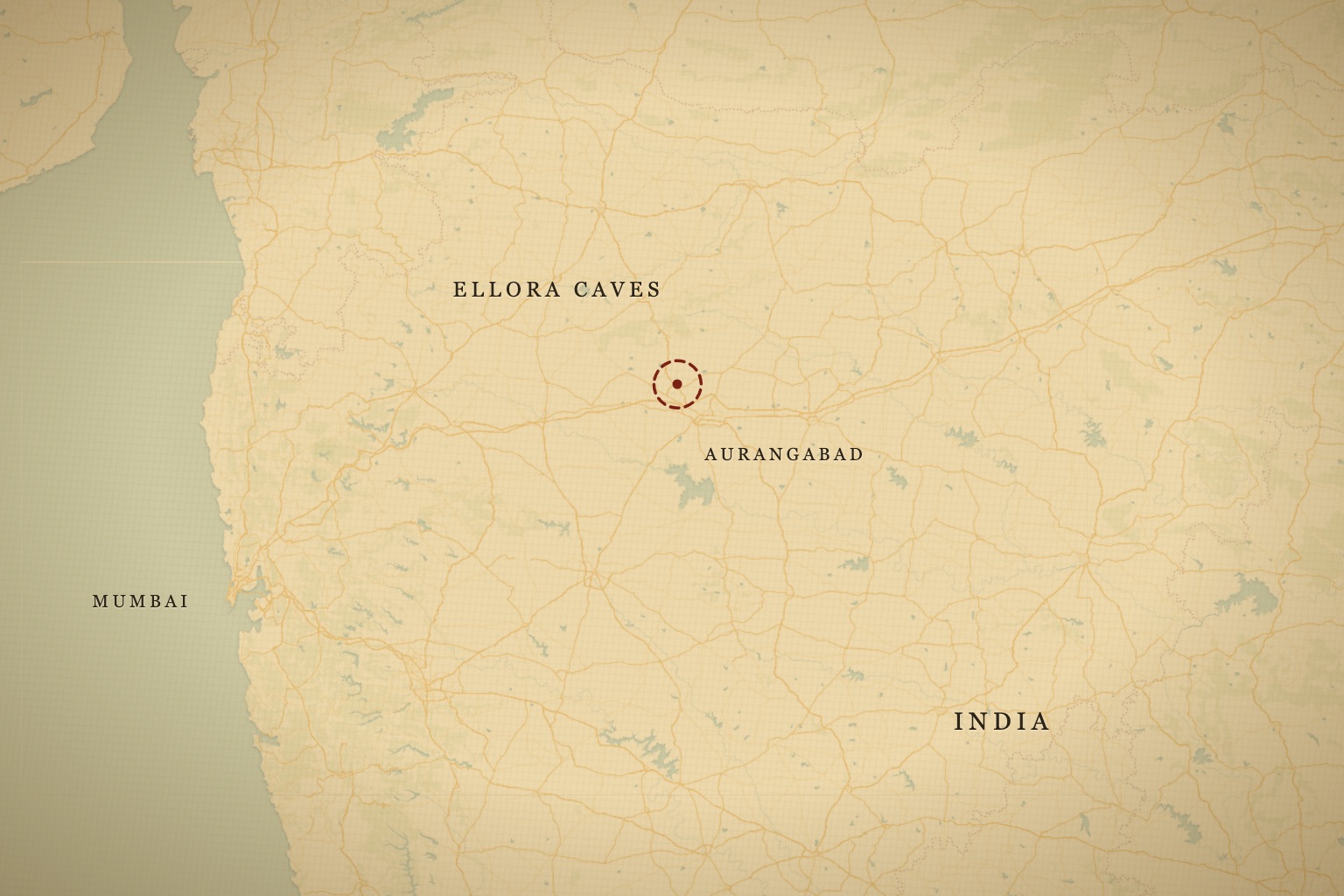
The Kailasa Temple is Cave 16 of the Ellora Caves, a complex of 34 major rock-cut monasteries and temples strung along a basalt escarpment in Maharashtra, about 30 kilometers from Aurangabad. Ellora itself is remarkable — twelve Buddhist caves, seventeen Hindu, and five Jain, carved side by side between roughly 600 and 1000 CE, three religions sharing one cliff for four centuries. The whole complex has been a UNESCO World Heritage Site since 1983.
But Cave 16 is the centerpiece, and calling it a "cave" undersells it badly. It is generally regarded as the largest monolithic rock excavation in the world: a courtyard on the order of 82 by 46 meters, open to the sky, with the freestanding temple rising from its center. Around the main shrine stand a pavilion for Shiva's bull Nandi, two colossal freestanding victory pillars, and those life-size elephants; along the plinth runs one of Indian art's most famous panels — the demon king Ravana straining to shake Mount Kailash itself, while Shiva pins the mountain still with a single toe. The temple was conceived as an earthly image of Mount Kailash, the Himalayan abode of Shiva, and the builders committed to the metaphor completely: the whole structure was once coated in white lime plaster — traces still cling to the stone — so that it gleamed pale against the dark basalt like its namesake under snow. It's carved as if the mountain itself had a temple hiding inside it all along.
Construction is traditionally attributed to the Rashtrakuta king Krishna I, who reigned from about 756 to 773 CE. The Rashtrakutas were no minor house — within a few generations they ranked among the great powers of medieval India, an empire that could command wealth, labor, and artistic talent across the Deccan. A patron like that explains the ambition. Hold on to those dates, though — they're where the mystery gets its teeth.
What the Show Claims
Ellora and the Kailasa Temple appear repeatedly across Ancient Aliens — in Season 3, Season 12, and in "Shiva the Destroyer" (Season 11, Episode 15), among others. The show's core argument is arithmetic. If the temple was excavated within Krishna I's reign — roughly 18 years — then the workforce had to remove hundreds of thousands of tons of hard basalt, on the order of dozens of tons every single day, year after year, with iron chisels and hammers, while simultaneously executing intricate sculpture to tolerances that leave no room for error. The show presents that as flatly impossible with 8th-century tools, and suggests the builders had help: advanced technology, perhaps something that softened or removed rock in ways we don't understand.
The show also points to the top-down method itself as anomalous — almost no major architectural tradition on Earth works this way — and to the iconography: the caves are rich in depictions of vimanas, the flying palaces and chariots of Hindu literature, which ancient astronaut theorists read as descriptions of real aerial craft remembered in scripture.
What Archaeology Says
The human story of Kailasa is well anchored — and it makes the achievement more impressive, not less. Tool marks and unfinished sections throughout the complex document exactly the technique you'd expect: iron chisels, hammers, and wedges, working in organized teams from the top of the cliff downward, a method with clear precedents in earlier Indian rock-cut monuments. The sequence can be read from the site itself: the excavators first cut enormous trenches straight down into the sloping hillside, isolating a colossal block of basalt on three sides, then sculpted that block from the summit downward — finishing the tower's crown while the halls beneath it were still solid stone. The top-down approach is actually the elegant solution — it eliminates scaffolding and lets the rock support itself throughout the work. Rashtrakuta patronage is documented, and the temple's design follows established Dravidian architectural principles.
Its family tree is even legible. Scholars have long noted that Kailasa's plan closely follows the Virupaksha Temple at Pattadakal, built by the Chalukya dynasty around the 740s CE — which was itself modeled on the Kailasanatha temple of Kanchipuram. Krishna I had just overthrown the Chalukyas, and the resemblance is strong enough that many historians think he recruited the very guilds of architects and sculptors who had built for his defeated rivals. Nor was carving whole buildings from living rock unprecedented: the Pallavas had cut the monolithic rathas out of granite boulders at Mahabalipuram a century earlier, and Ellora's own escarpment had been under the chisel for generations before anyone touched Cave 16. Kailasa was the tradition's masterpiece — but not its first experiment. Which makes what happened here rational, and still not quite explicable.
Because the timeline problem is real, and archaeologists know it. The art historian Hermann Goetz argued as far back as the 1950s that a project of this scale could not fit in one reign, and that the complex shows evidence of multiple construction phases under successive rulers — in his reading, the work spans generations of Rashtrakuta kings. Other specialists push back: the archaeologist M. K. Dhavalikar argued in a 1982 study that the main shrine is too stylistically unified to be a patchwork, and that the core of the temple was substantially completed under Krishna I himself, with the subsidiary shrines, the elephant court, and other elements added later. Notice what that disagreement means. Either the temple took far longer than the traditional attribution allows — or the impossible-sounding arithmetic is roughly right, and the heart of Kailasa really was cut free of the mountain in something like two decades. The mainstream positions bracket the mystery. Neither one dissolves it. And no contemporary record describes the building process, the size of the workforce, or how the project was planned and coordinated. For one of the greatest engineering feats of the ancient world, the paper trail is essentially blank.
And then there's the inscription. A Rashtrakuta copper-plate grant of Karka II, found at Baroda — modern Vadodara, in Gujarat — and dated to 812–813 CE, within living memory of the work, describes a temple on the hill at Elapura so astonishing that the gods who saw it doubted it was made by men, and even its own architect, the record says, was struck with wonder that he had built it. The people closest to the event found it as hard to believe as we do.
Medieval legend went further. In a Marathi tale preserved in the Katha-Kalpataru, a queen vows not to eat until she can see the finished crown of a great temple raised for Shiva — and the architect, named Kokasa, saves her by starting at the top, so that the shikhara stands complete within days while the rest of the temple still sleeps inside the rock. It's folklore, not history. But notice what the story chose to remember, centuries on: not the temple's size, but the direction of the work. Of everything about Kailasa, it was the top-down carving that lodged in memory as the miracle.
The Verdict
Even the ancients treated Kailasa as a one-off. A little way down the same cliff, ninth-century Jain builders attempted their own version — Cave 30, nicknamed the Chota Kailasa, the "little Kailasa," an unmistakable tribute at reduced scale. It was never finished. The one time anyone tried to repeat the feat, within sight of the original and within a century of it, the mountain won.
Nobody serious disputes that human hands carved Kailasa. What remains genuinely open is how the project was even possible as a project: the planning that let workers cut a flawless multi-story building downward out of a cliff with no drawings we've ever found, no recorded workforce, no described method, and no margin for error — on a timeline scholars still can't agree on.
The 8th century left us the temple and, in that copper plate, a shrug of disbelief from its own era. Everything between those two — the how — is silence.
Go stand in that courtyard if you ever can. Look up at a 30-meter tower that was never built, only uncovered, and remember that the first person recorded as doubting it could be done may have been the one who did it. Some monuments answer questions. Kailasa just keeps asking one: how do you carve a mountain into a prayer — and leave no notes?
Covered On Screen
- Shiva the DestroyerAncient Aliens · S11 E15
Track the 2 sites from this post on your map.
Free account · mark visited sites · build your bucket list.
Start tracking