The Mystery of the Great Pyramids of Giza
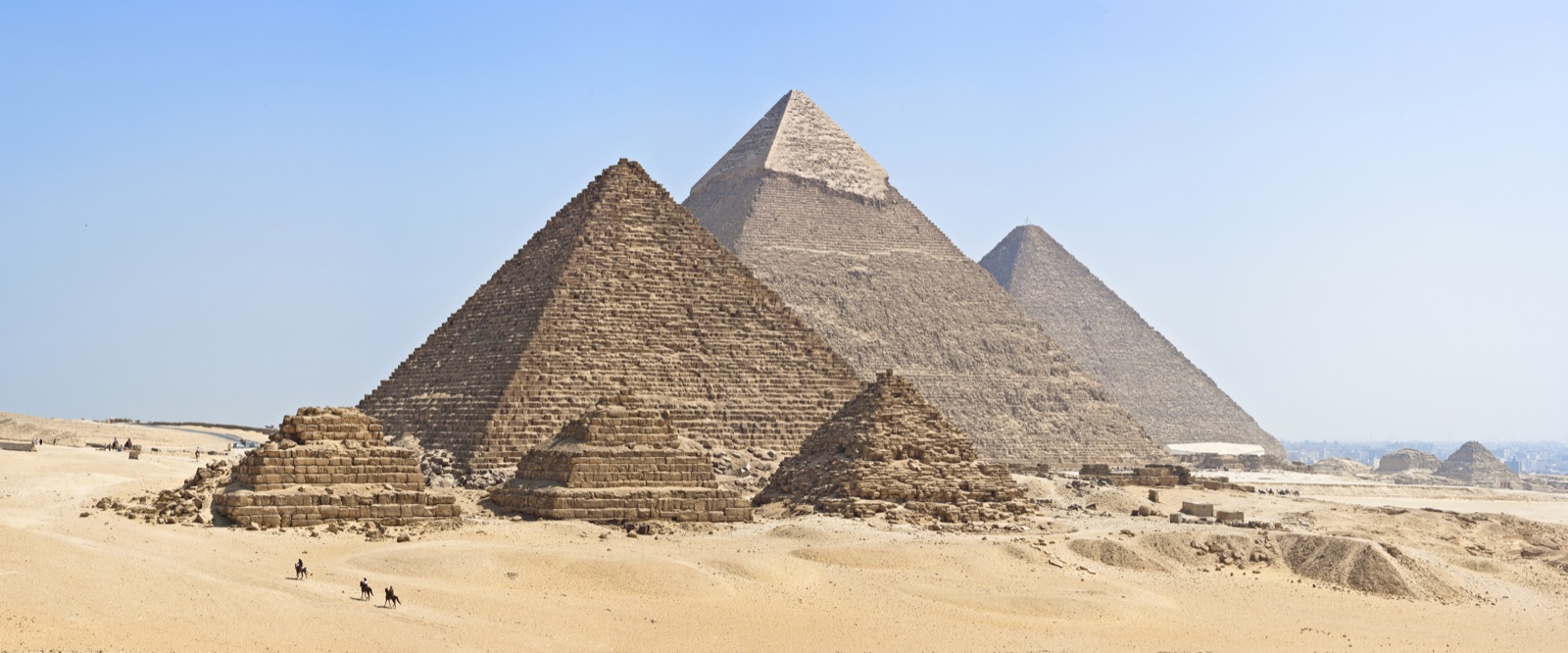
A single block in the Great Pyramid weighs as much as a pickup truck. There are 2.3 million of them.
Not rough boulders tossed into a pile — precisely cut limestone and granite fitted so tightly that you can't slide a piece of paper between them. The pyramid's base spans 13 acres and is level to within 2.1 centimeters across its entire perimeter. Its four sides align to true north, south, east, and west to within 3/60th of a degree — more accurate than many modern compass-based constructions. Whatever your theory about who built it, you have to start in the same place: this is genuinely extraordinary, and it only gets stranger the longer you look at it.
The Site
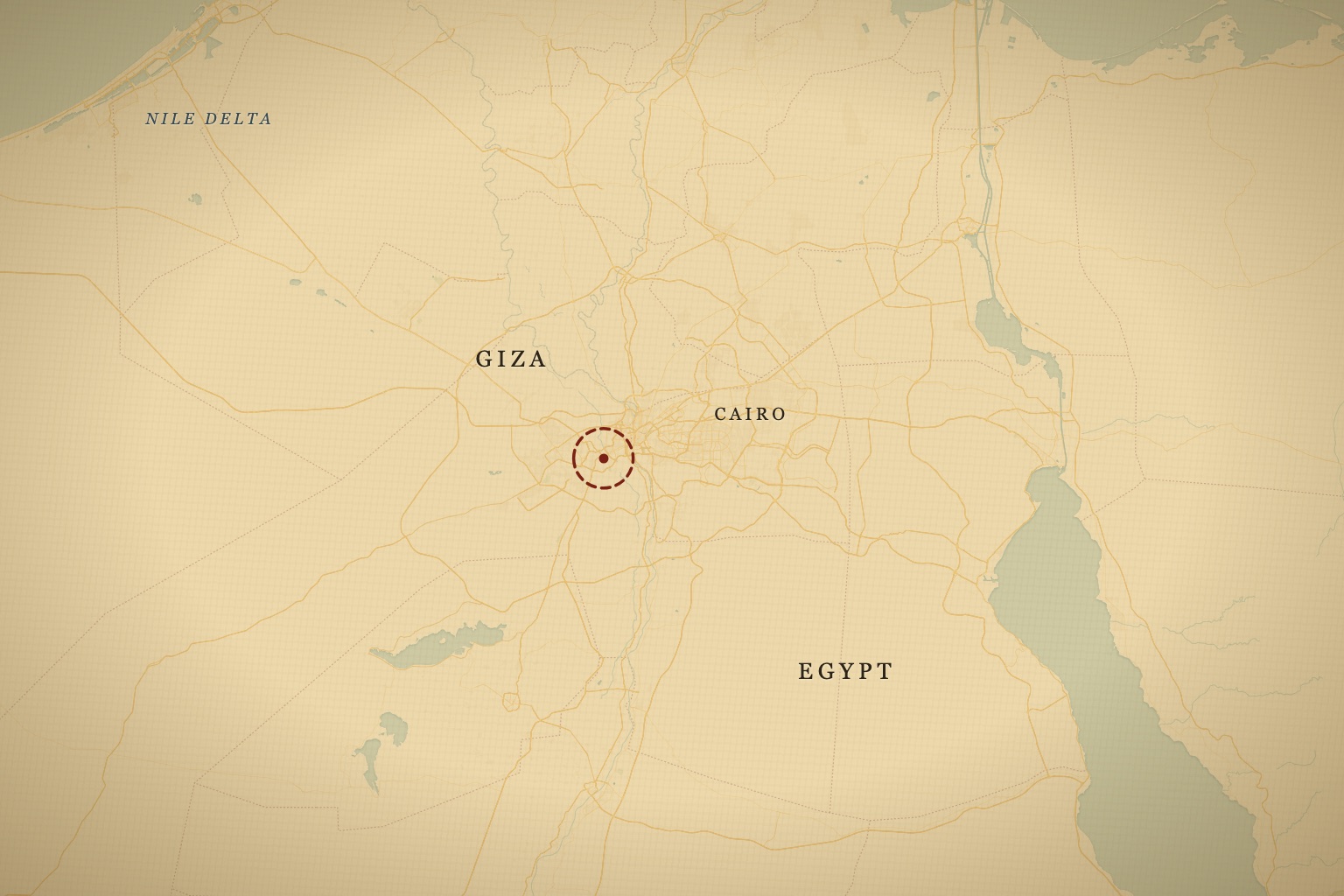
The Giza plateau sits on the western outskirts of Cairo, Egypt, on the edge of the Sahara Desert. Three major pyramids dominate the skyline — Khufu (the Great Pyramid), Khafre, and Menkaure — along with the Great Sphinx and a sprawling necropolis of smaller tombs and temples.
Khufu's pyramid, built around 2560 BC, stands 138 meters tall today (it was 147 meters when new, before the outer casing stones were removed). It held the title of tallest man-made structure in the world for nearly 4,000 years. You can stand inside it — crawling through low passages to reach the King's Chamber, a room of polished red Aswan granite quarried 800 kilometers upstream on the Nile. The site is a UNESCO World Heritage property, easily accessible from Cairo, and one of the most-visited monuments on Earth.
The three pyramids align in a pattern that has fascinated researchers for decades: they're not arranged in a straight row, but offset — with the smallest pyramid, Menkaure's, shifted slightly to the east. Nobody has fully accounted for why.
What the Show Claims
Ancient Aliens (S1E1, "The Evidence"; S1E2, "The Visitors"; S5E1, "Secrets of the Pyramids") returns to Giza constantly — it's arguably the show's spiritual home base. The claims build on each other.
The alignment argument comes first: the precision of Khufu's north-south orientation suggests surveying technology beyond what ancient Egypt possessed. Then there's the Orion Correlation Theory, popularized by Robert Bauval and picked up enthusiastically by the show — the three pyramids mirror the three stars of Orion's Belt as they appeared around 10,500 BC, not 2560 BC. The implication: the design dates to a lost civilization, or was given by beings who could see both the stars and the distant future.
The construction logistics follow: 2.3 million blocks, some weighing 80 tons (the granite ceiling beams in the King's Chamber), moved from quarries hundreds of kilometers away, placed at a rate of one block every two minutes across the entire 20-year construction period. The show suggests this exceeds what organized human labor could accomplish.
The more exotic claims involve the pyramid as machine: internal shafts aimed at specific stars, the King's Chamber's resonant acoustics, and a "power plant theory" suggesting the Great Pyramid generated and transmitted electromagnetic energy. Giorgio Tsoukalos has suggested the builders possessed "high technology that we don't fully understand."
What Archaeology Says
Archaeologists have spent a century reading the same stones, and what they've found doesn't shrink the mystery — it relocates it. The wonder moves from "who could have done this" to "human beings did this," which is somehow harder to hold in your head.
In 1990, American archaeologist Mark Lehner and Egyptian archaeologist Zahi Hawass excavated the workers' village at Giza — finding bakeries, breweries, medical facilities, and housing for roughly 10,000 workers. These weren't slaves; workers rotated in shifts, received fair rations, and were buried with honors. The administrative papyri found at Wadi el-Jarf in 2013 include a logbook from a supervisor named Merer who tracked the transport of limestone blocks from Tura — the earliest known papyrus documents, chronicling pyramid construction in real time. Sit with that: we can read a foreman's shipping notes, and they make the feat more astonishing, not less. A society of bread and beer rations and rotating crews produced the most precisely aligned structure in the ancient world.
The Merer papyri deserve a moment more. French Egyptologist Pierre Tallet discovered them in 2013 at Wadi el-Jarf, an ancient harbor on the Red Sea coast, and they date to roughly the 27th year of Khufu's reign — the very end of the Great Pyramid's construction. Merer ran a crew of about 40 men, ferrying casing stone from the Tura quarries to Giza by boat along the Nile and a network of canals, making deliveries every ten days to a destination the logbook calls "the Horizon of Khufu." The documents even name the project's overseer: Ankhhaef, Khufu's half-brother. We have, in other words, the middle-management paperwork of the Great Pyramid — and it describes a supply chain, not a miracle.
The construction methods are within human capability, and that's the unsettling part. Experimental archaeology teams have moved multi-ton stones on wooden sledges over wet sand with small crews — proof that the impossible was done by hand, not proof that it was easy. The precision alignment was likely achieved using stars and simple surveying techniques — sighting along the pole star, stretching ropes, observing shadow lengths. Which means people with copper, rope, and the night sky hit true north to within 3/60th of a degree. Ancient Egyptians were skilled astronomers and surveyors by any measure, and "by any measure" keeps running out before the achievement does.
There's even a serious proposal for exactly which stars. In 2000, Cambridge Egyptologist Kate Spence published an analysis in Nature arguing that the builders fixed true north by sighting the simultaneous transit of two circumpolar stars, Kochab and Mizar — a method so precise that the slow drift of Earth's axis lets her date the start of construction to within about five years of 2480 BC. The small alignment errors of the other Old Kingdom pyramids fall along the curve her method predicts, drifting as the stars did. If she's right, the Great Pyramid's orientation is so exact that it functions as its own timestamp.
The Orion Correlation Theory doesn't satisfy most Egyptologists: the correspondence requires mirroring the belt stars, and the three stars don't match the pyramid positions with the precision the theory claims. But notice what that leaves standing — the offset is real, Menkaure's pyramid really is shifted east, and the builders really were watching those stars closely enough that funerary texts aim shafts at them. The shafts, rather than carrying energy, appear to be symbolic pathways for the pharaoh's soul to join specific stars after death — a documented thread in Egyptian funerary belief. Whether that fully explains why a tomb was engineered to point a dead king at a particular star, or simply gives a name to an intention we still don't entirely understand, is a question the architecture keeps open.
The shafts have their own unresolved chapter. In 1993, engineer Rudolf Gantenbrink sent a crawler robot up the southern shaft of the Queen's Chamber and found it blocked, some 60 meters in, by a fitted limestone slab bearing two corroded copper pins — a "door" where no door should be needed. In 2011, a follow-up robot named Djedi drilled through that slab and photographed a small void with red ochre mason's marks and a second blocking stone behind it. Symbolic thresholds, most Egyptologists say. But someone sealed that shaft with metal-fitted stones, twice, for reasons no surviving text records.
And the pyramid is still producing genuine unknowns. In 2017, the ScanPyramids project — an international team imaging the monument with muon radiography, a technique that maps stone the way X-rays map tissue — announced in Nature the discovery of a large void above the Grand Gallery: at least 30 meters long, sealed, unentered, unexplained. In 2023, the same team confirmed a second hidden space, a corridor about nine meters long behind the chevron blocks on the north face; an endoscope fed through a joint photographed a rough-hewn chamber no human eye had seen in 4,500 years. Egyptologists suspect these are relieving spaces — architecture for managing colossal weight — but nobody knows. Four and a half millennia of scrutiny, and the building still has rooms we can't explain.
The Verdict
Archaeology has handed us better questions, not final answers. We still don't have a complete picture of how the heaviest blocks — the 80-ton granite ceiling beams in the King's Chamber — were raised into place. We can name the workers, read the foreman's logbook, and reproduce the sledges, and the central act still won't quite resolve: how a society with copper tools and rope organized and sustained a 20-year build of this precision, one block every two minutes, for two decades without faltering. The more we explain, the more specific the wonder gets.
The precision is real. The achievement is real. And the question the show asks — whether something more is going on here — is the same question the site itself keeps asking every visitor who stands at its base and looks up. The evidence doesn't close it. It sharpens it.
So go see it. Stand next to one of those blocks, which will come up to your waist, and then look at how many of them there are, stacked hundreds of feet into the sky — and let it ask you its question directly.
Covered On Screen
- The Top Ten Mysterious DevicesAncient Aliens · S19 E11
- Mysterious DevicesAncient Aliens · S8 E3
- Mysteries of the SphinxAncient Aliens · S9 E2
- The Giza LegacyAncient Aliens · S20 E16
- Secrets of the PyramidsAncient Aliens · S5 E1
Track the ancient sites you've visited on the interactive map.
Free account · mark visited sites · build your bucket list.
Open the tracker