The Antikythera Mechanism: The World's Oldest Computer
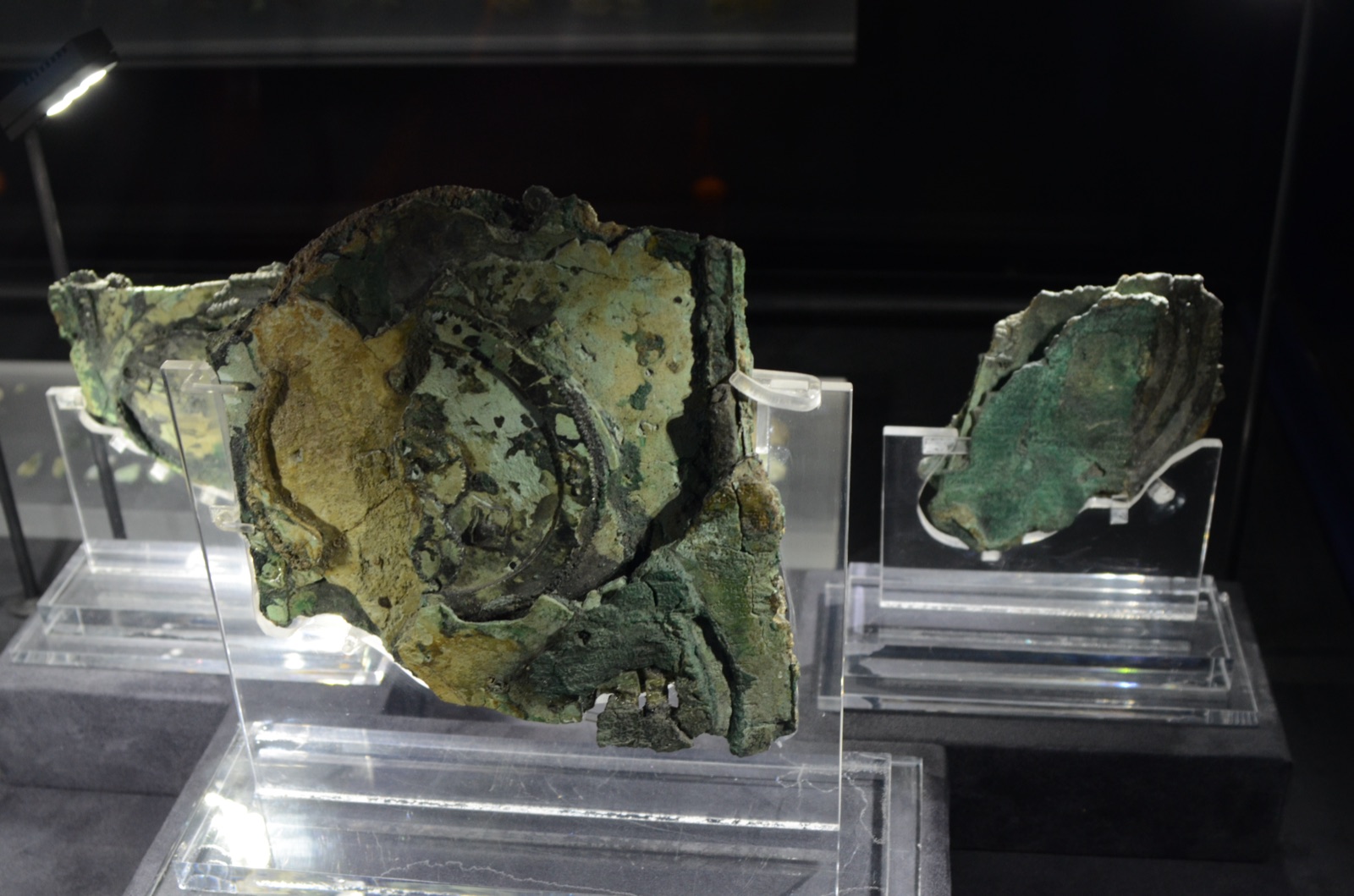
In 1901, Greek sponge divers working a shipwreck near the island of Antikythera hauled up an unremarkable-looking lump of corroded bronze. It sat in the National Archaeological Museum in Athens for nearly fifty years before anyone understood what it was. When they finally did, it reordered everything historians thought they knew about ancient technology.
The Antikythera Mechanism is a geared bronze device, roughly the size of a shoebox, capable of calculating the positions of the sun and moon, predicting solar and lunar eclipses on an 18-year cycle, tracking the four-year Olympic Games calendar, and modeling the motions of all five planets known to antiquity. It was built somewhere around 100 BCE. The next device of comparable mechanical complexity would not appear in the historical record for more than a thousand years. That gap — and the machine itself — is the genuine puzzle, and it's worth sitting with carefully, because the closer you look, the stranger it gets.
The Place
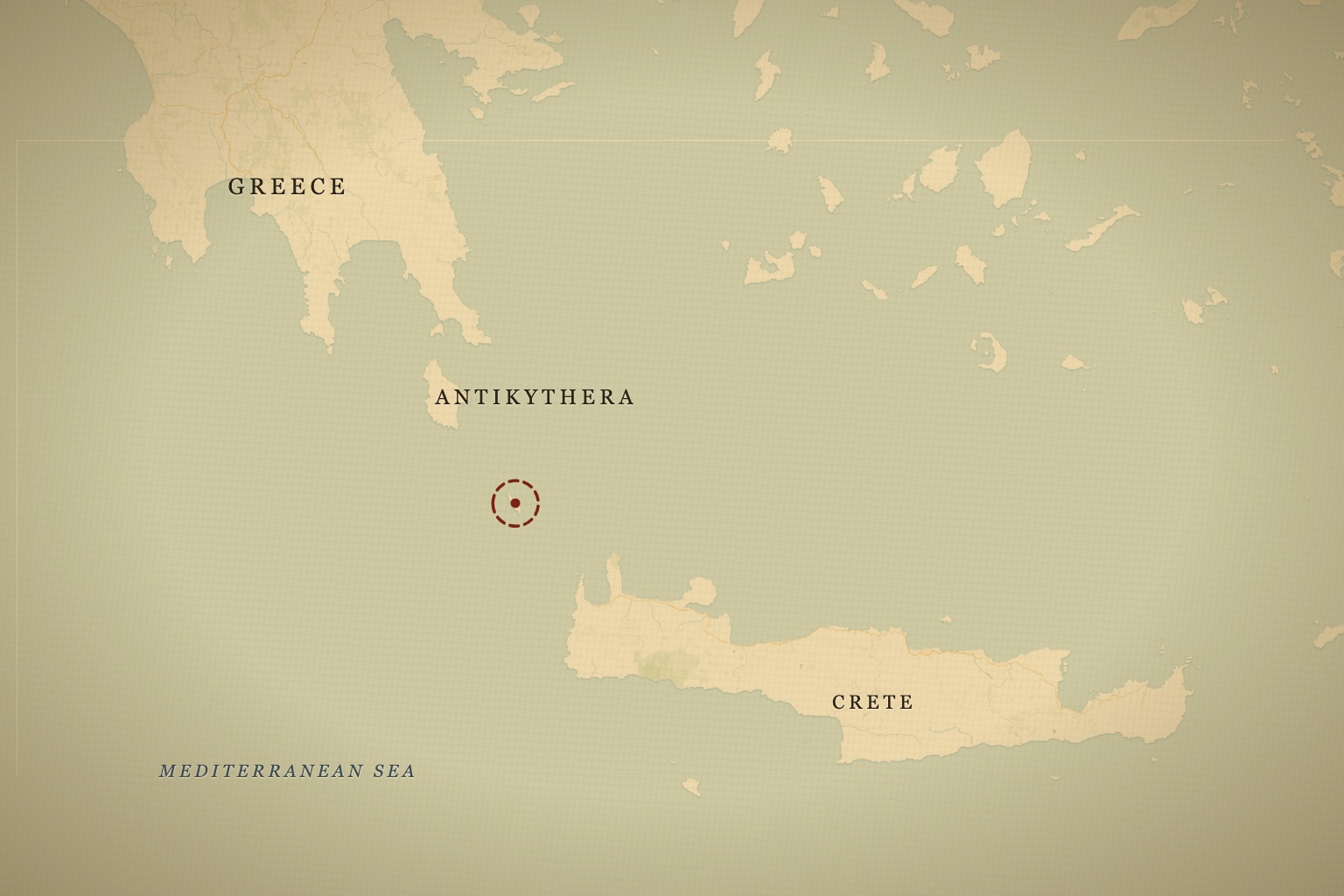
The mechanism came out of the richest ancient shipwreck ever found. The Antikythera wreck lies in roughly 50 meters of water off the northeastern coast of Antikythera, a rugged limestone outcrop in the Aegean between the Peloponnese and Crete, on the old sea lane that carried goods from the Greek east toward Rome. When the sponge divers first descended in 1900 and 1901, they surfaced with an inventory that reads like a museum manifest: life-sized bronze statues, marble sculptures, delicate glassware, ceramic amphorae, jewelry, and a cache of silver and bronze coins.
Those coins matter, because they date the disaster. The silver issues from Pergamon and the bronze from Ephesus place the sinking at roughly 60 to 70 BCE — a single merchant vessel, probably bound for Italy, loaded with high-value goods and quite possibly war plunder or luxury cargo destined for wealthy Roman buyers. The ship went down with all of it. What the sea preserved is a snapshot of Mediterranean trade at a precise moment, the bronze statuary alone making this one of the most important underwater finds in archaeology.
The mechanism itself was not recovered in one piece, and it was never going to be. It came up in fragments, and more fragments turned up across the wreck site over the decades that followed. Researchers have now catalogued at least 82 surviving pieces from what was originally a single assembled device — gears, plates, inscribed fragments, scattered and corroded after two thousand years on the seabed. Those fragments live today in Room 38 of the National Archaeological Museum in Athens, where the largest surviving sections are displayed alongside a full reconstruction showing how the device looked and worked when it was new. It is, for any traveler, one of the most arresting artifact encounters in the ancient world: a corroded green slab beside a gleaming model of what it once was.
The wreck did not stay forgotten. In 1976, Jacques Cousteau and the crew of the Calypso returned to the site and recovered more material — additional coins, bronze fragments, jewelry, and human skeletal remains. And the work is still going on. Since 2012, the Return to Antikythera expeditions, run by the Greek Ephorate of Underwater Antiquities with Woods Hole Oceanographic Institution and other partners, have brought modern survey technology, rebreather diving, and even exosuit equipment to the site. They've recovered more statuary, ship timbers, and human bones, and they keep finding the wreck is larger and richer than anyone assumed. The site is not open to recreational divers. But the excavation that began with sponge fishermen reaching into the dark over a century ago has never really stopped.
For decades after recovery, the mechanism's significance went unrecognized. It took Derek de Solla Price's landmark 1974 study, "Gears from the Greeks," to publish a rigorous reconstruction of its function. Since then, X-ray imaging, gamma-ray scanning, and high-resolution CT have progressively decoded its inscriptions and gear trains, turning a mystery lump into the best-understood machine of the ancient world.
What the Show Claims
Ancient Aliens has returned to the Antikythera Mechanism across multiple episodes, and the device is a recurring exhibit in the show's broader argument about ancient technological sophistication.
The core claim is discontinuity. The mechanism is presented as a leap so dramatic it can't be explained by the ordinary development of Greek engineering. The show's theorists argue that nothing in the surviving Greek mechanical tradition — no precursor device, no transitional technology — accounts for the complexity of its gearing and its layered astronomical calculations. In the show's framing, the absence of an obvious development arc is itself the evidence that something anomalous happened.
Specific features get singled out. The epicyclic gearing that models the moon's varying speed along its orbit. The 365-day solar calendar with leap-year correction. The Metonic dial tracking the 19-year cycle after which lunar and solar calendars realign. And above all, the Saros dial — the eclipse predictor, capable of forecasting solar and lunar eclipses 18 years and 11 days in advance. The show's argument is that building an eclipse predictor in bronze requires a mathematical command of astronomy that simply shouldn't have existed in 100 BCE Greece. Eclipse prediction on a Saros cycle means understanding deep periodicities in the motions of three bodies at once. Where, the show asks, is the schooling that produced that?
From there the argument reaches for a lineage and a loss. Ancient texts credit Archimedes with building orreries — mechanical models of the heavens — and the show treats this as a thread pointing back to knowledge that was once greater and then deliberately suppressed or destroyed. The fall of Alexandria and the burning of its library become the moment the lights go out: advanced knowledge concentrated in one place, then erased, leaving the Antikythera Mechanism as a lone orphan of a vanished intellectual world. The device is then folded into the larger catalogue — Baghdad Batteries, the Dendera "light bulbs" — as one more instance of advanced technology surfacing in antiquity with no visible ancestry, pointing either to a lost civilization or to outside help.
What Archaeology Says
The Antikythera Mechanism is genuinely remarkable, and the people who've spent their careers with it are the last people to want it explained away. What the research has done over the last few years is not shrink the mystery but relocate it — peel back one layer of strangeness and find another underneath.
Start with the date. The device belongs to the Hellenistic period, around 100 BCE, when Greek science and mathematics were at their height. This is the era of Hipparchus, who had already worked out the mathematics of the moon's irregular motion — the very anomaly the mechanism's epicyclic gear train reproduces. So the knowledge the device encodes was already in the air, documented and argued over by astronomers across the Greek world. Which only sharpens the real question: knowing the astronomy on paper is one thing; deciding to carve it into interlocking bronze gears, by hand, to a precision no one would attempt again for a millennium, is something else entirely. The math being available makes the leap to the machine more astonishing, not less.
The most revealing recent work came from the UCL Antikythera Research Team. In 2021, building on CT scans and decoded inscriptions, they published a reconstruction of the front of the mechanism — the long-mysterious "Cosmos" display — that accounts for the planetary gearing. Their model shows the device displaying all five planets known to antiquity: Mercury, Venus, Mars, Jupiter, and Saturn, each tracked around a dial. And here is the part that deepens the mystery rather than dissolving it. The team showed the planetary cycles were generated using Babylonian period relations — the centuries of meticulous eclipse and planetary records compiled by Babylonian astronomers — combined with Greek geometric gear-modeling to turn those numerical cycles into smooth mechanical motion. The genius of the mechanism is that it fuses two civilizations' worth of knowledge into a single object: Babylonian observational arithmetic and Greek geometry, married in bronze. Someone, somewhere, looked at two separate intellectual traditions and saw that they could be made to mesh — physically, in gear teeth. That synthesis is the whole astonishing story of Hellenistic astronomy, and the mechanism is its physical proof, and we still don't know whose mind first imagined it.
The same fusion is at work in the Saros dial. Eclipse prediction on an 18-year cycle draws on the Babylonian eclipse records, which had tracked exactly this periodicity for centuries — now translated into Greek gearwork that turns a column of numbers into a turning bronze pointer. The records existed. The decision to embody them mechanically did not have to. Someone made it.
Then there's the question of whether the mechanism was unique — and the ancient sources say plainly that it was not. Cicero, writing in De re publica around 54 BCE, describes a bronze device built by Archimedes that modeled the motions of the sun, moon, and five planets, accurate enough to reproduce eclipses, and notes a second such instrument brought to Rome as war booty. Other ancient writers describe similar instruments. So the Antikythera Mechanism may not be a lone orphan — it may be the sole physical survivor of a whole class of devices that ancient authors took for granted existed. Sit with that for a moment: an entire family of cosmos-modeling machines, all of them gone, and we'd never have known any of it was real if one ship hadn't gone down at the right depth. Bronze was valuable and endlessly recyclable, and the ancient world melted down metal objects as a matter of routine. Almost all Hellenistic bronze statuary is lost for the same reason — we know it mostly through Roman marble copies. The mechanism survived only because it sank in a shipwreck and dropped out of the recycling economy. That no other geared calculator survives may tell us less about how rare these were than about how completely the rest of them vanished.
The UCL team also built a working physical reconstruction from the decoded gear geometry, showing that the device could be made with materials and techniques available to a skilled Greek workshop. And yet the most basic questions stay open — chiefly who built it and where. The inscriptions point toward Corinth and the Greek colonies of Sicily, possibly into the orbit of Archimedes's Syracuse, but no maker's signature has surfaced and the specific workshop is still unknown. We can reconstruct exactly how the gears turn and still have no idea whose hands cut them. That's a real gap, and it's the kind that doesn't close — it just keeps the question warm.
The Verdict
The show keeps asking whether the Greeks could really have built this. The research has given us a better question than that one — not "could they?" but "how on earth did they, and where did the rest of it go?" We can trace the ingredients: Babylonian records, Greek geometry, skilled bronze-working. What we cannot do is explain away the thing those ingredients add up to, or account for what happened to it next.
Because here is the puzzle that survives every reconstruction, and it's stranger than the alien hypothesis, not safer than it. This level of mechanical sophistication — precision gear trains modeling the cosmos — appears around 100 BCE, fully formed, with no surviving rough drafts. And then it effectively vanishes from the historical record for roughly 1,400 years, until the geared astronomical clocks of medieval Europe. The astronomy persisted. The tradition of cutting interlocking bronze gears to embody that astronomy did not, leaving almost no trace until the cathedral clockmakers of the 14th century rediscovered the same basic idea from scratch. Why a technology this capable failed to propagate, improve, and survive is a genuine and unresolved problem. A capability can exist, get demonstrated at the highest level, and then simply not carry forward — and we still don't really understand why this one didn't.
That gap is the part worth sitting with. Human beings in the second century BCE were tracking the Saros eclipse cycle in bronze gear trains, fusing two civilizations' worth of astronomy into a machine you could hold in two hands — and then that thread of know-how thinned almost to nothing for fourteen centuries, and we still cannot say who first pulled it tight or why it slipped away.
The Antikythera Mechanism doesn't need to be alien to keep you up at night; if anything, the alien hypothesis is the tamer story. The real one is that minds like ours did this, once, and then the world let it disappear so thoroughly we found the proof by accident, two thousand years later, in a corroded lump off a Greek island. Go to Athens and stand in front of it in Room 38. The model gleams; the original sits beside it, green and broken and silent — still keeping its makers' names, still asking how it came to exist and how it came to be the only one left. Let it ask you directly.
Covered On Screen
- The Top Ten Mysterious IslandsAncient Aliens · S19 E12
Track the ancient sites you've visited on the interactive map.
Free account · mark visited sites · build your bucket list.
Open the tracker