Teotihuacan: City of the Gods
In the fall of 2003, a heavy rainstorm opened a sinkhole at the foot of the Temple of the Feathered Serpent, and INAH archaeologist Sergio Gómez found himself staring down a shaft into darkness. Beneath it lay a sealed tunnel entrance. Archaeologists followed it. It led 100 meters beneath the Temple of the Feathered Serpent to a series of chambers that had been sealed for roughly 1,800 years. Inside were extraordinary ritual objects: jade figurines, magnetite mirrors, pyrite discs, rubber balls, jaguar bones, seeds, and nearly 100,000 individual offerings. In a side chamber, they found a miniature landscape — a stone box filled with loose pyrite — and, pooled across the floor, liquid mercury.
No one has fully explained what the mercury was for.
The Place
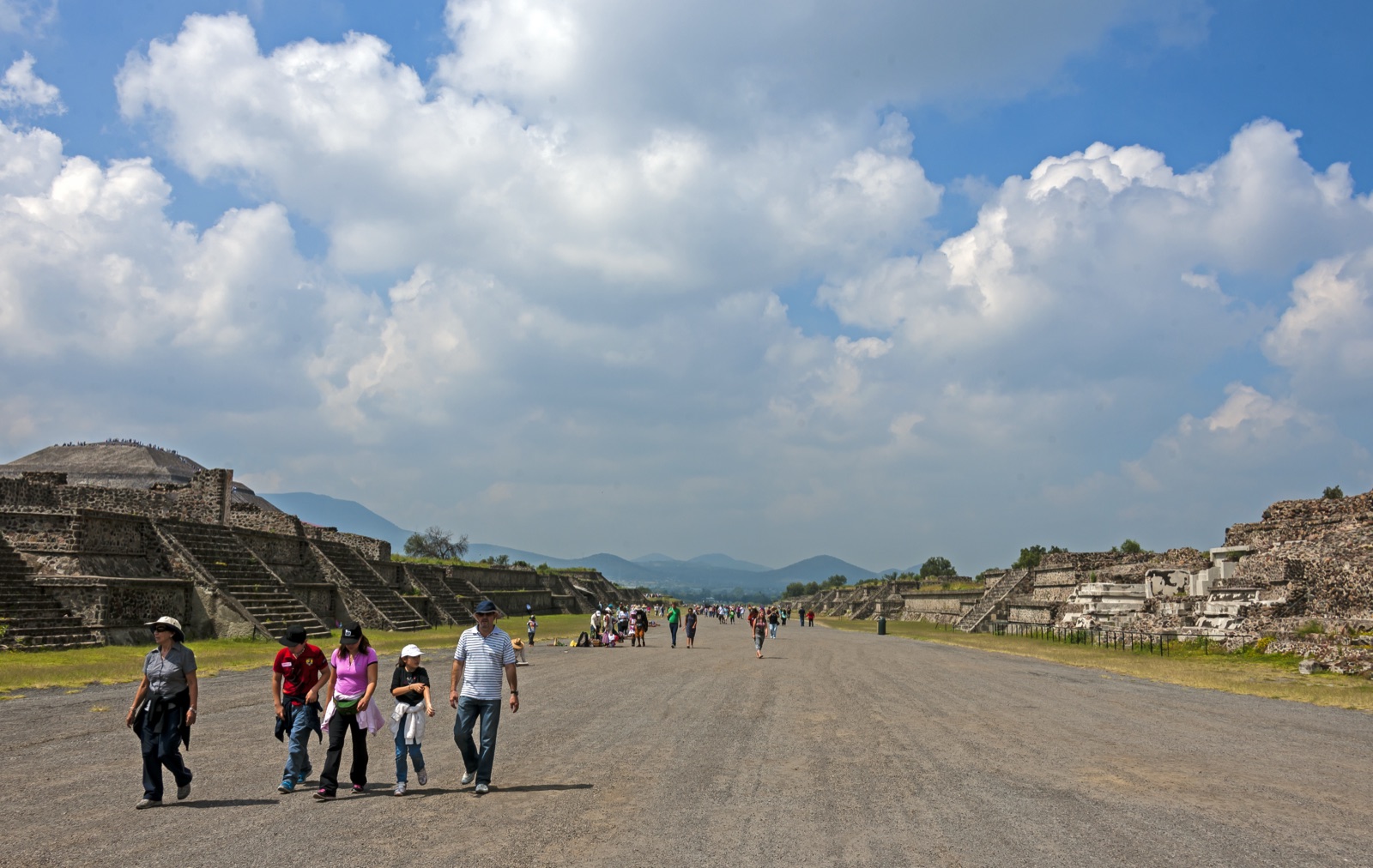
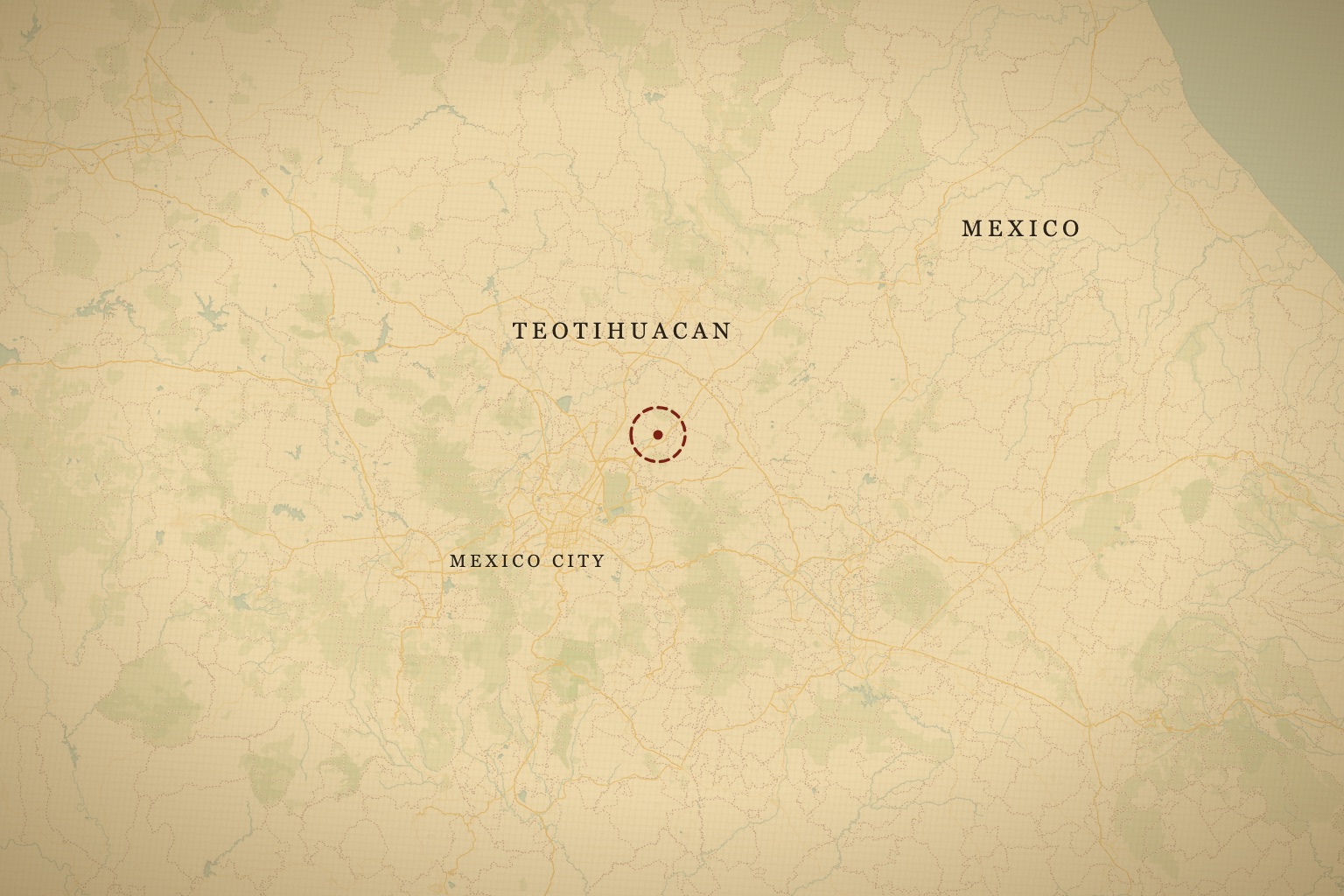
Teotihuacan sits in the Valley of Mexico, about 40 kilometers northeast of modern Mexico City, in the state of Mexico. The site sprawls across roughly 21 square kilometers, making it one of the largest planned cities of the ancient world. Its two main pyramids — the Pyramid of the Sun and the Pyramid of the Moon — are connected by the Avenue of the Dead, a 2.5-kilometer processional boulevard that runs roughly north-south through the city center.
The Pyramid of the Sun is staggering in scale: 65 meters tall with a base covering roughly the same area as the Great Pyramid of Giza. It contains approximately 1.2 million tons of stone and earth. Beneath it, a natural cave system — later expanded into a clover-shaped chamber — was almost certainly considered a sacred portal to the underworld by the city's builders.
At its peak between 1 and 500 AD, Teotihuacan housed somewhere between 100,000 and 125,000 people, making it potentially the largest city in the Western Hemisphere and one of the largest anywhere on Earth at that time. It dominated Mesoamerican trade and culture for centuries.
And yet: we don't know who built it. The people who created Teotihuacan left no deciphered writing, no clear royal tombs, no established succession of rulers. They were later absorbed, destroyed, or moved on before the Aztecs arrived to name their abandoned city "the place where the gods were created" — or, alternately, "the place where men become gods."
What the Show Claims
Ancient Aliens visited Teotihuacan in Season 3, Episode 6 and Season 12, Episode 7 ("City of the Gods"), among others.
The show's arguments cluster around several specific anomalies. First, the name: "the place where men become gods" is presented as literal — Teotihuacan was, the theorists argue, a site for alien-assisted transformation or ascension, a platform for beings traveling between human and divine (i.e., extraterrestrial) existence.
Second, the layout: several researchers featured in the show have argued that the positions of the Avenue of the Dead and the pyramids mirror the layout of the solar system, with the three pyramids corresponding to the inner planets. This claim was popularized by engineer Hugh Harleston Jr., who presented his Teotihuacan measurements at the International Congress of Americanists in 1974.
Third, and more concretely: mica. Large deposits of mica — a mineral used in modern electronics as an electrical insulator and thermal barrier — were found in a specific layer of the Pyramid of the Sun and in a dedicated "Mica Temple" discovered in the 1900s. The show argues that mica's industrial uses suggest Teotihuacan housed technology that required electrical insulation, pointing to advanced alien machinery.
The liquid mercury beneath the Temple of the Feathered Serpent — discovered by archaeologist Sergio Gómez Chávez in 2015 — gets significant attention. Mercury requires sophisticated processing to produce in large quantities, and its presence in a sealed ceremonial chamber is unexplained by standard ritual purposes.
What Archaeology Says
Archaeologists read the same city differently — and what they've found doesn't shrink the mystery so much as relocate it. Take the planetary layout. When the Avenue and the pyramids are measured against actual solar system proportions, the match is loose; the distances and angles don't line up with the precision the theory needs, and the claim hasn't made it into peer-reviewed archaeological or astronomical literature. But ruling out that one reading doesn't make the city ordinary — it just hands the question back. Why this scale, this deliberate geometry, raised by people who left no blueprint behind? The planets may be the wrong answer. The ambition behind the plan is still very much an open one.
The mica deepens rather than dissolves. Mica was traded across staggering distances in Mesoamerica — the deposits at Teotihuacan originated from Brazil, roughly 2,000 miles away. Archaeologist Saburo Sugiyama of Aichi Prefectural University has noted that mica appears in ritual contexts at Teotihuacan and at other Mesoamerican sites, suggesting it was valued for its optical properties — its shimmer and reflectivity. Sit with that. Someone hauled a glittering mineral across a continent to bury it inside a pyramid and lay it under a temple floor — not to insulate a machine, but because of how it caught the light. A floor sheathed in reflective mica would have flared in firelight. The industrial reading would have been tidier. The ritual one asks more of us: what was worth that journey?
The mercury is genuinely puzzling, and archaeologists are still working on it. The leading hypothesis, developed by Leonardo López Luján of Mexico's National Institute of Anthropology and History, is that the mercury pool represented an underworld river — specifically, the primordial waters described in Mesoamerican cosmology that the souls of the dead must traverse. It's a beautiful reading, and it fits the other objects in the tunnel, which appear to be offerings tied to the underworld and to ritual sacrifice. But naming what the mercury meant doesn't account for how it got there: liquid mercury in those quantities takes sophisticated processing to produce, then had to be carried underground and poured. The interpretation gives the pool a story. It doesn't yet give us the hands that made it.
The tunnel and chamber complex beneath the Temple of the Feathered Serpent has yielded one more thing that resists explaining away: the walls and floors were covered in pyrite and magnetite dust, turning the surfaces, under firelight, into something like a night sky. Picture standing in it — glittering walls, a hundred thousand offerings, a floor pooled with mirror-bright mercury. Whatever this chamber was for, it was engineered to overwhelm. It's a ritual theater built for experiences we can still barely imagine from the outside, and the more carefully it's excavated, the stranger the sense of purpose behind it becomes.
The Verdict
Teotihuacan's anonymity is its deepest mystery. The builders of one of the ancient world's greatest cities chose — or were forced — to leave no legible record of who they were. The city was deliberately burned around 550 AD, its palaces and elite structures torched while residential areas seem to have been left intact. This suggests internal conflict rather than external conquest, but we don't know who the factions were or what the burning meant.
The mica and mercury draw the most attention, but they sit inside a stranger puzzle: how did a city of 100,000 people function with what appears to be either no centralized ruler or a form of governance unlike anything else we know from the ancient world? The absence of royal tombs and clear dynastic imagery hints that Teotihuacan may have been organized around collective or religious authority rather than individual kingship — which would make it not just one of the largest cities of its age but one of the most quietly radical. We have the city. We don't have the people who agreed to build it that way.
Archaeology hasn't closed this site. It has handed us better questions and taken away the easy answers from every direction at once — the alien ones and the comfortable ones alike. A city aligned to a sky we can't fully read. A mineral carried across a continent for the way it shimmers. A pool of mercury that someone smelted and poured into the dark, for a meaning we can name but not yet hold. And over all of it, the silence of builders who left no legible record of who they were, then burned their own city around 550 AD and walked away.
When you walk the Avenue of the Dead and climb the Pyramid of the Sun, the scale makes a real demand on you. Something genuinely extraordinary happened here — built by people whose names we don't know, for purposes we're still reconstructing, across a span of centuries. Go stand at the foot of the Pyramid of the Sun, and let the city ask you its question directly: who does this, and tells no one why?
Covered On Screen
- City of the GodsAncient Aliens · S12 E7
Track the 1 site from this post on your map.
Free account · mark visited sites · build your bucket list.
Start tracking