The Mystery of Sacsayhuamán
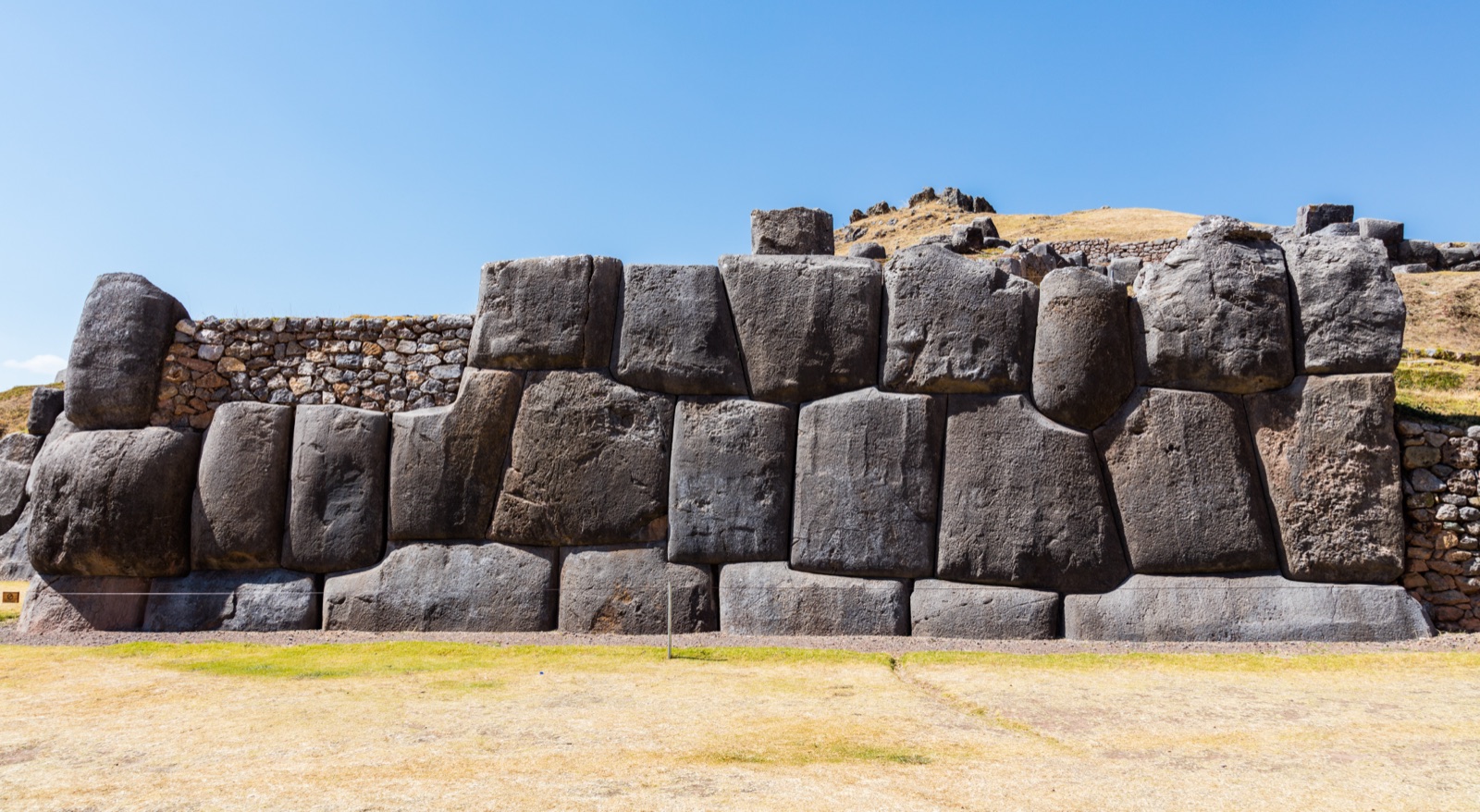
Stand at the foot of the lower terrace at Sacsayhuamán and look up. One of the limestone blocks in front of you is taller than you are — over twelve feet of stone, weighing something on the order of a hundred tons, maybe more. It does not sit on a flat foundation. Its bottom edge is cut into a curve, and a smaller block beneath it has been shaped into the exact answering curve, so the two lock together like puzzle pieces no one drew on paper first. There is no mortar. There is no gap. The joint is so tight that the standard test — try to slide a knife blade into the seam — fails, every time, along walls that run for hundreds of feet.
Now picture doing that by hand, without iron tools, on a slope at twelve thousand feet, one impossible block against the next, hundreds of times. The Inca did. The question that keeps people coming back to this ridge isn't whether it's real. You can put your palm flat against it. The question is how — and the answer, even after we've learned a great deal, still doesn't quite settle the wonder.
The Place
Sacsayhuamán sits on a hill overlooking Cusco, the old Inca capital, in the southern Peruvian Andes at roughly 3,700 meters — about 12,000 feet — above sea level. From the upper terraces you look straight down onto the red-tiled roofs of the city. The walk up from the Plaza de Armas is short but brutal at that altitude; most visitors arrive winded, which is part of the experience. This is high country, thin air, hard light.
The defining feature is three tiers of terraced walls arranged in a vast zig-zag, running roughly 360 meters across the hillside, the three tiers together climbing some 18 meters up the slope (the largest single walls stand closer to 5 or 6 meters). The walls are built of enormous polygonal blocks — irregular, many-sided stones fitted together without mortar in the style archaeologists call cyclopean masonry. The outer walls are largely limestone, quarried nearby; some of the harder interior stone, including diorite and andesite, came from farther away. The site doubles as its own quarry in places, with bedrock still bearing the marks of where blocks were worked loose from the mountain.
Sacsayhuamán was built in the 15th century, under the Inca emperor Pachacuti — the ruler credited with transforming Cusco from a regional power into the heart of an empire — and finished by his successors. That date rests mainly on Spanish colonial chronicles and Inca dynastic history rather than on any direct dating of the stonework itself. The Spanish chroniclers who saw it shortly after the conquest described a project of staggering scale, with tens of thousands of laborers working in rotation over decades.
The site's history didn't end with the Inca empire's peak. In May 1536, Manco Inca — the puppet ruler the Spanish had installed after the conquest, then betrayed and imprisoned — broke free and led a war of reconquest against Cusco with an army chroniclers numbered in the tens of thousands. His forces seized the abandoned fortress at Sacsayhuamán and turned its high ground and thick walls against the conquistadors now holding the city below. In the Spanish counterattack to retake it, a hurled stone struck Juan Pizarro, brother of the conquistador Francisco Pizarro, in the head; he died of the wound days later, and the Spanish only secured the fortress after a bloody final assault. Today the site carries a different kind of recognition: in 1983, Sacsayhuamán was inscribed on the UNESCO World Heritage List alongside the city of Cusco itself.
The name comes from Quechua and is usually translated as something like "satisfied falcon" or "speckled falcon." There's a richer reading, too. Cusco was reportedly laid out in the shape of a puma, the sacred Andean cat — and Sacsayhuamán, on its high ridge, was the head. From that angle the zig-zag walls aren't just defensive geometry. They're teeth.
What the Show Claims
Ancient Aliens has returned to Cusco's stonework more than once, framing Sacsayhuamán as a centerpiece of its broader argument about Andean megaliths — the same argument it makes at Machu Picchu and Puma Punku, scaled up to the largest blocks of all.
The core claim is straightforward: blocks this size, cut this precisely, fitted this tightly, are beyond what a society without iron tools, the wheel, or written plans should have been able to produce. The show points to the polygonal joints — those interlocking, many-angled seams with no mortar and no daylight between them — and argues that achieving them by trial and error, by hand, with stone hammers, strains belief. The implication is that the Inca had help, or inherited the technique, or used tools we haven't accounted for: methods to soften, mold, or precision-cut the stone that look, to modern eyes, almost industrial.
The logistics get folded in too. Moving hundred-ton blocks across uneven Andean terrain and lifting them into place, the theorists note, is hard even with modern cranes. How a civilization without draft animals capable of the task, without wheeled transport, without a metal harder than bronze, managed it at this altitude is presented as a gap that conventional explanation doesn't fill.
It's worth saying plainly: the underlying astonishment is honest. The stones really are that big. The joints really are that tight. The show takes a genuine mystery and reaches for an extraordinary answer.
What Archaeology Says
The answer archaeology has assembled is, if anything, harder to look away from — because someone went up the mountain and tried it.
The architect and researcher Jean-Pierre Protzen spent years studying Inca quarrying and stonecutting, and he didn't just theorize — he replicated it. Working with hammerstones — fist-sized cobbles of harder rock — he showed that Inca masons could dress and shape blocks by pounding, not slicing, wearing the stone down through patient percussion. More striking is how the famous joints were achieved. Rather than lifting a multi-ton block again and again to test its fit, the masons appear to have traced the contour of the lower stone onto the upper one and ground the upper stone down along that line, letting gravity settle it into place as material was removed. The polygonal seams aren't a mystery of impossible cutting. They're the fingerprint of a fitting method — block shaped to block, each joint unique because each was matched to its neighbor.
That doesn't shrink the achievement. It relocates it. The Inca had no iron, but they had something the show tends to undervalue: an immense, state-organized labor system — the mit'a — capable of marshaling tens of thousands of workers, and generations of accumulated stonecraft. The transport of the largest blocks was a feat of ramps, ropes, levers, and coordinated human muscle, the kind of organized effort that built the rest of the empire's road network and terraces. Spanish accounts describe the sheer manpower with something close to awe.
And here's the thread that stays open. The toolmarks tell us the method. They don't fully convey how human hands held a tolerance this fine, this consistently, across blocks the size of trucks, on a mountainside. Knowing it was percussion and abrasion rather than alien lasers doesn't make the wall less astonishing when you're standing in its shadow. It makes the people who built it more so. We can name the technique and still not quite picture the patience.
The Verdict
Archaeology has answered the question the show asks loudest — what tools? — and in doing so opened a quieter one it can't close.
What we've lost is most of the context. The Spanish, after taking Cusco, used Sacsayhuamán as a quarry, hauling away the smaller, more manageable stones to build colonial churches and houses in the city below. What survives are largely the blocks too colossal to move — which means the walls we marvel at today are the remnant, the part even the conquerors couldn't be bothered to dismantle. We're looking at the bones of something larger, and we don't fully know what the whole once was: fortress, temple, royal complex, ceremonial stage, storehouse for the empire's apparatus. Probably some of each. The chroniclers gave us pieces; the structure itself has gone quiet.
So the real mystery at Sacsayhuamán isn't a missing tool. It's a missing meaning. We know who built it and roughly when and largely how — and we still can't fully stand inside the minds that decided a puma's head should be made of hundred-ton stone, fitted tighter than a knife blade, on the roof of the world. Go to Cusco. Climb the hill until your lungs complain. Put your hand on the seam where two impossible blocks meet, and try to find the gap. You won't. Then stand back and let the wall ask you the question it's been asking for five hundred years: not how, exactly — we're closing in on how — but what were they reaching for, that this was the only way to say it.
Track the ancient sites you've visited on the interactive map.
Free account · mark visited sites · build your bucket list.
Open the tracker