Puma Punku's Impossible Precision
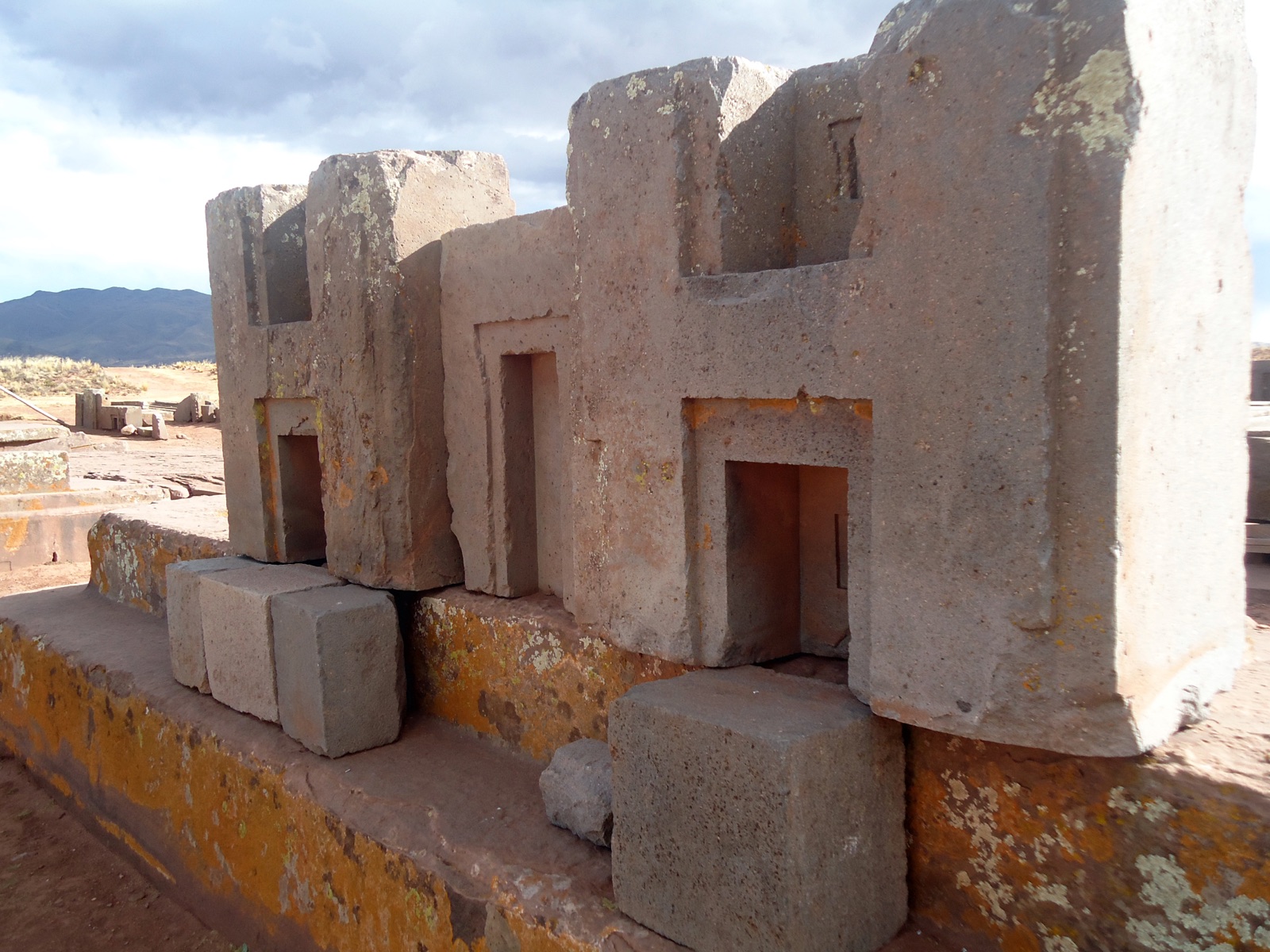
Pick up a fragment of red sandstone from the ruins of Puma Punku. Feel the weight of it, the slight roughness of the cut surface. Now look at the drill holes. They are round and smooth, with consistent diameter along their entire depth. The holes in different blocks are identical. Whoever made these holes had a way of producing repeatable, uniform results in very hard stone.
At 12,800 feet above sea level, with temperatures that swing 40 degrees Fahrenheit between night and day, using no iron tools — this is what the Tiwanaku civilization accomplished sometime between 500 and 900 AD. You can hold the evidence in your hand.
The Place
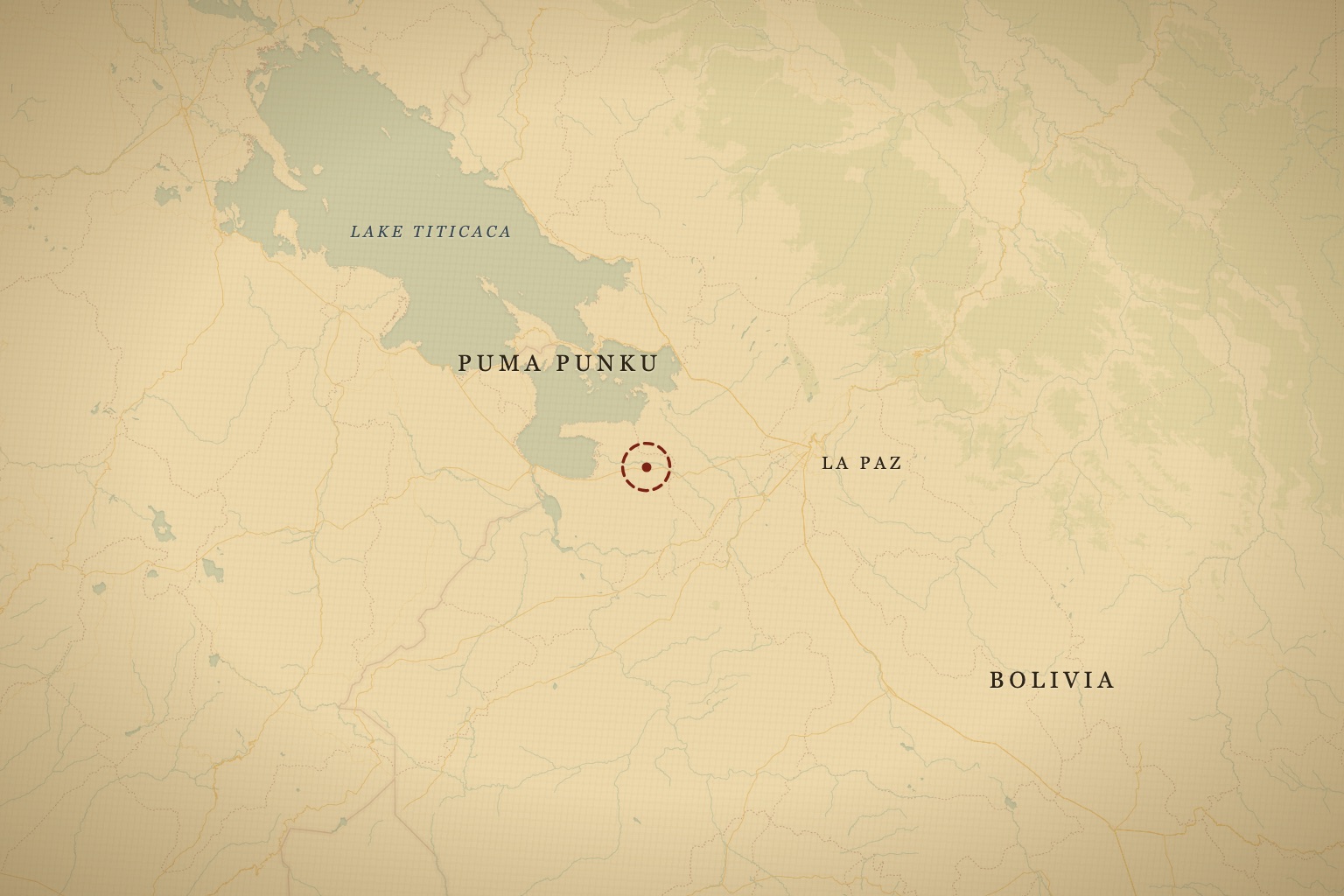
Puma Punku is a terraced platform mound forming part of the larger Tiwanaku archaeological complex, located near the southern shore of Lake Titicaca in western Bolivia, about 45 minutes by car from La Paz. "Puma Punku" means "Gate of the Puma" in both Aymara and Quechua.
The site was once a major ceremonial center — a series of interlocking stone platforms, courtyards, and gateways decorated with polished metal plaques and brilliant paint. What visitors see today are the scattered remnants of that structure: hundreds of precisely cut stone blocks, some weighing over 100 tons, lying in apparent disorder across the plateau. Some of that disorder traces back to the work of time, to later builders (the Inca and Spanish both quarried the site for building material), and to a major earthquake that struck sometime after the complex was constructed. How much each accounts for — and what the arrangement looked like before any of it — is harder to say than it first appears.
The blocks themselves are made from two types of stone: red sandstone, quarried locally, and grey andesite, quarried from a site across Lake Titicaca, roughly 90 kilometers away. Getting the andesite to Puma Punku required water transport across the highest navigable lake in the world, followed by a haul up the plateau. There is no wheeled technology in the archaeological record.
What the Show Claims
Ancient Aliens devoted an entire episode to Puma Punku — "The Mystery of Puma Punku" (Season 4, Episode 6, 2012) — and has returned to the site's stonework in later seasons.
The show's central claim is that the stone blocks at Puma Punku display a level of precision that cannot be explained by any known ancient tool or technique. The H-shaped blocks, in particular, draw significant attention: they are identical to each other, interlocking precisely, resembling prefabricated machine parts. The show argues that this level of repeatability is only possible with computer-controlled machining — or alien technology.
The drill holes get extended discussion. Their smoothness, their consistent diameter, their apparent precision — the show argues these could only have been produced by modern diamond-tipped drill bits, or their extraterrestrial equivalent.
The show also raises the question of logistics: moving 100-ton andesite blocks 90 kilometers, across a lake, to an altitude of 12,800 feet, using a civilization with no writing, no wheels, and no iron. The difficulty, the theorists argue, points to a level of technological capability beyond what the Tiwanaku could have possessed.
What Archaeology Says
The precision claims have been directly tested — and the people who tested them did so because the stones are extraordinary enough to deserve a closer look. Archaeologist John Hoopes of the University of Kansas and his colleagues have done extensive analysis of the Puma Punku blocks. What they found is its own kind of astonishing: the holes and surfaces are the work of stone tools, abrasive sand, and patient, skilled labor — not power drills.
The most telling detail is one the show doesn't examine. Under magnification, the drill holes show slight helical toolmarks consistent with a stone or bone drill spun using a pump or bow mechanism, with abrasive sand as the cutting medium. Those faint imperfections — invisible to the naked eye — are the fingerprints of human hands. Which raises a stranger question than the alien one: how do you produce holes of identical diameter, block after block, by hand, with sand and a spinning stick? The method is human. The consistency it achieved is still hard to fully picture.
The H-shaped blocks are repeatable to a degree that feels machined, and that repeatability points back to the Tiwanaku themselves — skilled stonemasons working from shared templates to produce standardized, interlocking components. Prefabrication and standardization show up elsewhere in the ancient world, from Rome to Egypt to the Inca. But knowing it can be done by hand doesn't tell you how these hands held a tolerance this tight, across hundreds of pieces, at this altitude.
Jean-Pierre Protzen, the Berkeley architecture professor who spent the 1980s famously replicating Inca stonework by hand — quarrying and dressing blocks with nothing but river-cobble hammerstones to prove it could be done — turned his methods on Tiwanaku with art historian Stella Nair. Their 2013 study, The Stones of Tiahuanaco, is the most detailed accounting of these blocks ever produced, and its conclusions cut both ways, which is why both camps cite it. The surfaces, the crisp inside corners, the drill holes: all consistent with stone tools and abrasives. But the system behind the stones — repeated modular forms, standardized angles, blocks that behave like interchangeable parts of buildings that could be assembled in more than one configuration — implies plans, templates, and an architectural rigor Protzen and Nair openly admitted they could not fully reconstruct. They also documented the metal: I-shaped cramps that once tied blocks together, some of them poured molten into carved sockets on site. Heather Lechtman's laboratory analysis found these were an unusual copper-arsenic-nickel bronze — meaning the builders carried portable smelting up to 12,800 feet and cast metal directly into stone, in place.
What the Tiwanaku had, archaeologists have established, was a highly organized labor system called mit'a — state-organized communal labor — and an understanding of stone working accumulated over centuries. Their tool kit included stone hammers, bronze chisels (copper-tin bronze was available in the Andes), and abrasive compounds. In skilled hands, over long stretches of time, those tools are capable of extraordinary precision. Younger and more earthbound than the show proposes — and that makes the achievement stranger, not tamer.
The dating is also more precise than the show lets on. Radiocarbon work at the platform and the chronological studies of John Wayne Janusek of Vanderbilt University — who spent his career on Tiwanaku's urban and ritual landscape — place Puma Punku's construction after roughly 530–600 AD, squarely within the rise of the Tiwanaku state. Janusek read the complex as a deliberately staged ritual landscape, its gateways and sightlines aligned to the mountains and the movement of the sun, a building designed to organize how people experienced the cosmos. That's not a lost pre-human civilization. It's something in some ways harder to picture: a specific Andean state, at a specific moment, deciding that this is what its finest labor was for.
Archaeologist Alexei Vranich has excavated extensively at Puma Punku and Tiwanaku, documenting construction sequences, tool marks, and the evidence of how the complex was built, used, and ultimately abandoned. His latest approach to the reassembly problem is characteristically pragmatic: since no one can heave the originals around to test-fit them, his team 3D-printed miniature replicas of dozens of blocks at 4 percent scale and reassembled them by hand, publishing the results in 2018 — the first physically grounded reconstruction of what one of Puma Punku's buildings may actually have looked like. The modeling has clarified where even the largest pieces sat, including the biggest single stone in the complex, a sandstone terrace slab estimated at 131 tons. It has not clarified why a building at the edge of the habitable world needed them. The deeper the record gets, the more there is left to explain.
The Verdict
Archaeology has given us better questions, not final answers. Set the alien claims aside and Puma Punku doesn't get smaller — it gets stranger. We still don't fully understand why it was built, why it was built this way, or exactly what happened to it.
The Tiwanaku civilization collapsed — rapidly, around 1000 AD — apparently due to a combination of extended drought and the failure of the sophisticated raised-field agricultural system that fed the population. Within a generation or two, the city emptied. Puma Punku was abandoned before it was completed: construction stones remain along the ancient transport routes, work apparently stopped mid-project. A site this deliberate, walked away from mid-sentence.
Naming the tools doesn't dissolve the wonder. A culture working at 12,800 feet, without iron or wheels, producing components precise enough to interlock across hundreds of separate pieces, coordinated over decades — knowing it was human hands only sharpens the question of how those hands did it.
And there's a specific detail that keeps asking: some of the andesite blocks at Puma Punku contain miniature gateways — perfect scale models of full-size gates, carved into the face of the stone. Were these architectural models? Ritual objects? Offerings? Nobody is sure. The Tiwanaku left behind a physical language we're still learning to read — and the stones are still here, holding their tolerances and their silence, waiting for someone to read them right.
Covered On Screen
- The Mystery of Puma PunkuAncient Aliens · S4 E6
- The Alien CodeAncient Aliens · S20 E20
- Top Ten Mysterious SitesAncient Aliens · S17 E2
Track the 1 site from this post on your map.
Free account · mark visited sites · build your bucket list.
Start tracking