Petra: The Rose City
The Place
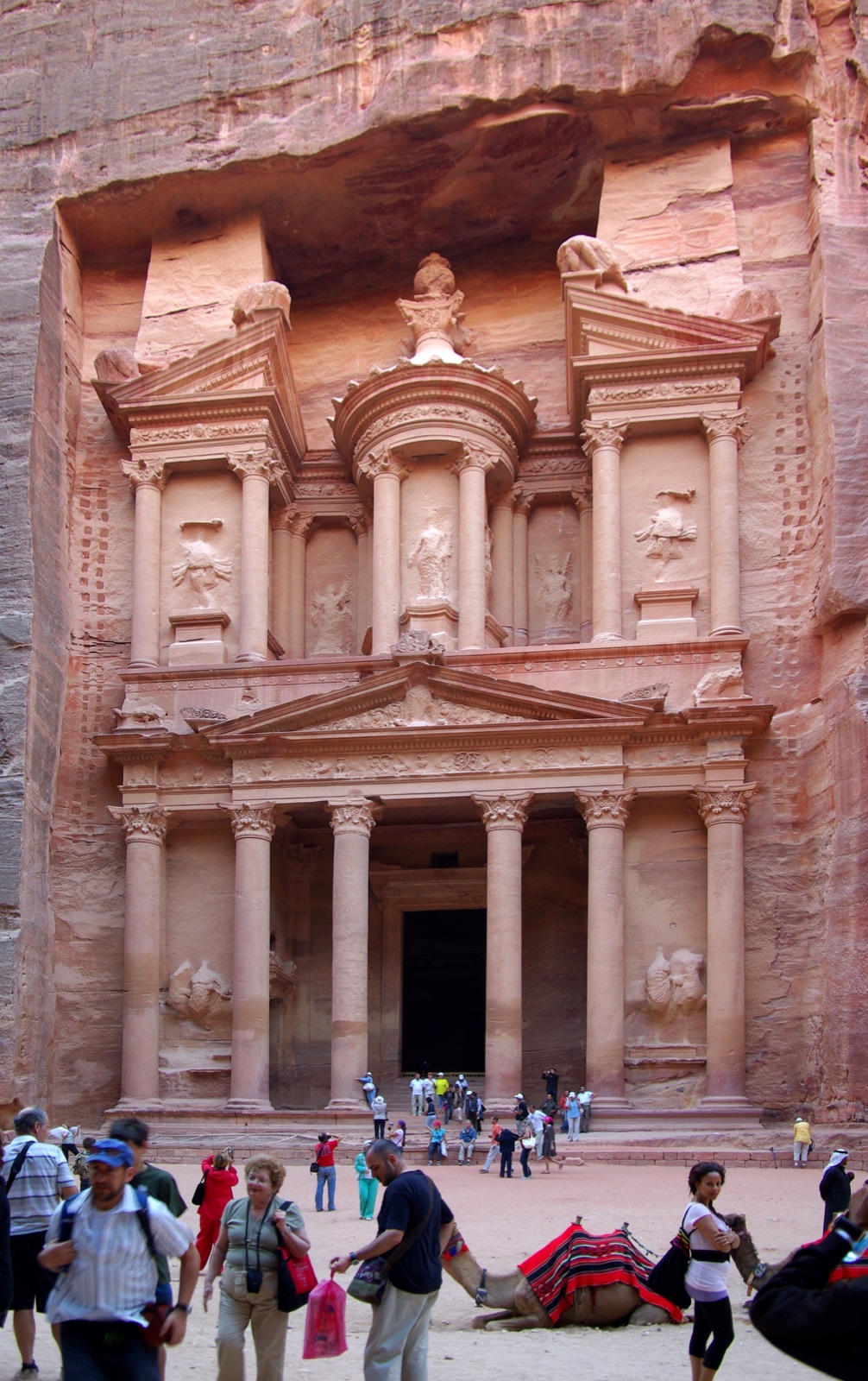
Petra sits in the sandstone highlands of southern Jordan, carved into rose-red cliffs in a basin formed by the Wadi Musa — the Valley of Moses. It is, by any measure, one of the most audacious construction projects the ancient world produced. The city is hidden: you approach through the Siq, a narrow canyon that winds nearly a mile between walls of striated rock, then emerges abruptly into the open face of Al-Khazneh — the Treasury — rising 40 meters against the sky. That first view has been stopping people cold for at least two thousand years.
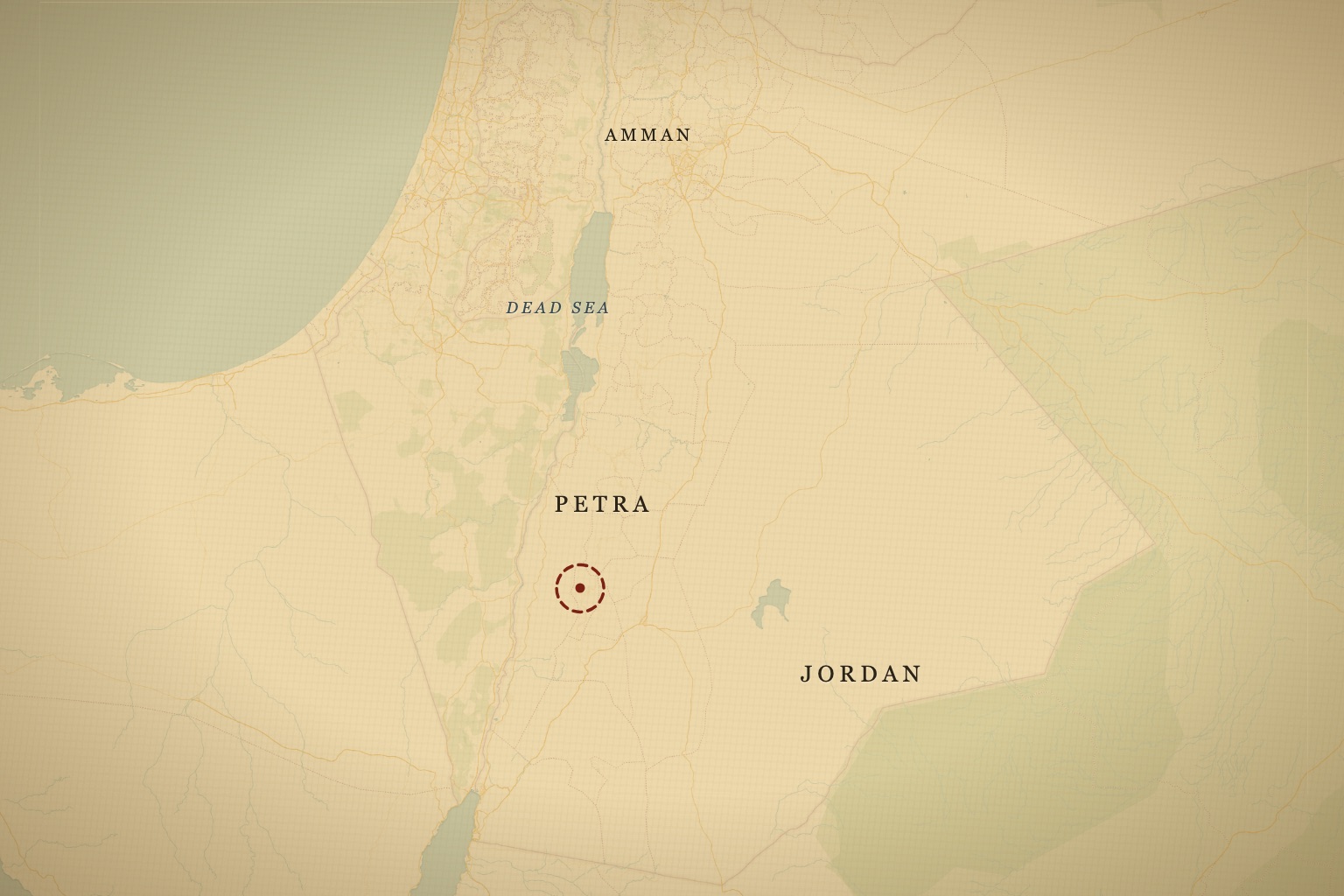
The Nabataeans founded Petra as their capital sometime in the 4th century BC, and it became the commercial hub of an empire that stretched across the Arabian Peninsula and into the Levant. They grew wealthy by controlling the overland spice and incense routes connecting Arabia, Egypt, Syria, and the Mediterranean. At its peak in the first century AD, Petra housed an estimated 20,000 to 30,000 people in a place that receives, on average, less than six inches of rain a year.
That last detail is the one most visitors miss, and it is the one that should impress them most. Petra is a city in a desert, and the Nabataeans solved the water problem with a hydraulic system that ranks among the most sophisticated in the ancient world. They built a network of dams to divert the flash floods that periodically tore through the Siq, channeling that water away from the city center and into storage rather than letting it destroy what they had carved. They cut hundreds of cisterns directly into the rock to capture and hold rainfall through the dry months. And they moved water across the city through a gravity-fed pipe system — terracotta pipe sections, fitted and sealed, calibrated to maintain a consistent flow gradient so the lines neither overflowed nor ran dry. The engineering tolerances on those pipes are tight. The people who designed them understood pressure, slope, and the behavior of moving water in a way that took the rest of the world centuries longer to formalize. Hold that thought as you walk in: whoever you imagine carved this place, they could already keep tens of thousands of people alive in a sandstone basin that sees less than six inches of rain a year. Whatever Petra is, it was made by people who had quietly solved a problem the rest of the ancient world hadn't.
The Treasury is the famous face of Petra, but it is a single building in a sprawling city. Beyond it lies a full urban landscape: a colonnaded street running through the center, the Great Temple complex, the temple known as Qasr al-Bint, a Roman-style theater cut into the hillside with seating for several thousand, and — in a striking reminder of how long this place was inhabited — a Byzantine church with preserved mosaic floors, built when Petra had passed into Christian hands. Carved into the surrounding cliffs are more than 800 tomb facades, ranging from simple recesses to the monumental Royal Tombs. The scale is hard to absorb from photographs. This was not a temple in the wilderness; it was a working capital, with neighborhoods, markets, and centuries of accumulated building.
For visitors today, the site is the Petra Archaeological Park, entered through the visitor center at Wadi Musa and then on foot through the same Siq the Nabataeans used. A serious visit takes a full day at minimum, and two days is better if you intend to see beyond the central monuments. The Treasury, the Street of Facades, the Royal Tombs, the Colonnaded Street, and the Great Temple are all reachable along the main route. For the Monastery — Ad-Deir, larger than the Treasury and arguably more impressive — you climb a rock-cut trail of roughly 800 steps up the mountainside, an ascent of about 45 minutes that most people remember more vividly than anything below. The full archaeological zone covers more than 260 square kilometers. What tourists see, even on a thorough visit, is a fraction of it.
The Swiss explorer Johann Ludwig Burckhardt rediscovered Petra for the Western world in 1812, disguised as a Muslim pilgrim. Systematic archaeological excavation didn't begin until the 20th century, and significant portions of the city remain unexcavated. UNESCO designated Petra a World Heritage Site in 1985, and in 2007 it was named one of the New Seven Wonders of the World.
What the Show Claims
Ancient Aliens has returned to Petra across multiple seasons. The core argument runs as follows: the Nabataeans were nomadic traders, not a civilization with the architectural tradition or technological base to produce what Petra actually is. The Treasury in particular — its symmetry, its classical columns, its ornate facade carved directly into living rock — represents a leap in capability that the show's commentators find implausible without outside assistance.
The specific anomalies the show highlights:
Scale and precision. The Treasury facade is roughly 30 meters wide and 40 meters tall, carved from a single sandstone cliff face. The level of precision in its Corinthian columns, broken pediment, and central tholos is consistent across the entire height. The show asks how Nabataean craftsmen, working top-down without scaffolding they could anchor to a finished surface, achieved this level of control.
The Urn Tomb's substructure. One of the Royal Tombs, the Urn Tomb, sits above a series of barrel-vaulted chambers built into the slope to create a level terrace in front of the facade. Ancient Aliens points to this vaulted substructure as evidence of engineering knowledge — true arch-and-vault construction — that the show argues exceeds what a desert trading culture should have possessed, presenting it as a sign of borrowed or inherited technical sophistication rather than a homegrown skill.
The Treasury's iconography. The show also reads meaning into the figures carved across the Treasury facade: eagles, the Dioscuri (the divine twins Castor and Pollux), and weathered Medusa-like heads among the decorative reliefs. Rather than treating these as standard Hellenistic religious imagery, Ancient Aliens raises the possibility that the iconography encodes cosmic or astronomical knowledge — a deliberate message embedded in stone by whoever truly guided the design.
Astronomical alignment. The Treasury faces east, and twice a year — near the spring and autumn equinoxes — sunrise sends direct light into the monument's interior. Ancient Aliens presents this as evidence of sophisticated astronomical knowledge beyond what a trading culture should possess, suggesting the alignment was intentional and possibly encoded by an advanced civilization.
Global parallels. The show draws comparisons between Petra's cliff-carved facades and similar rock-cut architecture at Ajanta in India, Lalibela in Ethiopia, and sites in Peru, arguing that no independent tradition could have arrived at the same approach and that a single advanced source — extraterrestrial — must connect them.
The show presents these as evidence that the Nabataeans either received direct extraterrestrial assistance or inherited the site from a more advanced prior civilization.
What Archaeology Says
Here's the thing worth saying up front: archaeologists take Petra seriously enough to read it closely, and what they've found doesn't shrink the place. It enlarges it. The Nabataeans turn out to have been one of the ancient world's most sophisticated hydraulic engineers, and the closer you look at their mastery of stone, the harder it is to look away.
On the Nabataeans themselves. By the time Al-Khazneh was constructed — most likely in the first century BC or first century AD, based on stylistic dating of its Hellenistic facade elements — Petra had been a functioning city for at least three centuries. The Nabataeans operated a long-distance trade empire and had sustained, simultaneous contact with the major centers of the Mediterranean world. Their caravans ran goods into Hellenistic Alexandria, the wealthiest intellectual and architectural capital of the age; into Ptolemaic Egypt; and into Rome as it expanded east. This matters because trade routes were how technology actually moved in antiquity. Architectural ideas, decorative vocabularies, engineering techniques, and the craftsmen who carried them traveled along the same roads as incense and silver. A Nabataean elite that was buying frankincense in Arabia and selling it in Alexandria was, by the same token, exposed to Corinthian columns, broken pediments, tholoi, and vaulted construction — and wealthy enough to hire the architects who knew how to build them. But notice what that picture actually asks of us: a desert people running a continent-spanning network so well that the finest ideas of the ancient world flowed back to them and got carved into a cliff. The Hellenistic character of the Treasury isn't the mystery dissolving. It's the mystery getting more interesting — how did a culture out here become that connected, that quickly?
On the carving technique. Rock-cut architecture was not unique to Petra. The Egyptians carved directly into cliffs at Abu Simbel centuries earlier. The technique used at Petra — working top-down, removing material in horizontal passes — is understood from the tooling marks preserved on unfinished facades and tomb interiors throughout the site, and experimental archaeology projects have replicated the approach using period-appropriate iron tools. But knowing how it was done makes the result stranger, not tamer. A top-down carve is unforgiving: there is no undo. Every line of the Treasury's symmetry had to be held in someone's head before the first blow, because once the stone above is gone you cannot put it back. The precision isn't explained away by the method. The method is what makes the precision astonishing.
On the Urn Tomb and the vaults. Barrel vaulting was a workhorse of Hellenistic and Roman construction in the first centuries BC and AD, used everywhere from warehouses to bridges to aqueducts, and the Nabataeans — in constant contact with both worlds — would have had ready access to the technique and to builders who used it routinely. So the vaulted substructure of the Urn Tomb is masonry of a high and confident standard for its era. What stays with you is the ambition of the gesture: they didn't find a level shelf in the cliff and build on it. They engineered the terrace itself, raising vaulted chambers out of the slope so the facade above would stand exactly where they wanted it. That's not a people borrowing a trick. That's a people bending a mountain to a plan.
On the iconography. Eagles, the Dioscuri, and Medusa heads sit among the most common motifs in the entire Hellenistic decorative repertoire. The eagle was associated with Zeus and with royal power; the Dioscuri were protective deities of travelers and sailors — a fitting choice, you could argue, for a culture built on caravans; the Medusa head, or gorgoneion, was an apotropaic image meant to ward off evil, carved on shields, doorways, and tombs all over the Mediterranean. So these figures tell us the Nabataeans spoke the shared religious and artistic language of their trading partners. What that documented vocabulary still doesn't tell us is why these gods, on this facade, in front of a single empty chamber with no name attached to it. Knowing what the symbols meant elsewhere isn't the same as knowing what they were chosen to say here.
On the astronomical alignment. The equinox sunrise alignment at the Treasury has been confirmed by archaeoastronomers. It is real. It also isn't unique — orientation to cardinal directions, solstices, or equinoxes appears at hundreds of sites across the ancient world, from Stonehenge to the Pantheon's oculus — and navigating by the sun and stars was foundational knowledge for a civilization running trans-continental trade routes. Knowing where east is doesn't take instruction from the stars. But the alignment isn't just east. Twice a year the rising sun reaches past that narrow facade and lights the inside of a chamber cut from solid rock. Someone wanted that. The open question archaeology hands back is intent: they clearly could have aimed it — did they, and what for?
On the global parallels. Rock-cut architecture emerges wherever there is soft stone, a reason to build in permanence, and craftsmen with metal tools, and the resemblance between Petra, Ajanta, and Lalibela reflects shared constraints — gravity, stone behavior, the logic of removing material. You don't need a single hidden source to explain why three cultures reached for the same idea. What you're left with is almost more haunting: the same impulse — to carve permanence directly into a mountain — surfacing independently in India, in Ethiopia, in the Jordanian highlands. People who never met, reaching for the same way of refusing to be forgotten.
What the ground itself shows. Between 2010 and 2013, the Brown University Petra Archaeological Project, led by archaeologist Susan Alcock, used magnetometry and ground-penetrating radar to survey areas of Petra that had never been excavated, mapping subtle variations in the soil to detect buried structures. The survey revealed building foundations extending well beyond the visible monuments — walls, rooms, and urban features still buried under centuries of accumulated sand and debris. And this is the detail that resets the scale of everything else: the more we look, the more city there is. Not the relics of a vanished super-civilization, but the residential and civic fabric of a vast Nabataean capital, most of it still underground. The famous facades are the part that happened to face outward. The bulk of Petra is still down there, unread, waiting.
Genuine open questions. The function of the Treasury remains genuinely debated. It may have been a royal tomb, a temple, or a civic monument. The interior is a single undecorated chamber, with no inscription, which is unusual for a structure of this ambition. Sit with that: the most photographed facade in the ancient Middle East fronts a room that says nothing about itself. The people who could carve that much certainty into a cliff left us no word of who it was for or why. That's not a gap careful excavation has closed. It's the question Petra is still asking from behind its own front door.
The Verdict
Petra is genuinely extraordinary, and the strange thing is that the ancient astronaut framing, for all its reach, ends up wanting less mystery than the place actually holds. Pin the wonder on visitors from elsewhere and you've answered the question and closed it. The harder, stranger truth keeps it open: engineers who moved millions of gallons of water through a desert city using gravity-fed pipes and rock-cut cisterns, traders who negotiated with Rome and Egypt simultaneously, craftsmen who cut stone with a precision that survives two millennia of erosion — and we still can't say for certain what their most famous monument was for.
And then there's the part archaeology can describe but not really settle: the city's disappearance. After the Roman annexation of 106 AD, Petra declined slowly as trade shifted to sea routes and to Palmyra in the north. A catastrophic earthquake in 363 AD damaged much of the infrastructure, including the water system that had made the city possible. There was a Byzantine revival, the church with its mosaics, a final flourishing — and then a long fade. Another major earthquake in 551 AD. By the 7th century the city had been largely abandoned, and over the following centuries it slipped out of Western knowledge almost entirely, remembered only by the local Bedouin who lived among its tombs.
This is the part worth sitting with. Ancient Aliens spends its time on how Petra was built and almost entirely passes over how it was lost — which is the question that actually has a strange shape to it. A city of 20,000 to 30,000 people, with monumental architecture and a water system ahead of its time, emptied out and was forgotten so thoroughly that an entire civilization's capital became a rumor. How does that happen? The answers we have — shifting trade, earthquakes, the slow draining of a regional economy — are plausible, and they are partial. They tell you the mechanisms. They don't quite tell you how a place this ambitious becomes a thing nobody remembers.
So archaeology hasn't dissolved Petra. It has handed us better questions than the show thought to ask. What was the Treasury for. Why aim the equinox light into an empty room. How does a city this large go silent. Most of it is still underground, unread. Go through the Siq yourself, stand in the place where the canyon opens and the facade rises 40 meters out of the rock, and let it ask you those questions directly. The fact that it's still asking them is the most remarkable thing about it.
Episodes referenced: Ancient Aliens S3E3, S6E10
Track the ancient sites you've visited on the interactive map.
Free account · mark visited sites · build your bucket list.
Open the tracker