The Mystery of Newgrange: The Tomb That Catches the Sun
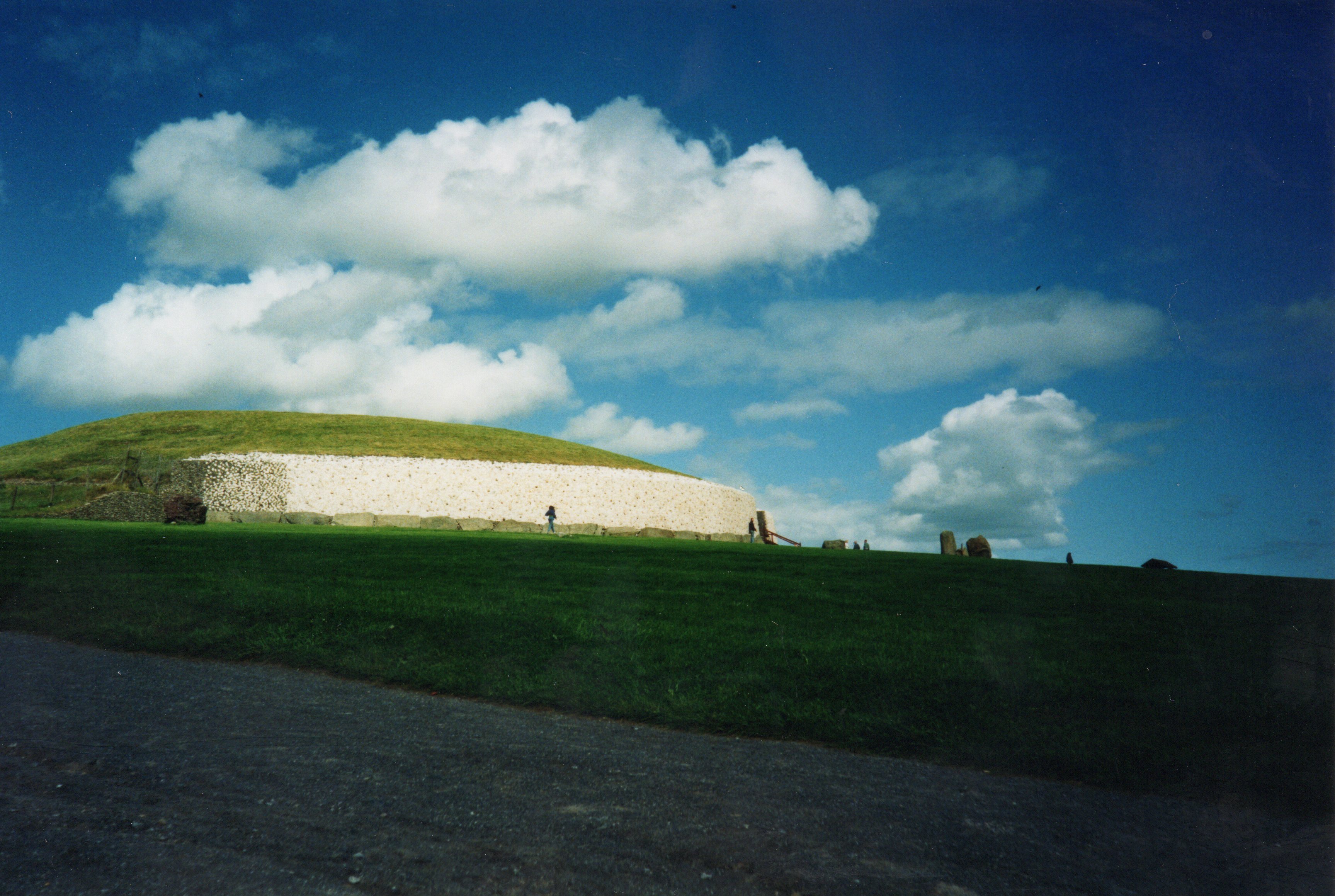
Once a year, on the mornings around the winter solstice, a beam of sunlight enters a slot above the doorway of a grassy mound in Ireland's Boyne Valley, travels down a stone passage nineteen meters long, and lands on the floor of a chamber that has otherwise been dark since the Stone Age. It holds there for about seventeen minutes, brightening and then fading, and then the mound goes dark again for another year. Someone built this to happen. Not stumbled into it, not decorated a tomb that happened to face east — someone cut a deliberate opening above the door, a "roof-box," aimed it at the rising midwinter sun, and got the geometry right around 3200 BC. That is roughly five centuries before the first stones went up at Stonehenge, and six centuries before the Great Pyramid at Giza. The light was arriving in that chamber before the pharaohs existed. It is still arriving now.
The Site
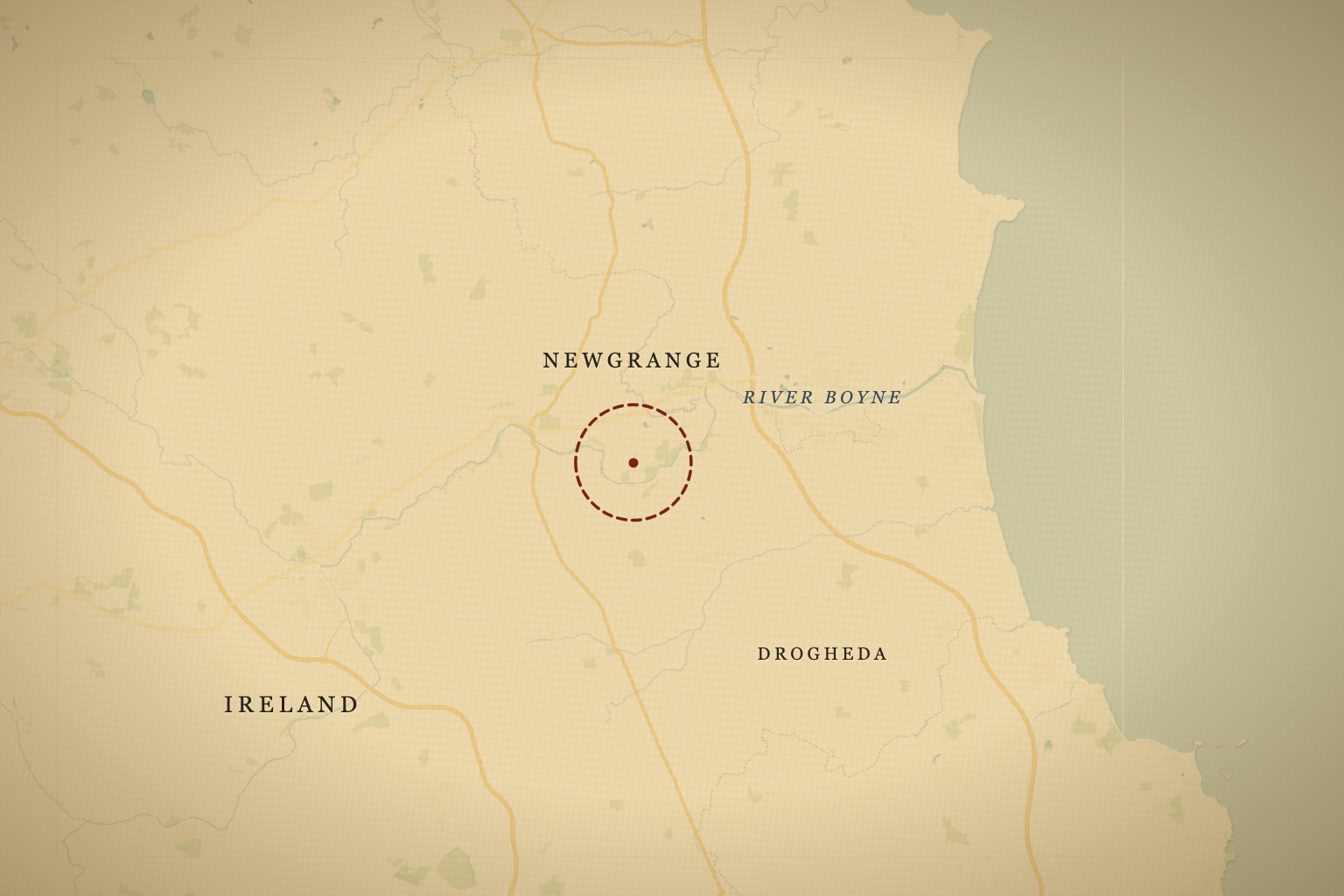
Newgrange sits on a low ridge above a bend in the River Boyne, about eight kilometers west of Drogheda in County Meath, on the east coast of Ireland. It is the most famous monument in a cluster archaeologists call Brú na Bóinne — the "palace" or "mansion" of the Boyne — which also includes the great mounds of Knowth and Dowth. The whole complex is a UNESCO World Heritage Site, and Newgrange is its showpiece: a circular mound roughly 85 meters across and 13 meters high, covering about an acre of ground. The three great mounds do not stand in isolation; the wider landscape is dotted with smaller satellite tombs, standing stones, and enclosures, the accumulated work of generations who returned to this same bend of the river to build for centuries.
The mound is not just a pile of earth. Its edge is ringed by 97 enormous kerbstones laid end to end, many of them carved, and the front of the monument is faced with a striking wall of white quartz and dark granite cobbles — a reconstruction, controversial in its details, based on stone found collapsed around the entrance. Inside, a single passage leads to a cross-shaped chamber with three recesses, roofed by a corbelled vault of overlapping stones that has stayed watertight and standing for five thousand years without mortar. Each recess holds a large stone basin, the kind that once received cremated human remains, and the walls and roof-stones of the interior carry more of the carved designs that mark the site throughout. The passage itself narrows and lowers as it goes, so that a visitor must stoop to reach the chamber at the heart of the mound — a deliberate transition from the open air into a confined, deliberately theatrical darkness.
The stone that built all this came from far away. The large structural slabs, the greywacke, were most likely brought from the coast to the north, while the water-rounded cobbles and the brilliant white quartz appear to have been gathered from sources scattered across the region, the quartz possibly from the Wicklow Mountains far to the south. Moving that tonnage without wheels, without draft animals harnessed to carts, and without metal tools represents an organized effort of labor and planning that stretched over what must have been a substantial span of years.
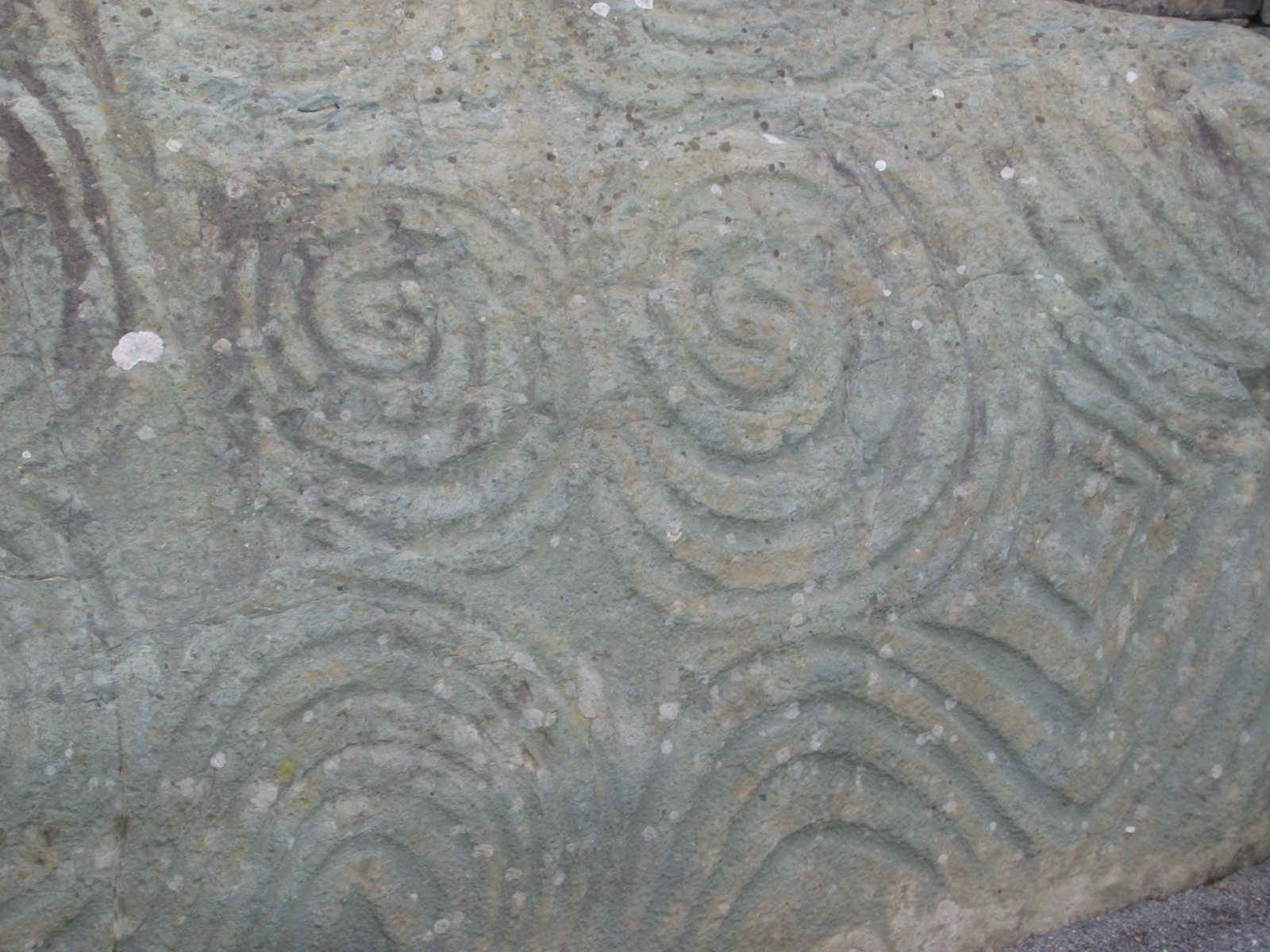
You reach it today only by guided tour, shuttled from the visitor centre across the river, because the site is far too fragile and too visited to open freely. Access to the chamber itself during the solstice is limited to a tiny number of people, and demand is so overwhelming that places are allocated by lottery each year, with tens of thousands entering for a handful of spots. And the great entrance stone — a boulder carved with interlocking spirals and lozenges — stops most people in their tracks before they even go in. It is one of the most recognizable pieces of prehistoric art in Europe, and it lies directly in the path of anyone approaching the sealed passage behind it.
What the Show Claims
To Ancient Aliens and the wider alternative-history world, Newgrange is irresistible, and the reason is precision. This is not a rough heap of Neolithic rubble. It is an instrument. The roof-box is aligned to catch the solstice sunrise with an accuracy that implies its builders tracked the sun across years, understood exactly where it would rise on the shortest day, and engineered the passage and the light-slot to intersect at that one moment. The show's framing asks the obvious question: how does a preliterate farming culture, with no writing and no metal tools, achieve astronomical alignment on the scale of a building? The alignment is not a matter of pointing a passage vaguely at the horizon; it required anticipating where the sun would clear the ridge on the single shortest morning of the year, and then constructing a fixed aperture that would admit that light and no other.
From there the argument builds outward. The carvings — those famous triple spirals, the concentric arcs, the diamond patterns cut into hard stone across the site — are read as a symbolic language, possibly a star map or a record of knowledge handed down rather than invented. The engineering is invoked too: the corbelled roof that still keeps the chamber dry, the sheer tonnage of stone hauled from the coast and the Wicklow mountains, the way water is channeled off the vault through carved grooves so that rain seeping into the mound is diverted before it can reach the chamber. In the show's logic, all of this points beyond a scattered population of Stone Age farmers. It suggests instruction — a source of astronomical and architectural sophistication that the people of the Boyne inherited from somewhere, or someone, rather than working out for themselves. The mound, in this reading, is a message, and we are only slowly learning to read it. The argument leans heavily on the gap between what we imagine Neolithic people could do and what the mound plainly demonstrates they did.
What Archaeology Says
Here is where the story is supposed to become ordinary, and instead becomes almost more staggering.
The modern excavation of Newgrange was led by the archaeologist Michael J. O'Kelly of University College Cork, who dug the site through the 1960s and into the early 1970s. It was O'Kelly who, on the morning of 21 December 1967, stood alone inside the chamber and confirmed what local tradition had half-remembered — that the sun entered through the roof-box and lit the floor at the winter solstice. He watched it happen and documented it. The roof-box itself, the deliberate slot above the entrance, had been recognized during his work as a purpose-built feature rather than an accident of collapse, and its function only made sense once the solstice light confirmed it. Radiocarbon dates from his excavation put the construction around 3200 BC, and that date is the thing that changes everything. It does not make Newgrange less impressive by making it "just" a tomb. It means the alignment was calculated, and the mound built to hold it, by people who did all of this with stone, antler, wood, and bone — no metal, no wheel, no writing. The consensus doesn't shrink the achievement. It removes every tool that would make the achievement easy.
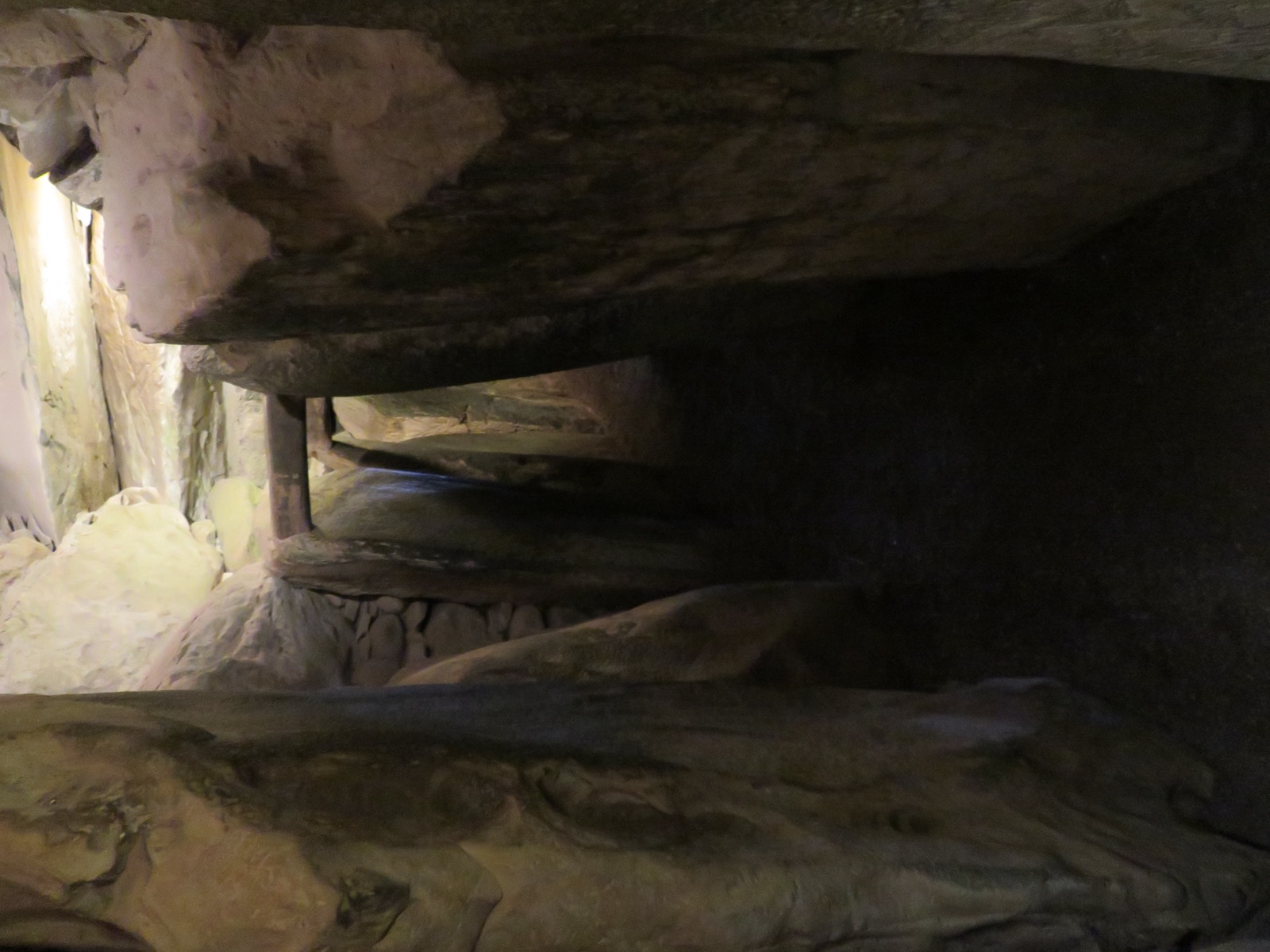
The corbelled vault is a genuine feat of engineering that archaeologists fully credit to its builders — and it still works. Each ring of stones in the roof is laid to overlap the one below and tilted slightly outward to shed water, rising course by course until a single capstone closes the space at the top. That the chamber has remained dry through five thousand Irish winters, with no mortar binding it, is a direct result of that design and the grooves cut to carry water away. The carvings, meanwhile, sit in a category the researcher Elizabeth Shee Twohig spent a career cataloguing under the name "megalithic art," found across Ireland, Brittany, and Iberia. Scholars can describe the motifs precisely and trace their distribution, and they still cannot tell you with certainty what a single spiral meant. Documenting a symbol is not the same as reading it. We know the vocabulary and have lost the language. Some of the carved stones show signs of having been decorated before they were set in place, and some carry designs on surfaces now hidden inside the structure, invisible to anyone who ever entered — a detail that complicates any simple reading of the art as public message.
There's a live argument, too, worth knowing about. Not everyone accepts that the celebrated white-quartz façade ever stood as it does now; some archaeologists, including Cork's own later researchers, have questioned whether O'Kelly's reconstruction reflects the original monument or a modern interpretation of collapsed stone. The stone was found lying in a spread around the entrance, and how it was originally arranged — a vertical wall, a sloping bank, a pavement — remains genuinely contested. And more recent ancient-DNA work on remains from Newgrange, published by a team including geneticist Lara Cassidy and Dan Bradley of Trinity College Dublin in 2020, turned up something nobody expected: an adult male buried in the chamber whose parents were first-degree relatives — the kind of union associated across cultures with ruling dynasties who marry within the bloodline. That same study traced networks of kinship linking individuals buried at these Irish passage tombs, suggesting the people interred in them belonged to something more like an extended dynastic web than a random cross-section of the population. It is a single genome, and its meaning is fiercely debated. But it hints, faintly, at a society more stratified and more strange than the tidy image of egalitarian farmers.
The Verdict
We know when Newgrange was built, roughly who built it, and exactly what the light does on the shortest morning of the year. The excavation is thorough, the dating is solid, the solstice event is filmed and repeatable. And none of it answers the question the mound keeps asking.
Because the settled facts sharpen the mystery instead of dissolving it. A people with no writing tracked the sun precisely enough to freeze a single sunrise in stone and aim a nineteen-meter tunnel at it — and then covered the whole apparatus with an acre of earth so that the beam would fall on darkness, witnessed by no one, year after year, for millennia. Why build an instrument this exact and then bury its purpose? What did the seventeen minutes of light mean to the hands that carved the spirals guarding the door? The alignment is deliberate, the engineering is theirs, the labor is accounted for — and still the intention behind it stays locked in the same darkness the light briefly interrupts. We can date the charcoal and sequence the bones and still not know what they were thinking on that first cold morning when the sun came down the passage exactly where they'd told it to.
Go stand in the Boyne Valley if you can, and put your hand on the great entrance stone with its endless spirals. Then imagine the calculation behind the dark chamber beyond it — and notice that the best answer archaeology has, after all these years, still ends where the mystery began: someone knew where the sun would be, and made the earth remember it.
Track the ancient sites you've visited on the interactive map.
Free account · mark visited sites · build your bucket list.
Open the tracker