The Mystery of Mohenjo-daro: The City Built by Ghosts
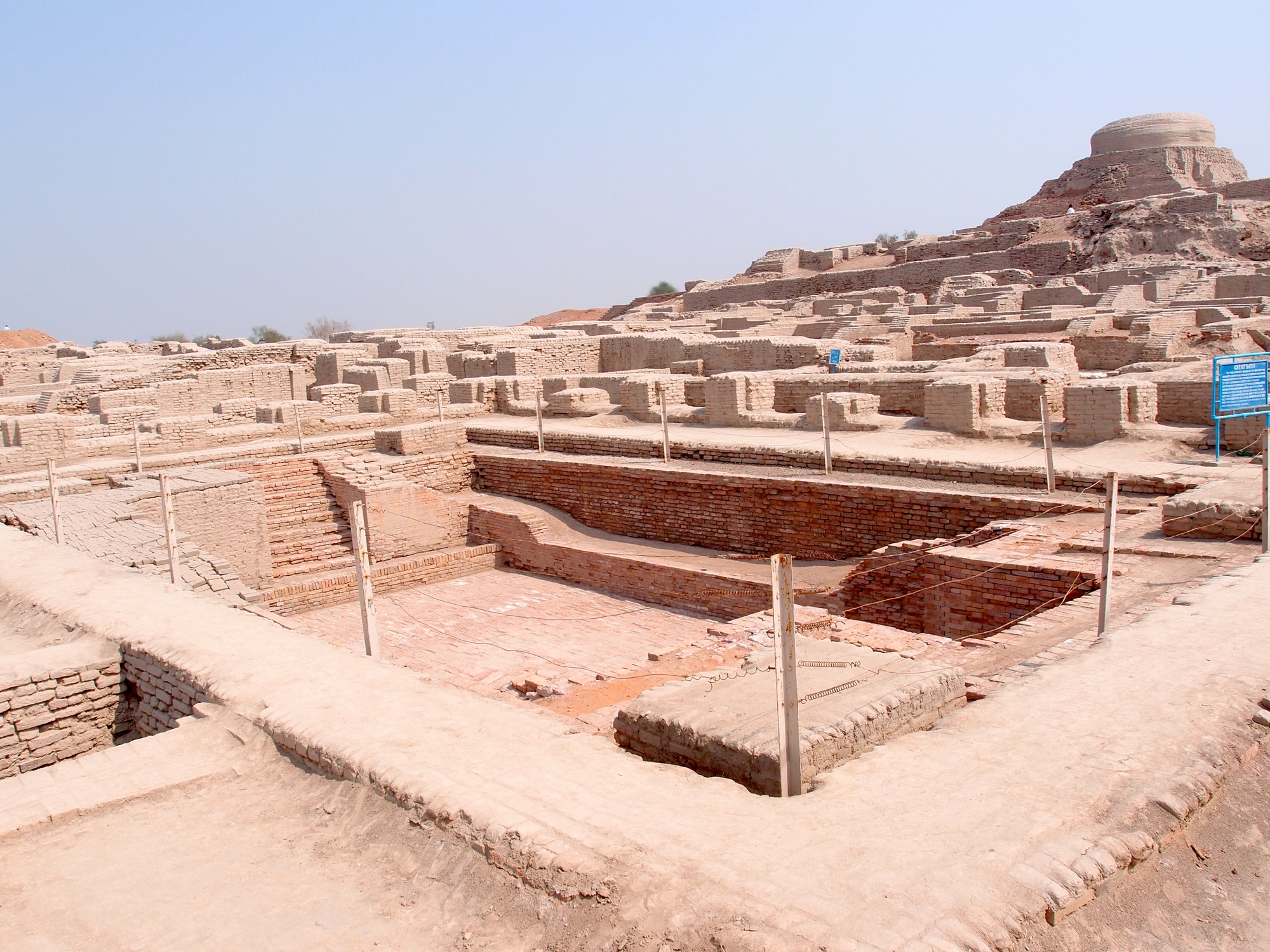
Nearly 5,000 years ago, in what is now southern Pakistan, someone laid out a city on a grid. Not a scatter of huts that grew into streets over generations — a plan, drawn before the first brick was set, with main avenues running dead north-south and east-west, blocks arranged in a rough grid, and beneath the streets a covered drainage system that carried wastewater out of the houses and away. The bricks themselves were made to a standard ratio, the same proportions turning up hundreds of kilometers apart. Many houses had their own bathing platforms and toilets. There is a public bath the size of a small swimming pool, sealed watertight with bitumen.
And here is the part that keeps people awake: we do not know who ran the place. No palace has been found. No royal tomb. No temple we can confidently name a god for. A city built with the discipline of an army — and no visible commander.
The Site
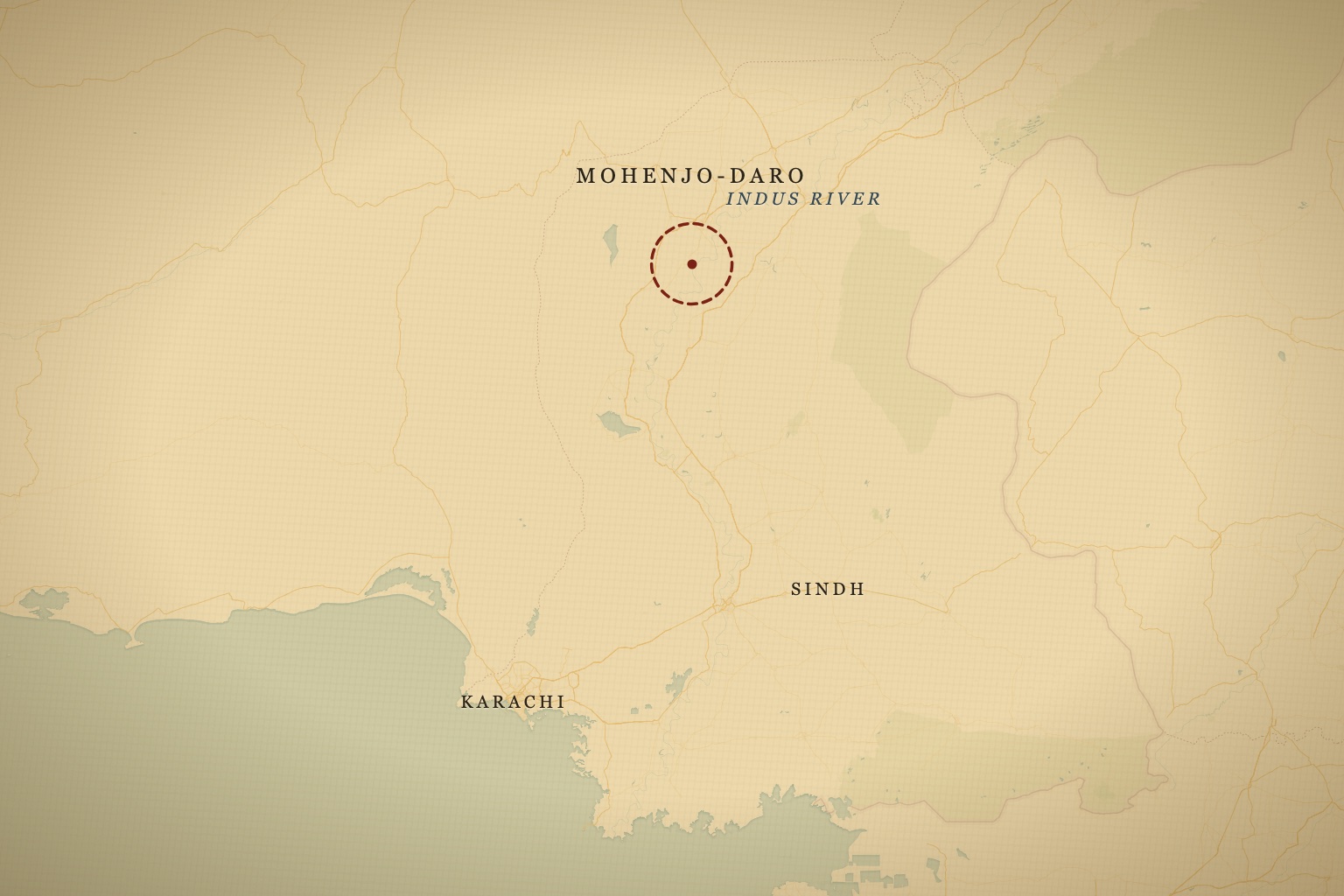
Mohenjo-daro sits in the Sindh province of Pakistan, on the right bank of the Indus River, in the flat, hot floodplain about 500 kilometers north of Karachi. The name is not ancient; it's a modern Sindhi phrase usually translated as "Mound of the Dead Men." What the builders themselves called it, we have no idea — because we can't yet read a word they wrote.
The city was one of the largest settlements of the Indus Valley Civilization (also called the Harappan Civilization after its first-excavated site), a Bronze Age culture that flourished roughly between 2600 and 1900 BC across a territory larger than ancient Egypt and Mesopotamia combined. At its peak, Mohenjo-daro may have housed tens of thousands of people. It was divided into a raised western mound — often called the "Citadel," though nobody is sure it was ever military — and a sprawling "Lower Town" of residential and workshop districts below.
The Citadel mound is where the most famous public structures sit. The Great Bath — that watertight tank, its floor and walls of fitted brick sealed with bitumen, reached by steps at either end — is the single most photographed structure at the site, and the most debated. It has no clear parallel and no inscription telling us its purpose; guesses range from ritual bathing to civic waterworks, and all of them remain guesses. Nearby stood a large pillared building and a structure often labeled a "granary," another interpretation that rests on architecture alone rather than any surviving grain or record. Even the vocabulary we use — Citadel, granary, bath — is a set of borrowed labels from other civilizations, pressed onto buildings whose real function we simply do not know.
The Lower Town is where daily life happened. Streets divided the settlement into blocks, and within them houses turned inward around courtyards, presenting plain walls to the road. Many homes were built around wells, and the city as a whole was studded with them — brick-lined shafts sunk at regular intervals, a standing supply of water within reach of nearly everyone. This is part of what makes the place feel so uncannily modern: not a single grand aqueduct for a palace, but distributed, ordinary access, house after house.
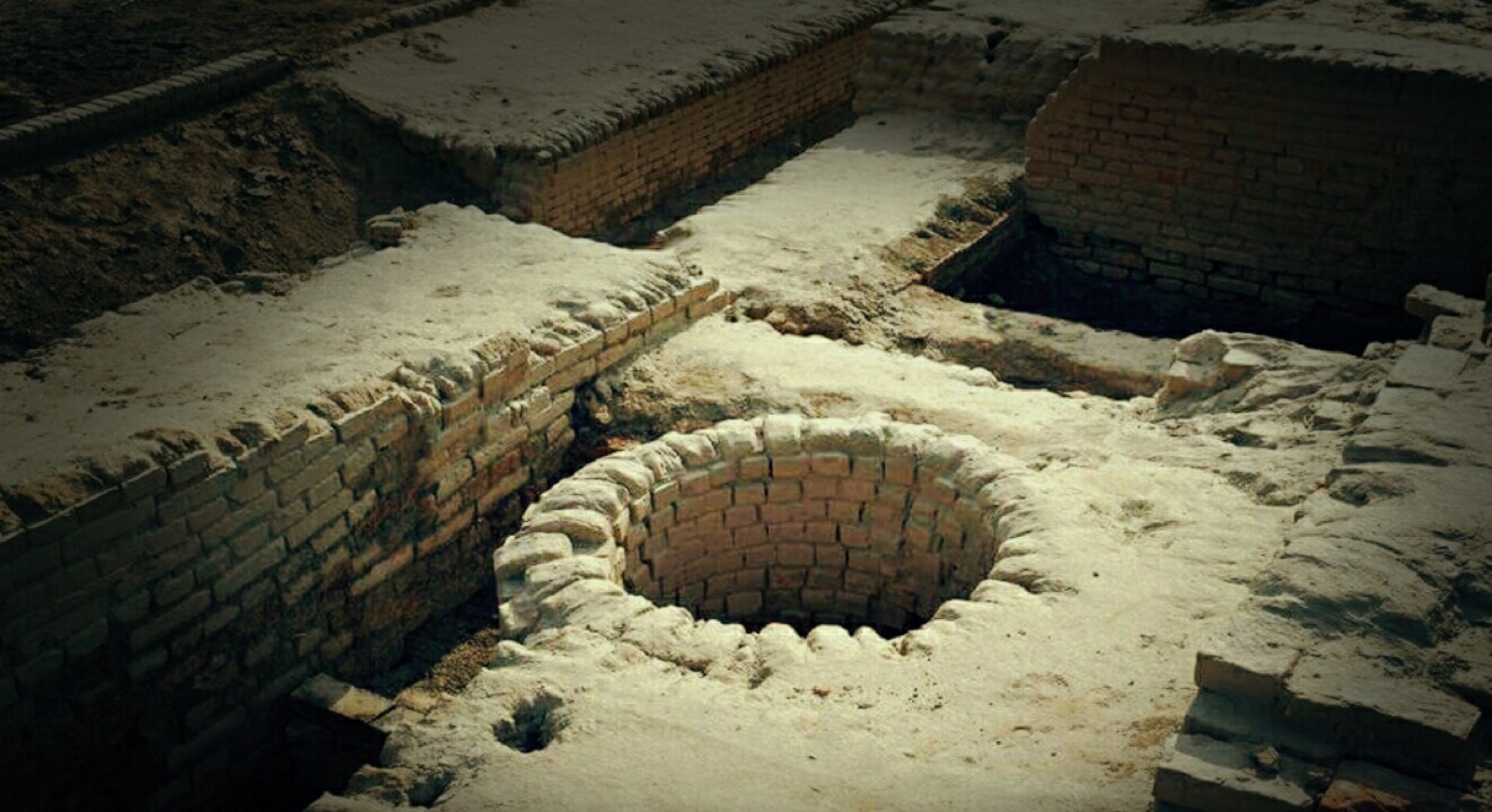
It's reachable today. The site is a short drive from Larkana, has its own small railway station and a nearby airport, and is a UNESCO World Heritage Site open to visitors. Walk its streets and you walk on baked brick laid by hands that had no metal harder than bronze. The scale is quiet and overwhelming at once: block after block of careful masonry, wells at regular intervals, and everywhere those drains — the plumbing of a civilization that seems to have cared, obsessively, about clean water and getting rid of dirty. Household waste ran into channels along the streets, some covered with brick or stone slabs, some feeding into soak pits. The system was maintained, cleared, and built to a shared logic across the whole settlement. Very few ancient cities anywhere thought about sewage at this level of ambition, and the ones that did usually served a temple or a ruler first. Here the concern seems to have been the population at large.
What the Show Claims
To Ancient Aliens and the wider alternative-history world, Mohenjo-daro is a magnet for two very different arguments — and the show has reached for both.
The first is the "too advanced, too suddenly" case. The city appears in the archaeological record already sophisticated: grid streets, standardized weights and measures, mass-produced bricks, and municipal sanitation that Europe would not match for thousands of years. Where, the argument goes, is the messy learning curve? Civilizations are supposed to stumble into cities. This one seems to arrive fully formed, as if the knowledge were handed to it. The standardized weights are a favorite exhibit: small, precisely cut cubes, mostly of chert, following a consistent system of proportion that shows up across Harappan sites. To the show, that kind of uniformity looks less like organic growth and more like a blueprint dropped in from outside — a teacher civilization, or visitors, seeding urban planning into the Bronze Age.
The second claim is darker and stranger, and it's the one Mohenjo-daro is famous for in fringe circles: that the city was destroyed by some kind of ancient catastrophic blast. This idea leans on a handful of skeletons found sprawled in the streets and on scattered mentions of "vitrified" material — stone or brick supposedly fused by intense heat. Writers have tied this to passages in the Sanskrit Mahabharata describing a weapon of blinding light and terrible destruction, arguing that the epic preserves the memory of an ancient nuclear or high-energy event, and that Mohenjo-daro is where it happened. The bodies in the road, in this telling, are people cut down where they stood — victims of a weapon the ancient world should not have possessed. The story has been repeated so often, in so many books and documentaries, that it has taken on the texture of fact, complete with claims of unusually radioactive skeletons and streets scorched by heat.
What Archaeology Says
Start with the discovery, because it reframes everything. Mohenjo-daro was excavated beginning in the 1920s under the Archaeological Survey of India — R.D. Banerji identified the site in 1922, and John Marshall directed the large-scale digs that followed. Later work in the mid-twentieth century, including excavations associated with Mortimer Wheeler, added to the picture, particularly on the Citadel mound. What they uncovered didn't tame the mystery. It sharpened it.
Take the "too advanced, too suddenly" claim. Archaeologists have shown the Harappans didn't spring from nowhere — the civilization grew out of earlier village cultures in the region, like those at Mehrgarh, over thousands of years. Mehrgarh alone documents farming, herding, and settled life in the broader region long before the great cities rose, giving the Harappan achievement a deep local root. But knowing that almost makes it worse. Because the leap to this — a rigorously planned metropolis with unified brick standards and city-wide drainage, replicated at sister cities like Harappa and Dholavira hundreds of kilometers away — implies something we still can't explain: coordination. Standardized bricks and weights across a vast territory suggest a shared authority, an agreed system, some mechanism enforcing uniformity across half a subcontinent. And yet the excavators found no throne, no obvious ruler's residence, no grand tomb. There is no towering temple-mountain as at Ur, no pyramid, no palace complex stuffed with tribute and inscriptions boasting of a king's deeds. A civilization that behaved like it had a powerful central government, while leaving behind none of the monuments central governments obsess over building. That is not a smaller puzzle. It is a genuinely open question in world archaeology.
The catastrophic-blast story fares differently under examination, and it's worth being honest about why. The famous skeletons — sometimes called the "massacre" bodies — were found across different levels and periods, not laid down in a single moment, and later analysis by scholars including George Dales dismantled the idea of a simultaneous slaughter. The remains do not represent one violent afternoon; they accumulated over time and context, and some were simply burials or the debris of a long-inhabited city. There is no confirmed layer of nuclear vitrification, no measured radiation anomaly that the archaeological community accepts, and no scorched stratum marking a single fiery end. The evidence for a Bronze Age superweapon simply isn't there. The Mahabharata connection, meanwhile, links a text composed many centuries later to a city its authors show no sign of having known existed.
But notice what the debunking leaves untouched: nobody actually knows why Mohenjo-daro was abandoned. The leading explanations involve the Indus and its tributaries — shifting river courses, catastrophic flooding, or the drying of the once-mighty Ghaggar-Hakra system, possibly driven by climate change around 1900 BC. The city sat in a floodplain and appears to have been rebuilt over its own earlier levels more than once, raising itself against the water. Recent paleoclimate studies point to a long weakening of the monsoon that could have unraveled Harappan agriculture, thinning the surplus that fed the cities and pushing populations east and toward smaller settlements. These are compelling, well-argued theories. They are also, still, theories. A city of tens of thousands emptied out, and the mechanism remains contested — likely not one dramatic blow but a slow strangling of the conditions that had made it possible.
And then there's the deepest silence of all: the script. The Harappans left thousands of inscribed seals and objects, covered in a writing system used for something like 700 years across the entire civilization. The inscriptions are famously short — often just a few signs, frequently paired with a carved animal like the enigmatic "unicorn" bull — which is part of why they resist decipherment: there is no long bilingual text, no Rosetta Stone, to break them open. It has never been deciphered. Every attempt — and there have been many, some by serious computational linguists — remains unconfirmed. We don't even agree on what language family lies beneath the signs. We have their words. We simply cannot hear them. Whatever they wanted us to know about their kings, their gods, their reason for the drains and the great bath and the endless careful bricks, they wrote it down — and it's sitting in museum cases, mute.
The Verdict
Here is what is genuinely unresolved about Mohenjo-daro, a century after the first shovels went in: we have one of the best-planned cities of the ancient world, and we cannot name a single person who lived in it.
We can date the bricks. We can map the streets to the meter and trace the drains from house to soakpit. We can rule out the ancient nuclear war with a clear conscience. And with all of that, the questions that matter most — who governed this place, why it was abandoned, and what its people were telling one another in that unreadable script — sit almost exactly where they sat in 1922. The catastrophe theory dissolves; the real mysteries do not. If anything, stripping away the superweapon leaves the true strangeness exposed: a disciplined, egalitarian-looking, hyper-organized civilization that ran for seven centuries, built to a shared standard across an empire's worth of land, and then vanished from history so completely that we had to rediscover it, and still can't read its name for itself.
That is the real provocation of Mohenjo-daro, and it needs no aliens to sharpen it. Nearly every other early civilization loudly announced its rulers — carved them into walls, buried them under mountains of gold, wrote their names in stone so we would remember. This one did the opposite. It poured its genius into things a whole population would use: water, sanitation, order, standards. Then it let the river and the changing climate close over it, leaving behind a script that keeps its confidences to this day.
Go stand in the Lower Town if you can — the site is real, reachable, and quietly staggering. Follow a covered drain with your eye until it disappears under the next block, and ask yourself the question Mohenjo-daro has never stopped asking: who built a city this careful, and then left without telling us a single thing we could understand?
Track the ancient sites you've visited on the interactive map.
Free account · mark visited sites · build your bucket list.
Open the tracker