Derinkuyu: The City That Hid Underground
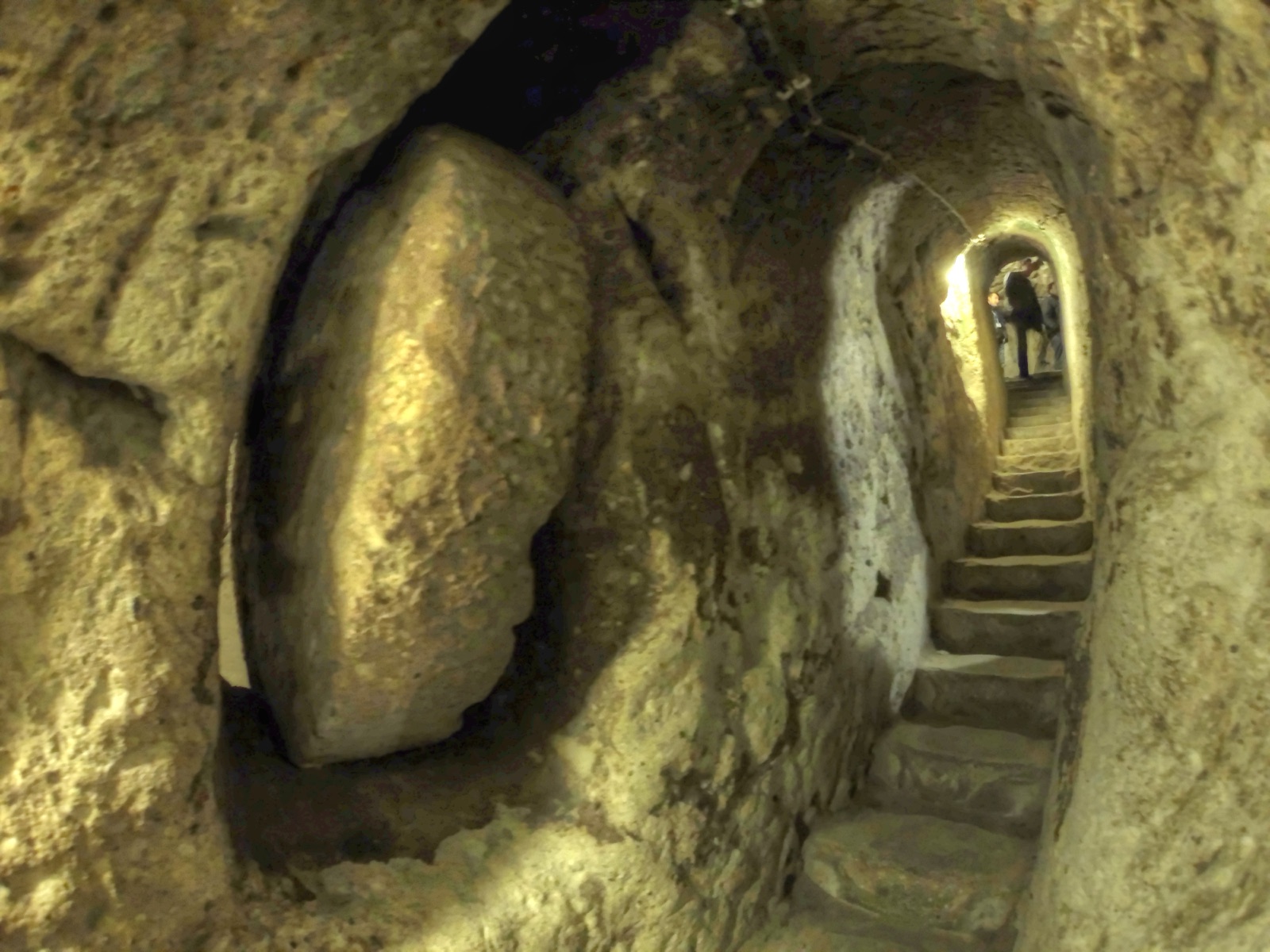
In 1963, a man in the Turkish town of Derinkuyu was renovating his house. He knocked through a wall in his basement and found a passageway. The passageway led down. And down. And down.
What lay behind that wall was an entire underground city: a network of tunnels, chambers, wells, and ventilation shafts descending roughly 85 meters — about 280 feet — into the volcanic rock of Cappadocia. Estimates of its depth run from 13 to 18 levels. At capacity, it could have sheltered something on the order of 20,000 people, along with their livestock, their food stores, their wine presses, and their chapels.
Think about that for a moment. A city the size of a small town — with stables, kitchens, and places of worship — built entirely in the dark, beneath the feet of people who, by 1963, had no idea it was there.
The Place
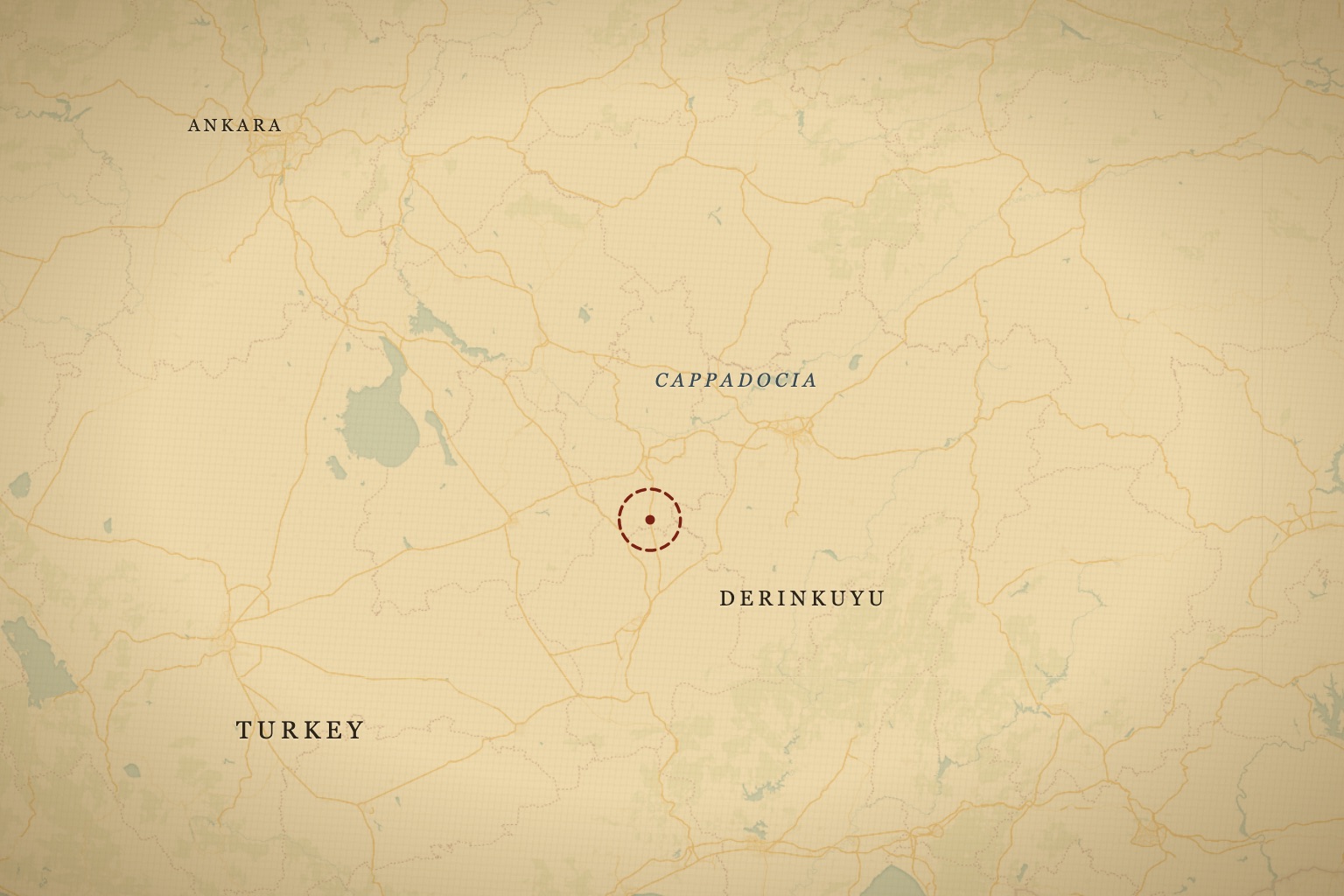
Derinkuyu — the name literally means "deep well" in Turkish — sits in Cappadocia, in central Anatolia, about 30 kilometers from Nevşehir. The region's landscape is made of soft volcanic tuff, laid down by ancient eruptions: rock soft enough to carve with iron hand tools but firm enough to hold a ceiling. Cappadocians have been carving homes, churches, and dovecotes into it for millennia; the region's rock sites were inscribed as a UNESCO World Heritage area in 1985.
The modern town sits on top of its own forgetting. Until the Greco-Turkish population exchange of 1923, this was a community its Greek-speaking Christians knew as Malakopi, and the tunnels below it were not archaeology — they were infrastructure, used within living memory. When that population left in 1923, the knowledge largely left with them. That is how a city large enough to shelter thousands stayed sealed behind a basement wall for forty years, under the feet of a town that walked over it daily.
But Derinkuyu is the extreme case. It is the deepest excavated underground city in Turkey, and it isn't alone — the region contains a couple of hundred known underground settlements of various sizes, dozens of them with multiple levels, and Derinkuyu is said to be linked to its neighbor city of Kaymaklı by a tunnel running several kilometers.
Inside, the engineering is astonishingly deliberate. More than fifty ventilation shafts carry fresh air down to the deepest galleries — the greatest of them descending some 55 meters, doubling as wells that reach the water table without ever opening to the surface, where an enemy could poison them. Narrow stairways force visitors — and would have forced attackers — to move stooped, in single file. And at strategic choke points sit the site's signature feature: massive rolling stone doors, disc-shaped, weighing hundreds of kilograms, that could be rolled shut — from the inside only — with a small hole in the center for the defenders to watch, or strike, through.
The site was opened to the public in 1969, six years after the wall came down. Eight levels are open to visitors today; the rest remain closed or unexcavated below. The tunnels are narrow, the ceilings low, the temperature constantly cool, and even on the lowest open floors the air stays fresh — the ancient shafts still work. It does not feel like architecture. It feels like a held breath.
What the Show Claims
Derinkuyu is one of Ancient Aliens' recurring exhibits, featured most fully in "Underground Aliens" (Season 2, Episode 4) and revisited in later seasons. The show's argument starts from a simple observation that deserves to be taken seriously: everything about Derinkuyu is defensive, and everything about it points down.
The doors seal from within. The wells don't open to the surface. The air shafts are disguised. The entire design assumes an enemy above — one you cannot fight, only hide from. So the show asks: who were they hiding from? One of the show's regular commentators puts the hypothesis on camera directly, suggesting the original caves "may have been used as shelters against possible aerial bombardment from extraterrestrials that were warring with each other during that time."
The show also emphasizes scale and coordination — a 280-foot-deep city with functioning ventilation, it argues, is not something you improvise with hand picks — and points to the tunnel connections between underground cities as evidence of a region-wide refuge system, planned and dug against a threat that history never recorded.
What Archaeology Says
The archaeology of Derinkuyu is genuinely fascinating — and refreshingly human. The soft tuff really can be carved with simple iron tools, and the carving styles show the city was not built in one campaign but expanded over many centuries.
We even have something close to an ancient written witness. Xenophon, marching ten thousand Greek mercenaries home across Anatolia around 400 BCE, describes in the Anabasis villages where the houses were built underground: entrances like the mouth of a well, opening out below into broad chambers where whole families lived through the winter alongside their goats, sheep, cattle, and fowl — the animals brought down by ramps — with stores of grain and a barley wine drunk from great buried jars through reed straws. He was not describing Derinkuyu itself, but he was describing the tradition: alive, ordinary, and already old, twenty-four centuries ago.
When the digging at Derinkuyu actually began is a harder question — and here the honest answer is that the experts disagree, for a wonderful reason: an underground city is nearly impossible to date. Carving rock leaves no organic material to radiocarbon-date; you can date what people dropped, but people were dropping things down there for well over two thousand years. The Turkish Ministry of Culture attributes the earliest excavation to the Phrygians, around the 8th–7th centuries BCE. Some researchers argue for older antecedents still, reaching back toward Hittite-era Anatolia in the second millennium BCE. More cautious scholars counter that little of what a visitor actually walks through can be proven older than the Byzantine centuries, when the complex reached its final, deepest form. This isn't fringe versus mainstream — it's mainstream versus mainstream. The first pick-stroke at Derinkuyu floats somewhere inside a window more than a thousand years wide.
The famous capacity figure deserves the same honesty. The 20,000 number repeated in nearly every account is an extrapolation from floor area and air supply, not a headcount; more conservative estimates run to a few thousand. What nobody disputes is that the systems — the wells, the granaries, the stables, the ventilation — were engineered for a population, not a household.
The city's greatest era came much later. In the Byzantine centuries, Christian communities dramatically expanded Derinkuyu and used it as a refuge during the Arab–Byzantine raids that swept across Anatolia for generations, and later populations sheltered there through subsequent invasions. The chapels, the wine cellars, the mangers cut into the rock — that's them. The threat from above wasn't from the sky; it came on horseback, repeatedly, for centuries. The design makes ruthless sense once you know that.
And unusually for an ancient mystery, we have testimony from the very end of its working life. The Cambridge linguist R. M. Dawkins, who studied the Greek-speaking communities of Cappadocia between 1909 and 1911, recorded that when news of massacres spread in 1909, villagers in the region still fled into their underground chambers — the last documented use of a defensive system that may already have been more than two and a half thousand years old. Fourteen years later, the population exchange emptied the Christian villages, and the memory rolled shut like one of the doors.
But knowing who used it is not the same as knowing everything. The full extent of the complex is still unknown — by some estimates only a fraction has been excavated and opened. The precise construction timeline is still debated, and the deepest origins of the digging tradition in Cappadocia remain genuinely obscure: we can date occupations, but the first hands to cut into the tuff left no record of themselves. New chambers, and even new underground settlements elsewhere in the region, are still being found — most dramatically in 2013, when demolition work for a housing project around the castle hill of nearby Nevşehir broke into yet another underground complex, one that early surveys suggest may rival or even exceed Derinkuyu itself.
The Verdict
Derinkuyu has a documented, human story — and a hole in the middle of it exactly where the beginning should be. We know who sheltered here. We do not really know who started digging, or when, or what first drove people in this one region of the world to answer danger by building downward on a scale found almost nowhere else on Earth.
That instinct is the real mystery. Whole generations were born knowing that when the signal came, the correct response was to descend into the dark and roll the stone shut behind them. Something taught them that. History remembers some of the threats. It may not remember the first one.
Go to Cappadocia and take the stairs down yourself. Eight stories under the earth, in the cool dead air, put your hand on one of those rolling stone doors — sealable only from the inside — and ask the question the show asks, because it's the right question even if you don't like their answer: what were they so afraid of?
Covered On Screen
- The Top Ten Underground WorldsAncient Aliens · S20 E13
Track the 1 site from this post on your map.
Free account · mark visited sites · build your bucket list.
Start tracking