Baalbek's Impossible Stones
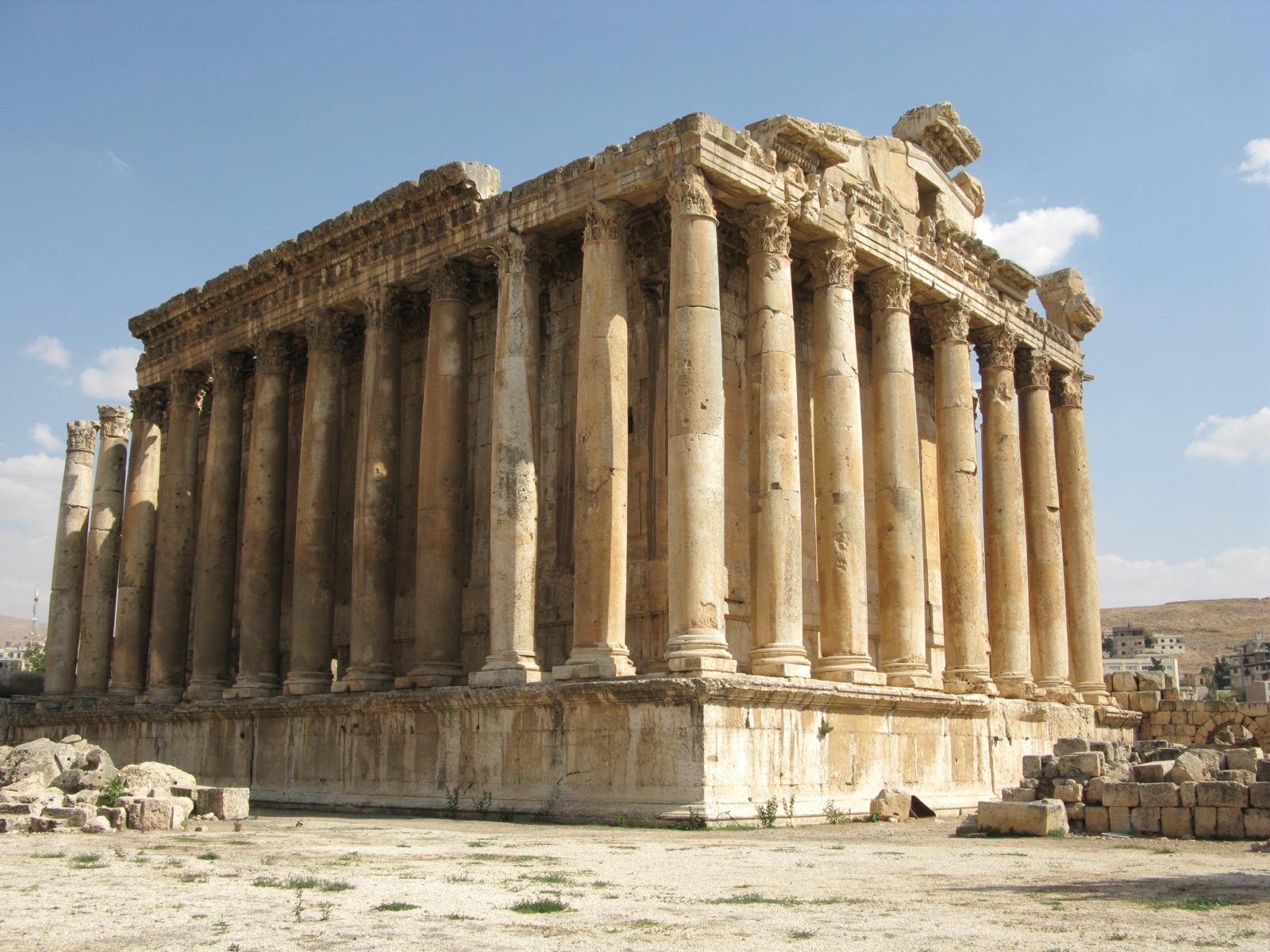
Three limestone blocks sit in the foundation of a Roman temple in the Bekaa Valley of Lebanon. Each one weighs roughly 800 tons. Together they form what's called the Trilithon — three of the largest dressed stones ever incorporated into a building in the history of human construction.
Nearby, still half-buried in its ancient quarry, lies a fourth block. It was never moved. It weighs an estimated 1,200 tons.
Nobody disputes these numbers. The disagreement is about what they mean.
The Place
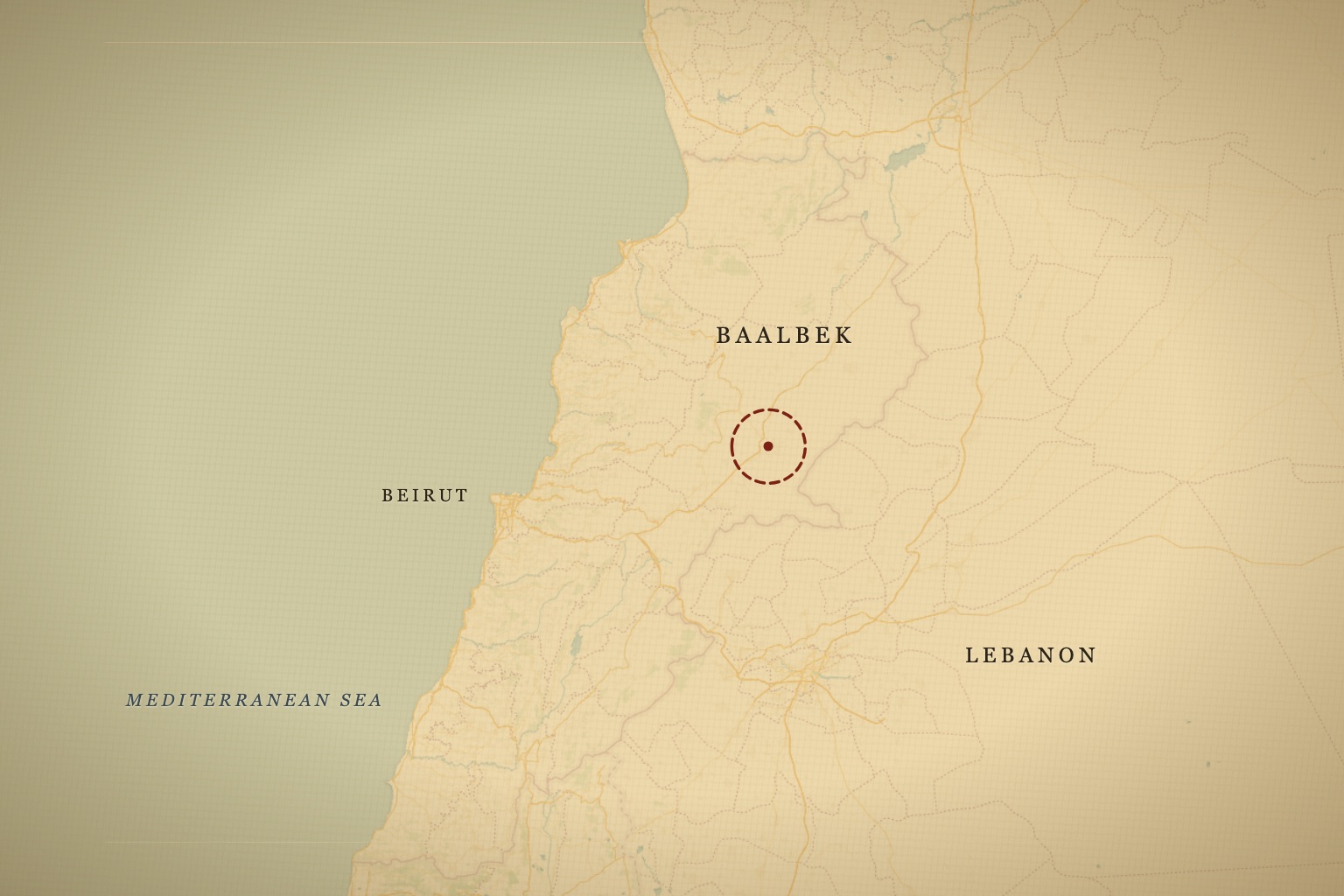
Baalbek sits in the Bekaa Valley of Lebanon, about 85 kilometers northeast of Beirut, at an elevation of around 1,150 meters. The modern city of Baalbek has roughly 80,000 residents. The ancient site — called Heliopolis by the Romans, meaning "City of the Sun" — rises from its center like a stone fortress, the column shafts of its Temple of Jupiter visible from miles away.
The Romans built their great temple complex here beginning in the first century BC and continuing into the third century AD. The Temple of Jupiter Baal was one of the largest religious structures in the Roman world — its columns are 22 meters tall, and six of the original 54 survive, giving the site its most iconic silhouette. Adjacent to it stands the Temple of Bacchus, smaller but better preserved, considered one of the finest Roman temples anywhere.
But before Rome arrived, this was already a sacred site. The Phoenicians worshipped their god Baal here for centuries. The name Baalbek likely derives from that older tradition. What the Romans built on top of — and why they chose to build on top of it — is where things get interesting.
The Trilithon blocks form part of the western foundation wall of the Jupiter temple podium. They are not decorative. They are load-bearing. Each block is approximately 19-21 meters long, 4 meters tall, and 3.6 meters wide, and each weighs between 750 and 880 tons. They were quarried from limestone outcrops about 900 meters from the temple.
What the Show Claims
Ancient Aliens devoted substantial attention to Baalbek in Season 1, and revisited it repeatedly across later seasons, including Season 2, Episode 8, "Unexplained Structures."
The show's primary claim: the Trilithon predates Roman construction. The Romans, the argument goes, simply built their temple on top of a far older megalithic platform that was already in place when they arrived. And whoever built that original platform must have had technology beyond anything we associate with the ancient world.
The supporting evidence the show presents is largely a matter of scale. No Roman-era crane, pulley system, or ramp structure has been archaeologically documented that could handle an 800-ton load. Ancient texts don't describe the technology used to place the Trilithon blocks. The blocks themselves exceed by a significant margin anything the Romans are known to have moved elsewhere in their empire.
The show's theorists argue that a structure capable of landing heavy spacecraft would require exactly this kind of foundation — massive, level, and engineered to bear extraordinary weight. Baalbek, in this interpretation, was not originally a temple. It was a landing pad.
The "Stone of the Pregnant Woman" — the enormous quarried block still lying in its pit about 900 meters from the temple — is presented as evidence that the project was interrupted before completion. Something stopped the work. Whatever was happening at Baalbek, the show argues, it was bigger than any Roman building project.
What Archaeology Says
The German Archaeological Institute has been excavating at Baalbek since 1898, with more recent intensive campaigns focused specifically on the questions the ancient astronaut theorists raise. Archaeologists read the same stones differently — and what they've found makes the site harder to walk away from, not easier.
First, the most controversial premise: is the Trilithon pre-Roman? The current archaeological reading is that it isn't. Excavations place the foundation podium, including the Trilithon, in the Roman construction phase. So far, no separate pre-Roman megalithic platform has turned up beneath the Roman structure. Which means the heaviest dressed stones ever set into a building weren't the leftover bones of some forgotten older world — they were chosen, cut, and moved by people we think we already understand. That's the stranger answer, not the tamer one.
The construction sequence itself has been read stone by stone. Architectural historian Daniel Lohmann, documenting the podium for the German Archaeological Institute's renewed campaigns under Margarete van Ess, has shown that the Trilithon course bonds into the Roman podium's build sequence — part of a colossal first-century enlargement of the temple platform that was, remarkably, never finished. The Trilithon was meant to be invisible: buried inside an even larger completed wall, structural fill behind a facade that never came. The most extraordinary dressed stones in the history of architecture were, by design, never supposed to be seen.
Second, could the Romans move 800-ton blocks? This is genuinely hard, and the honest answer is "probably, but we're not entirely sure how." Roman engineering was capable of feats that genuinely surprise modern observers — they routinely transported obelisks from Egypt to Rome, some weighing over 400 tons. They used elaborate wooden cranes, capstans, rope systems, and — critically — large, organized workforces of thousands. Notice what that gives us, though: a plausible how that still doesn't touch the why, and a block — 1,200 tons in the quarry — that sits well past anything we can confidently say even that crane could lift.
The engineering case has real literature behind it. Vitruvius, writing in the first century BC, describes the Roman crane-and-capstan toolkit in Book 10 of De Architectura, and French architectural historian Jean-Pierre Adam ran the Baalbek numbers in a 1977 study: using multiple capstans, rollers, and levers of the documented Roman type, he calculated that a Trilithon block could be moved by several hundred organized men — slowly, over prepared ground, from a quarry that conveniently sits slightly uphill of the temple, letting gravity do part of the work. Adam's math is widely cited and never quite conclusive; a calculation on paper is not a block in a wall. But it shifted the burden of the argument: the question stopped being whether the physics allows it, and became whether we can find the physical traces of it actually being done.
Archaeologist Jeanine Abdul Massih of Lebanese University has argued that the Romans chose to build big because they could — and because scale conveyed power. The Bekaa Valley was Rome's breadbasket, and Heliopolis was a major regional religious center. An emperor commissioning the largest temple in the empire would want the largest possible foundation stones. It's a real explanation, and it names something true about Rome. Whether it fully accounts for stones this far outside Rome's own habits — or simply gives a familiar motive to something we still haven't seen the Romans do anywhere else — is the question the foundation keeps open.
The "Stone of the Pregnant Woman" — still in its quarry — is now thought to have been abandoned after the Roman project concluded rather than interrupted mid-project. Stone quarrying and shaping continued at the site for centuries. It lies there still: the largest worked stone humans are known to have cut, finished to the edge of moving, and then left in the ground.
Or so everyone thought. In 2014, a German-Lebanese survey team working with Jeanine Abdul Massih and the German Archaeological Institute, excavating beside the Stone of the Pregnant Woman, uncovered a still larger block hidden beneath it: roughly 19.6 meters long and an estimated 1,650 tons — the largest worked stone ever documented anywhere in the ancient world. Its edges are dressed, its sides straightened; it was being prepared for transport when it, too, was abandoned. Whatever ambition drove Baalbek's builders, the quarry records it outrunning even the Trilithon — twice.
The Verdict
Here is what remains genuinely puzzling about Baalbek, even after all the archaeological work: the question of why.
We can accept, cautiously, that Roman engineers could move 800-ton blocks using known ancient techniques. We have partial evidence. But it remains true that no other Roman building project anywhere in the empire uses stones remotely close to this size. In Rome, in Athens, in Carthage, in Alexandria — Roman temples are built from blocks that weigh a few tons, maybe a few dozen. At Baalbek, they used stones twenty to forty times heavier than anything else in their construction portfolio.
Why here? Why these specific stones, at this specific scale, in this specific place?
The most compelling mainstream answer is that it was a regional statement of imperial power at a site that already held enormous local religious significance — Rome building bigger than whatever came before, as it always did. That explanation is reasonable. It's also where the answer stops and the question starts again.
Archaeology has given us better questions here, not final ones. It has, if anything, sharpened the strangeness: it took the easy out — a lost older civilization — off the table, and handed the whole impossible scale back to people we thought we'd already measured. The mainstream explanation works, but it doesn't settle. People made choices at Baalbek — about what to build, and how unthinkably large to build it — that fall outside everything else they ever did. And one of their stones is still lying in the quarry, finished and unmoved, because something we can't name decided that was far enough.
Whether those choices were made by Rome, by someone before Rome, or by someone we haven't yet identified, the stones themselves demand something from you when you stand next to them. They're there. They exist. And they are, by any reasonable measure, extraordinary.
Go if you can. The valley air is cool and the site is walkable. Six columns still stand against the Lebanese sky. Go stand under them, next to stones nobody has fully explained, and let the place ask you its question directly: why here?
Track the 1 site from this post on your map.
Free account · mark visited sites · build your bucket list.
Start tracking