The Mystery of Angkor Wat
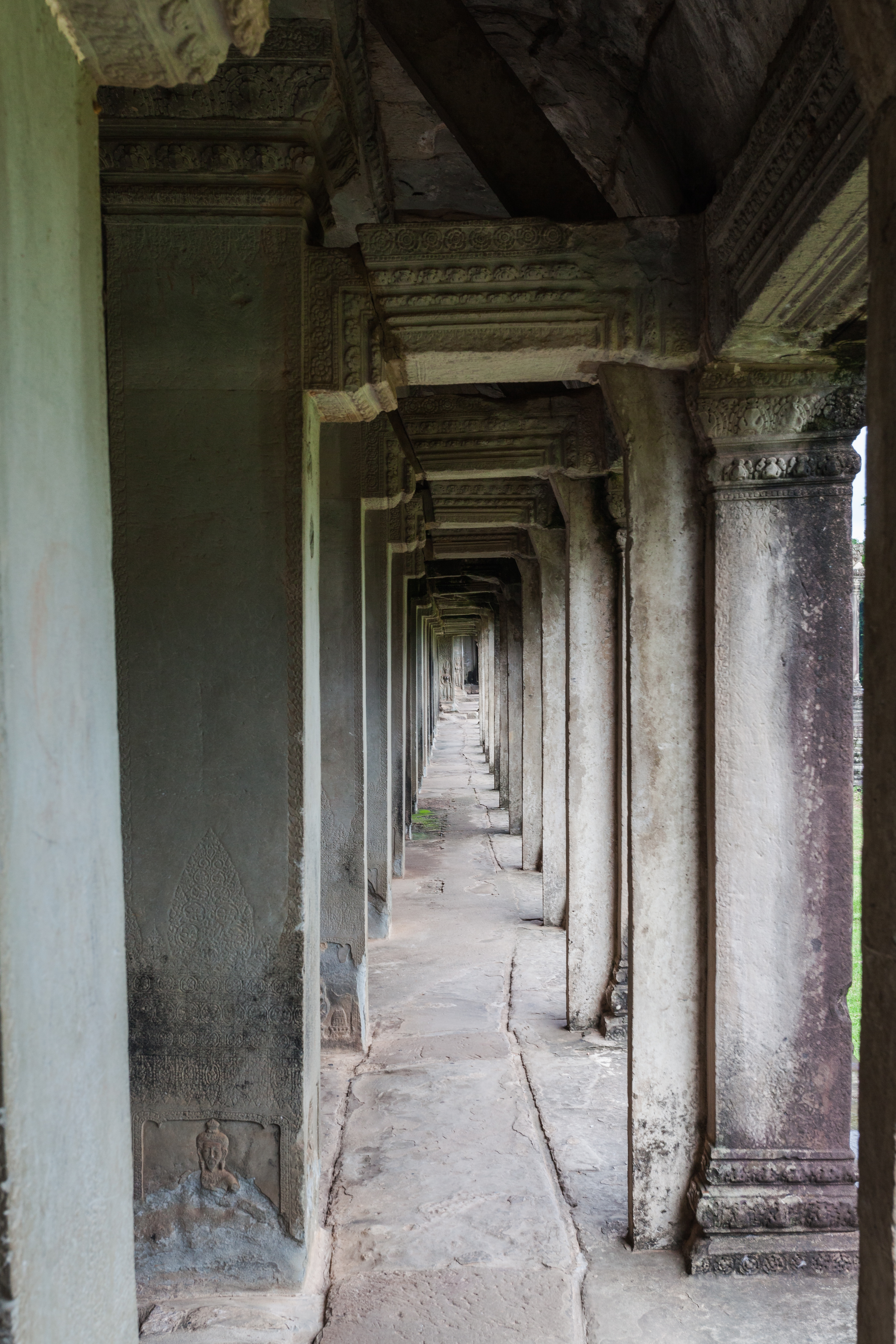
The central towers of Angkor Wat rise about 65 meters above the Cambodian plain — a stack of sandstone shaped like a lotus bud, or a mountain, depending on who you ask. To build them, the Khmer moved somewhere between five and ten million blocks of sandstone, some weighing more than a ton and a half, from a quarry at the foot of a mountain roughly 50 kilometers to the northeast. They floated them, dragged them, lifted them, and fitted them together so tightly that in many places you cannot slide a knife blade between two stones. There is no mortar. The blocks simply hold.
And here is the detail that keeps historians up at night: they seem to have done nearly all of it in about thirty to forty years, during the reign of a single king, without leaving behind a single foundation inscription that says how. The largest religious monument on the planet, and its builders left us its gods, its kings, and its wars carved across acres of wall — but almost nothing about the engineering that raised it.
The Site
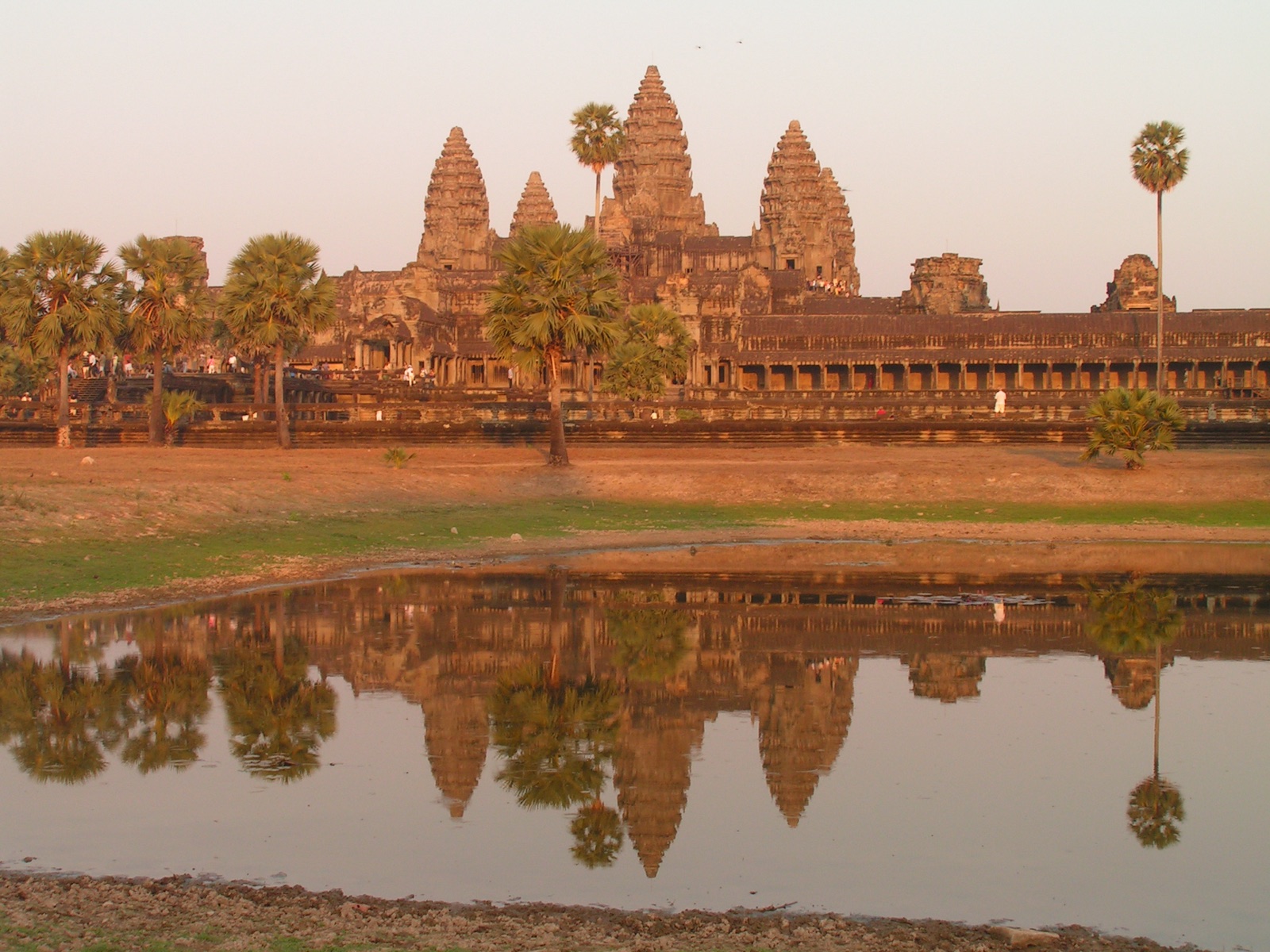
Angkor Wat sits just north of the modern town of Siem Reap in northwestern Cambodia, on the flat, hot floodplain above the Tonlé Sap, the great lake that swells and shrinks with the monsoon. It is one temple within Angkor, the sprawling capital of the Khmer Empire — a city that at its height may have supported close to a million people across roughly a thousand square kilometers, making it one of the largest pre-industrial urban complexes ever mapped.
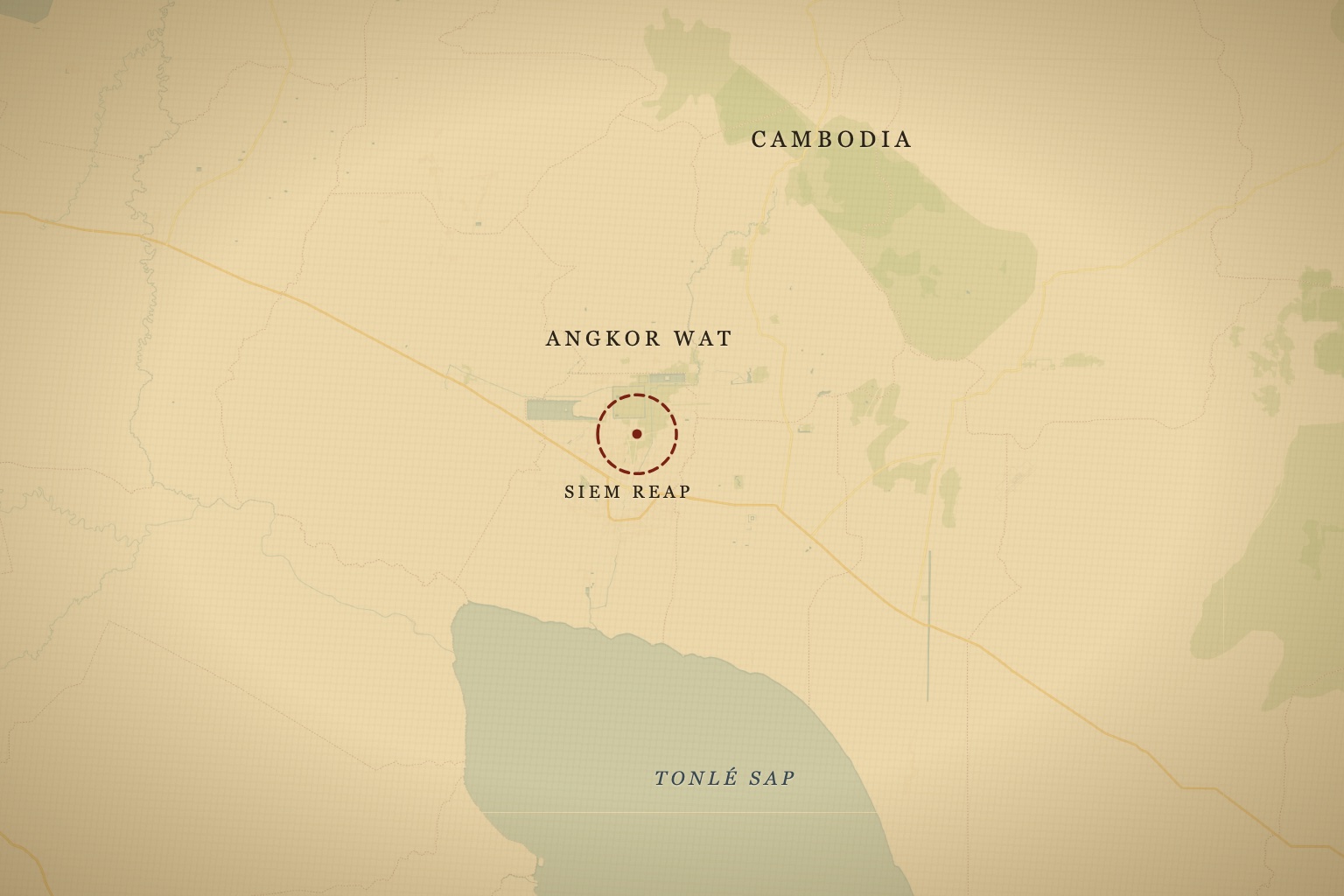
The temple itself is enormous. A rectangular moat, about 190 meters wide and more than five kilometers around, frames a walled enclosure of nearly 200 hectares. Inside, causeways lead across the water to a raised terrace, then up through galleries to the central quincunx of five towers. The whole thing is oriented to face west — unusual for a Khmer temple, and one of the small strangenesses that has fed centuries of speculation.
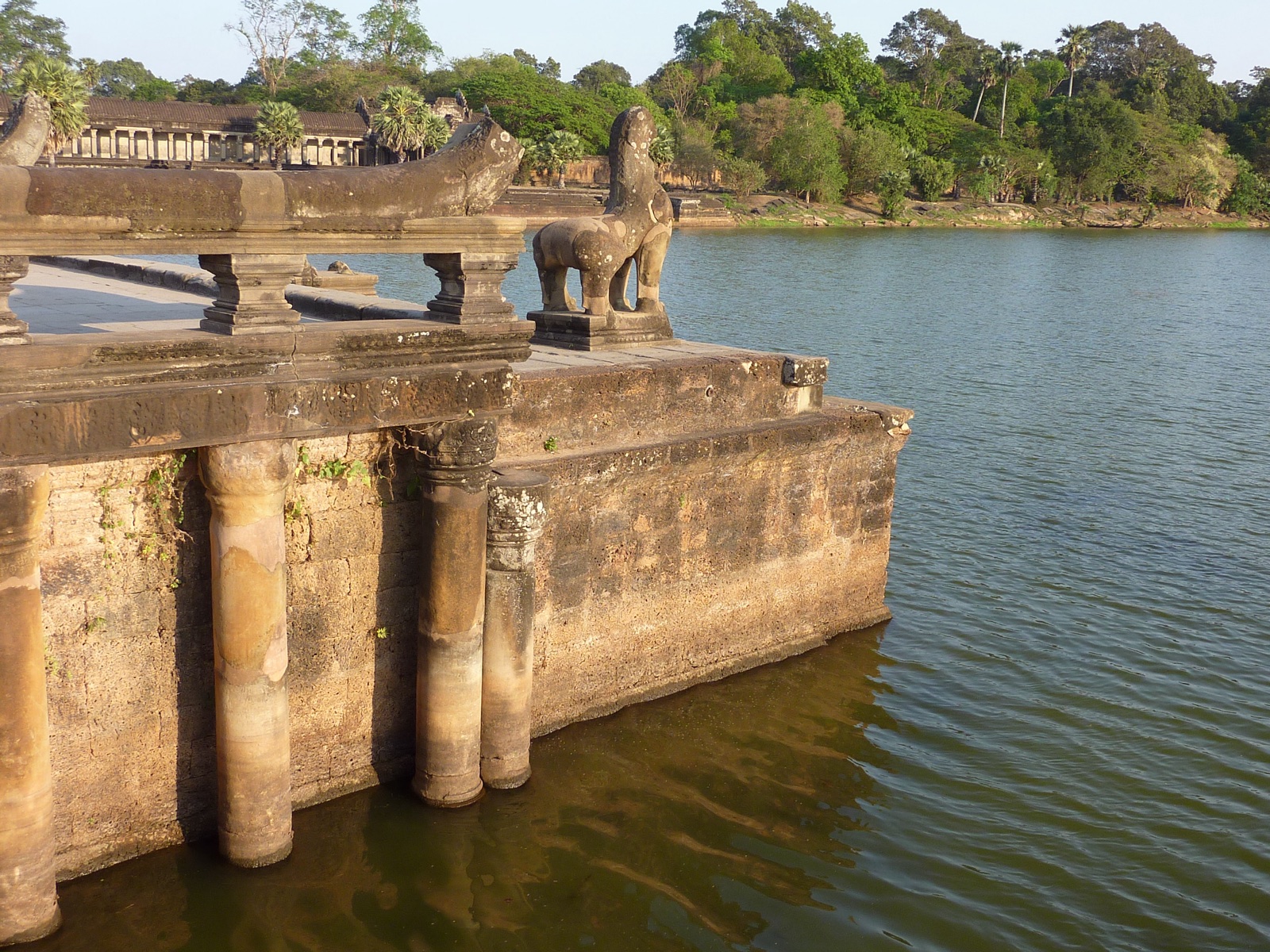
It was built beginning in the early 12th century under King Suryavarman II, who ruled from around 1113 to about 1150. Originally it was dedicated to Vishnu, the Hindu god of preservation — Angkor Wat is a temple-mountain, a scale model of Mount Meru, the home of the gods. Over later centuries, as the empire's faith shifted, it was gradually converted to Buddhist use, and it has remained an active place of worship almost continuously ever since. You can walk it today. It is reachable, well-preserved, and staggering at any hour — though locals will tell you to arrive before dawn, when the towers appear black against a lightening sky and their reflection sits perfectly in the moat.
What the Show Claims
To Ancient Aliens and the wider lost-history community, Angkor Wat is irresistible — not because it looks alien, but because the scale, the speed, and the precision seem to outrun the tools we credit to the people who built it.
The argument usually starts with the numbers. Millions of blocks, a mountain-sized quarry 50 kilometers off, a monument the size of a small city, and a construction window measured in a few decades. The show frames this as a logistical impossibility for a Bronze-Age-tier workforce with no draft animals suited to the terrain, no iron cranes, and no written playbook. How, the reasoning goes, do you cut, transport, lift, and fit that much stone that fast — and that accurately — without machinery we'd recognize?
Then there's the astronomy. Researchers have long noted that Angkor Wat is riddled with astronomical alignments. On the spring equinox, the sun rises directly over the central tower as seen from the western causeway. Scholars like Eleanor Mannikka have argued that the temple's very measurements encode calendrical and cosmological numbers — the lengths of its axes matching the lengths of the great cycles of Hindu time, the yugas. To the show, this precision points to knowledge that seems too advanced, too deliberate, to have emerged from ordinary trial and error.
And finally there are the carvings that skeptics love: the famous "stegosaur" at the nearby temple of Ta Prohm, a small relief that some insist depicts a dinosaur — evidence, the argument suggests, of knowledge the Khmer shouldn't have had, or of contact with something older and stranger than the archaeological record allows.
What Archaeology Says
Here is where the story is supposed to get smaller. It doesn't — it gets more astonishing, because archaeology has actually been answering the "how" questions, and the answers make the achievement more impressive, not less.
Take the transport problem. In 2012, a team led by Etsuo Uchida of Waseda University surveyed the quarries at the base of Phnom Kulen and found something unexpected: a network of canals and roads that appear to have carried sandstone not the long way around the Tonlé Sap floodplain, as had been assumed, but along a much more direct route of roughly 35 kilometers via a canal system feeding toward the site. The Khmer weren't fighting the landscape — they were engineering it, moving mountains of stone across a hydraulic network they had built themselves. That's not a workaround. That's civil engineering on a scale that makes the whole thing more remarkable.
And the broader Khmer genius for water has come into sharper focus through remote sensing. Beginning in 2012, airborne lidar surveys led by Damian Evans and the Khmer Archaeology Lidar Consortium stripped away the jungle canopy and revealed that Angkor was laced with an immense grid of reservoirs (the great barays), canals, dikes, and field systems — an entire managed waterscape. The empire that raised Angkor Wat was, above all, a civilization that mastered water in a monsoon climate. That mastery is almost certainly what let them feed the labor force and float the stone in the first place.
The astronomy, meanwhile, is real — and better documented than the show even needs it to be. The equinox sunrise alignment is well established, and Mannikka's measurement studies genuinely argue that the temple's dimensions encode cosmological cycles. But notice what that does. It doesn't require a lost teacher. It shows a culture with sophisticated, native traditions of astronomy and sacred geometry, deliberately building the structure of time and the cosmos into stone. That's stranger and more beautiful than a borrowed blueprint.
As for the "stegosaur" at Ta Prohm — most scholars read the little carving as a boar or a chameleon framed by decorative foliage, part of a wall of many similar animal medallions, and the "plates" as ornamental leaf shapes. It's a genuinely fun puzzle, and worth seeing with your own eyes. But it's a footnote against the real mystery, which the excavations keep circling without ever fully closing.
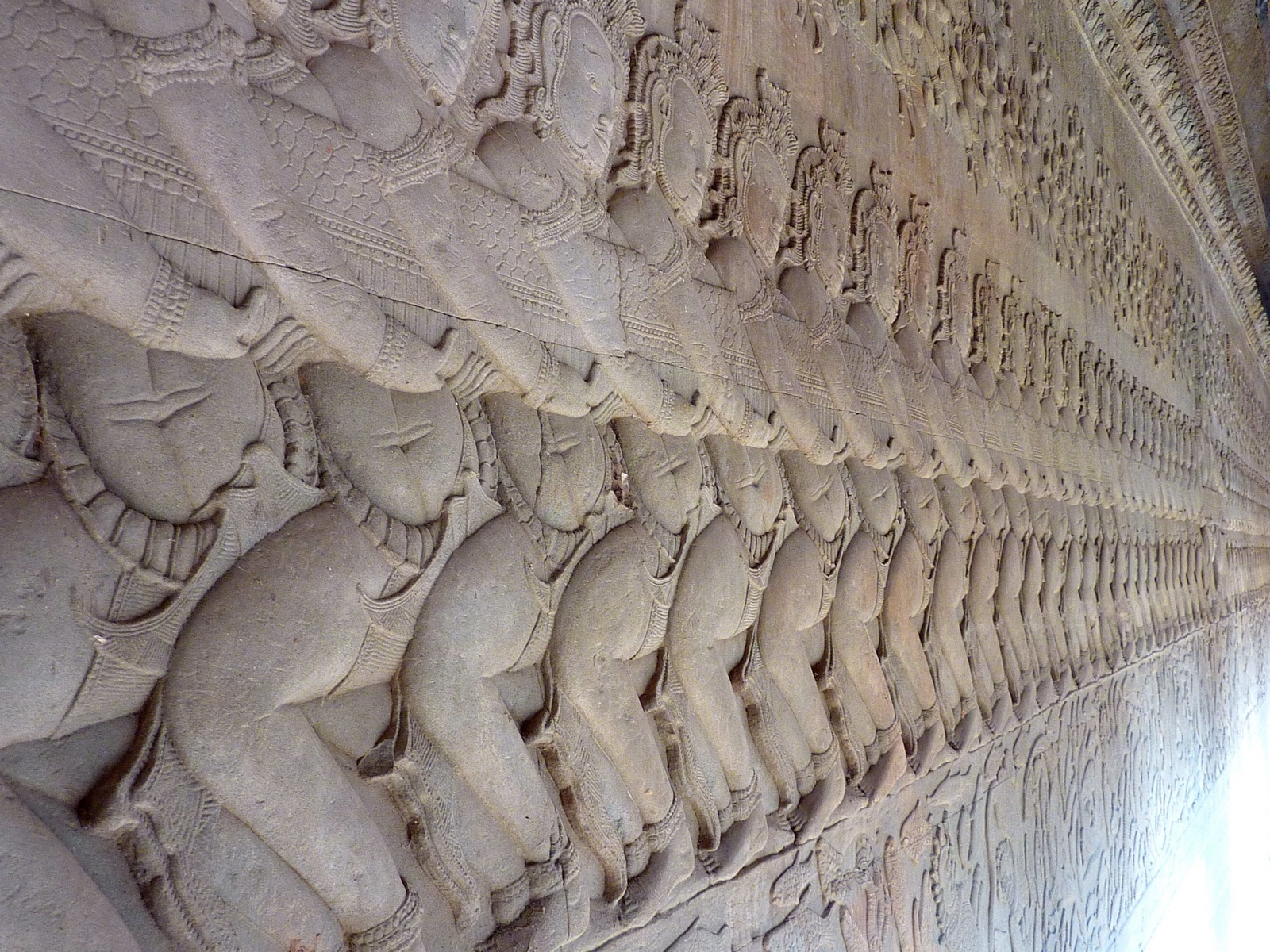
Because here is the thread that stays open: we still don't have the builders' own account of the construction of Angkor Wat. Suryavarman II left extensive bas-reliefs — his armies, his court, the churning of the cosmic ocean stretched across 49 meters of gallery wall — but no foundation stele describing the temple's making, no ledger of the workforce, no engineer's record. We can reverse-engineer the how from canals and quarries and tool marks. What we cannot yet do is read it in their words.
The Verdict
What's genuinely unresolved about Angkor Wat isn't whether humans built it — they demonstrably did, and we can trace the quarries, the canals, the reign that ordered it. The unresolved thing is quieter and harder to shake: how a single kingdom, in a single lifetime, marshaled the labor, the food, the water, and the sheer organizational will to raise the largest religious structure on Earth — and then declined to explain it.
Archaeology hasn't dissolved that. It has deepened it. Every survey that reveals another canal, another buried reservoir, another quarry road makes the ambition more comprehensible and the silence more conspicuous. We know how they moved the stone. We're still working out how they organized a society capable of wanting to, at that pace, in that heat, and then let the doing pass into the reflection in the moat without a word of instruction to the future.
Go, if you can. Stand on the western causeway before dawn and watch the sun climb the central tower, exactly where the builders meant it to. Put your hand against a joint so tight no blade will pass, and ask the question Angkor keeps asking: not could they have done this — they clearly did — but how did they hold an entire empire steady long enough to build a mountain, and why did they leave the mountain to tell the story for them?
Covered On Screen
- Aliens and DinosaursAncient Aliens · S4 E10
Track the ancient sites you've visited on the interactive map.
Free account · mark visited sites · build your bucket list.
Open the tracker