Ancient Mystery Sites You Can Visit in Peru
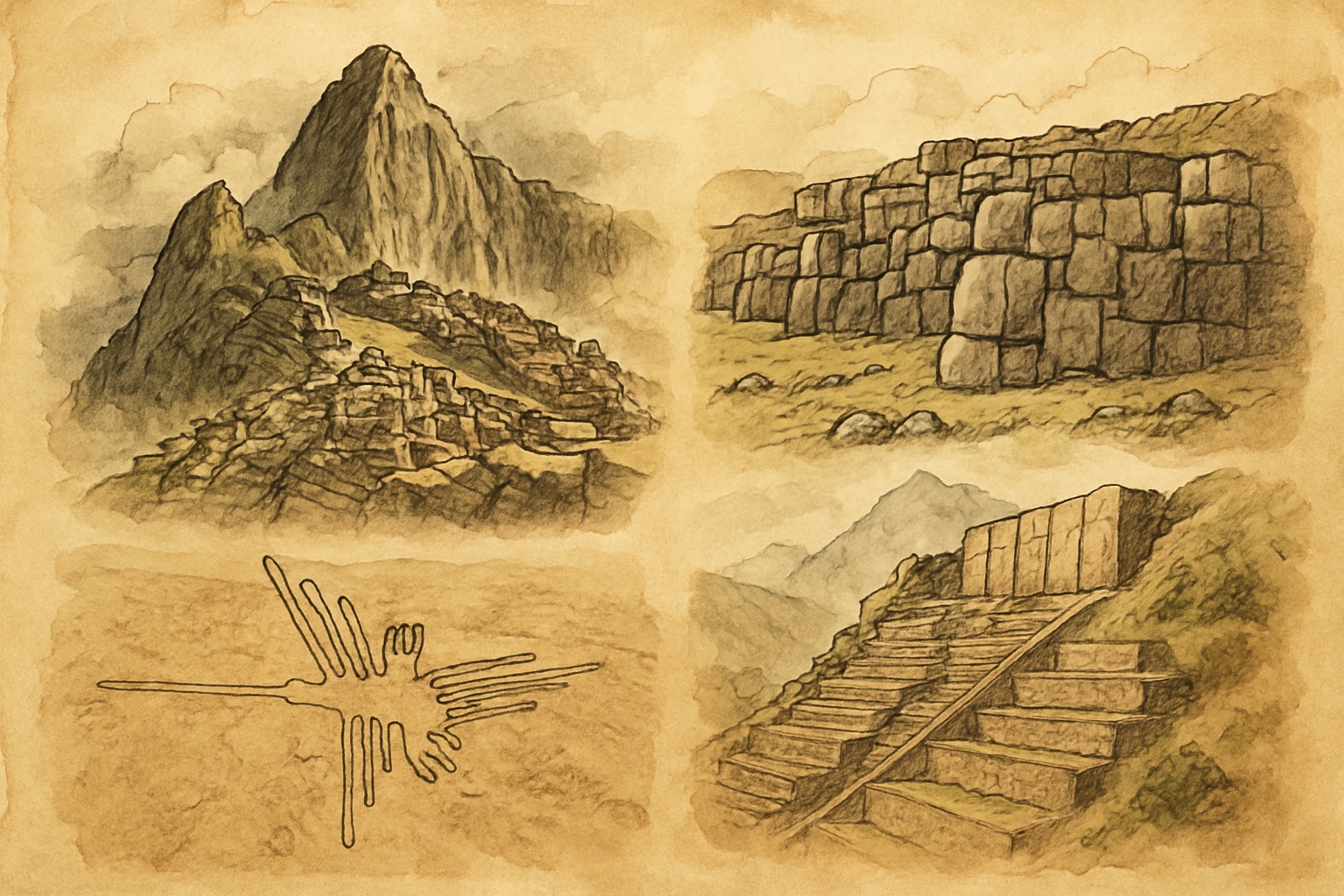
Peru is, by any reasonable measure, one of the great archaeological destinations on Earth — and one of its most haunting. In a country the size of Alaska, you'll find geoglyphs that resolve into spiders and hummingbirds only from the air, mortarless stone walls that have outlasted everything Spain built, a doorway carved from solid rock that opens onto nothing, and a high-altitude plateau covered in formations that seem to stare back at you. Ancient Aliens has used Peru as a backdrop across dozens of episodes — and for once, the show undersells it.
Here are six sites featured in the series that you can actually visit — including how to get there and what you'll find when you do.
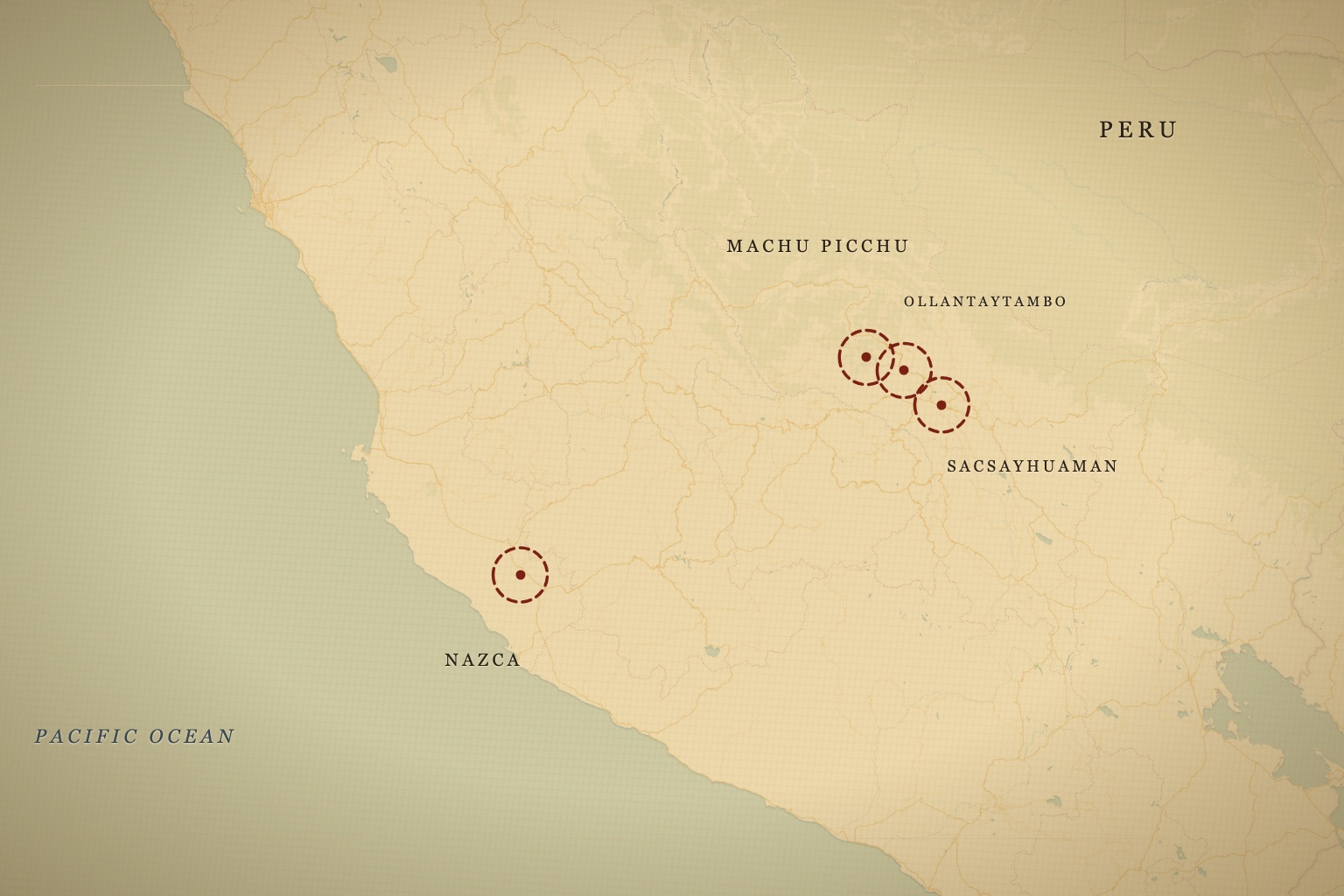
1. The Nazca Lines **Country:** Peru | **Region:** Ica Desert, southern coast | **Elevation:** ~400 meters
The Nazca Lines are a collection of over 800 straight lines, 300 geometric figures, and 70 animal and plant geoglyphs etched into the desert floor of southern Peru — the largest concentration of geoglyphs in the world. Created by the Nazca culture between 500 BC and 500 AD, they cover an area of roughly 500 square kilometers.
Ancient Aliens (Season 1, Episode 1; Season 5, Episode 8) presents them as landing strips or signals for alien spacecraft — the argument being that figures visible only from altitude must have been intended for observers in the sky. We know more than that now, and what we know is almost stranger: the lines are visible from nearby hillsides too, and the technique — removing iron-oxide pebbles to expose lighter soil — needed only organized groups, sighting poles, and measuring cords. No altitude required. Which means people who never once saw their own work whole still committed to drawing it at the scale of a city.
And the deepest question is still wide open: why? A long-repeated (and scientifically contested) claim holds that the spider geoglyph depicts the reproductive organ of a rare Amazonian spider not native to the coastal desert — which, if true, would mean someone crossed between ecosystems to study this creature closely enough to render it at landscape scale, in a form no human eye on the ground could ever take in. That's not a riddle the desert has given up. It's one of the great unanswered "why"s of the ancient world.
Getting there: Fly or take a bus to the city of Nazca (6-7 hours from Lima). Scenic flights over the lines depart from Nazca airport; book in advance, especially in peak season. Ground-level observation towers along the Pan-American Highway give a limited but free view.
Best time to visit: May through September (dry season) for clearest flying conditions.
2. Machu Picchu **Country:** Peru | **Region:** Cusco, Sacred Valley | **Elevation:** 2,430 meters
The Inca citadel built by Emperor Pachacuti in the mid-15th century is Peru's most-visited archaeological site — and the moment you see it clinging to its ridge between the peaks, you understand why. The mortar-free stonework, the terraced agriculture, the water management system, and the mountain setting combine into something that feels less built than grown out of the rock. There is genuinely nowhere else like it.
Ancient Aliens (Season 17) focuses on the precision stonework (argued to require alien tools), GPR anomalies beneath the site (suggested as hidden chambers), and the Intihuatana stone (presented as an alien astronomical instrument). Here the truth is, if anything, more impressive than the legend: the precision comes from the Inca grinding technique, the GPR anomalies match drainage channels and buried walls, and the Intihuatana is a documented solar calendar — meaning these builders read the sky well enough to carve it into stone. That they did all of this by hand, at this altitude, on this knife-edge of mountain, is the real marvel.
And one question still hangs over the whole place: why was it abandoned? Machu Picchu was left, completely intact, sometime after 1532. No looting, no destruction. It simply emptied — a city the world forgot until it was stumbled back into, and one that has never fully explained why its people walked away.
Getting there: Train from Cusco (or nearby Ollantaytambo) to Aguas Calientes, then bus or hike up to the site. Entry tickets are timed and sell out weeks in advance — book well ahead. The classic Inca Trail hike takes 4 days; permits are limited and should be booked months in advance.
Best time to visit: May through September. April and October offer good weather with smaller crowds.
3. Sacsayhuaman **Country:** Peru | **Region:** Cusco | **Elevation:** 3,701 meters
Just a short uphill walk (or taxi ride) from Cusco's Plaza de Armas, Sacsayhuaman is Machu Picchu's less-visited but arguably more physically staggering sibling. Its three parallel zigzag walls are built from limestone blocks weighing up to 100 tons, fitted together without mortar so tightly you cannot slip a blade between them. The largest block is estimated at 125 tons. Stand at the base of those walls and the question is involuntary: how?
Ancient Aliens (Seasons 3 and 17) claims the stones appear "softened" or "melted" and that the construction required alien energy technology. The documented answer doesn't make the walls smaller — it makes them more astonishing. Archaeological documentation, including Spanish colonial chronicles, describes the Inca methods in considerable detail: quarrying, shaping with stone and bronze tools, transport on log rollers, and placement using ropes and levers by large organized labor forces. Picture the human scale of that — thousands of people moving 125-ton stones across the mountains by muscle and rope, and seating them with a tolerance modern masons would envy. The aliens would have been the easy explanation.
The zigzag design apparently represented the teeth of a puma — the overall plan of Cusco was laid out to resemble this sacred animal, with Sacsayhuaman as its head. You can still trace the shape on a map, a whole city built as a sleeping cat, which tells you these were people who thought at the scale of the gods.
Getting there: 20-minute walk uphill from Cusco's Plaza de Armas, or a short taxi. Included in the Boleto Turístico de Cusco (the regional tourist pass), which also covers several other sites.
Best time to visit: Year-round accessible. The Inti Raymi (Festival of the Sun) celebration here in June is spectacular but extremely crowded.
4. Ollantaytambo **Country:** Peru | **Region:** Sacred Valley | **Elevation:** 2,792 meters
Ollantaytambo is a living Inca town — people still inhabit the original stone buildings on the original street grid — with a spectacular fortress and temple complex rising above it. The Wall of Six Monoliths at the Temple of the Sun comprises enormous pink granite blocks hauled from a quarry across the Urubamba River valley. The transport route is still there, littered with abandoned stones the builders never quite delivered — a moment of ancient labor frozen mid-stride, which you can walk today.
Ancient Aliens (Season 3) highlights the transport logistics and claims the stone bosses visible on some blocks are remnants of anti-gravity lifting mechanisms. The real story is written into the route itself: the bosses are rope-attachment points, a standard Inca construction feature, and the unfinished blocks lying along the path confirm it. There's something more moving in that evidence than in any anti-gravity beam — these were people hauling mountains across a river valley by rope and will, and you can still see exactly where they set one down and never came back for it.
Ollantaytambo also functions as the gateway to Machu Picchu for the Inca Trail hike. Spend a night in the town itself; the evening views of the fortress lit by the Andean dusk are worth the detour.
Getting there: 90 minutes by road or 90 minutes by train from Cusco. The town is compact and walkable; the fortress requires a short uphill climb. Entry included in the Boleto Turístico de Cusco.
Best time to visit: May through September, though the site is open year-round.
5. Aramu Muru (Gate of the Gods) **Country:** Peru | **Region:** Puno, Lake Titicaca | **Elevation:** ~3,850 meters
Aramu Muru is a T-shaped doorway carved from solid red sandstone in a remote mountain face near Lake Titicaca. It measures 7 meters high by 6.7 meters wide and leads nowhere — a door cut into living rock that opens onto more rock. Local Quechua tradition holds that Inca priests used a golden disk to activate it as a gateway to the land of the gods, and standing in front of it, you can feel exactly why someone would tell that story.
Ancient Aliens (Season 14) presents it as a stargate or interdimensional portal. The honest history is more grounded but no less intriguing: the T-shaped form is a recurring Andean architectural motif, appearing at Tiwanaku, Puma Punku, and other sites across the region — a doorway form with deep regional meaning rather than portal technology. And the golden-disk legends, it turns out, were largely popularized in the 1990s rather than carried down from pre-colonial times. Which leaves the older, quieter mystery untouched: someone carved a full doorway into a cliff that goes nowhere, and we still don't fully know what it was for.
What makes Aramu Muru worth the journey is that the place itself does the convincing. It's remote — reaching it requires a vehicle and a guide — and the landscape around it, high Altiplano grassland dropping to the glittering blue of Lake Titicaca, is among the most powerful in the Andes. The doorway in its rock face does something to you that's hard to explain with either aliens or geology.
Getting there: Approximately 35 kilometers from Puno, in the district of Juli. Requires a sturdy vehicle and guide; rough mountain roads. No formal visitor infrastructure; arrange through a tour operator in Puno.
Best time to visit: May through September (dry season). Roads can be impassable after heavy rains.
6. Marcahuasi Plateau **Country:** Peru | **Region:** Lima Region, Andes | **Elevation:** ~4,000 meters
Marcahuasi is a plateau east of Lima covered with enormous granite boulders, shaped over millennia of wind and water into formations that seem to depict human faces, animals, and figures from different continents. Researcher Daniel Ruzo popularized the idea in the 1950s that these were deliberately carved by an advanced civilization — and once you've stood among them, you understand how a careful person could come to believe it.
Ancient Aliens (in its early "Mysterious Places" episode, 2010) treats Marcahuasi as evidence of a pre-Columbian global civilization, pointing to faces that resemble African, Asian, and Andean features. The geological reading is more sober — natural erosion plus pareidolia, the human instinct to find faces in random shapes — and no tool marks or associated artifacts have turned up to suggest a chisel ever touched them. But that explanation opens a stranger door than it closes: why does this one plateau, out of all the eroded rock on Earth, so insistently throw human faces back at us? The mystery here isn't who carved the stones. It's what it means that we cannot stop seeing ourselves in them.
This is genuinely one of the stranger places in Peru. At 13,000 feet, in a landscape of eroded stone and high-altitude grass, the formations are dramatic and disorienting. The question of where the line falls between the rock and the eye — between what's out there and what we bring to it — is one you'll be turning over long after you leave.
Getting there: Village of San Pedro de Casta is the base (about 80 km northeast of Lima). From the village, a multi-hour hike or mule trek reaches the plateau. Allow 2 days minimum; camping or village accommodation required.
Best time to visit: May through September. Weather at 4,000 meters is unpredictable — be prepared for cold and rapid changes.
Planning Your Trip
The natural base for most of these sites is Cusco for the Sacred Valley sites (Machu Picchu, Sacsayhuaman, Ollantaytambo) and Puno or La Paz for the Lake Titicaca sites (Aramu Muru). Nazca sits on the coast between Lima and Cusco. Marcahuasi is a separate day trip from Lima.
Allow at least two weeks if you want to do the Sacred Valley sites justice and add Nazca. The altitude affects most visitors — spend your first day in Cusco acclimatizing, not climbing ruins.
What ties these six places together isn't a single secret waiting to be cracked. It's that each one leaves you standing in front of something — a spider drawn for no eye on the ground, a 125-ton wall fitted without mortar, a city abandoned intact, a doorway into solid rock, a plateau of faces — and quietly insisting there is more to the story. The honest answers we do have don't shrink that feeling; they sharpen it, because the people who made these things turn out to be the real wonder. The altitude is real, the sites are worth it, and the questions they raise will follow you home — and stay there.
Covered On Screen
- The Lost City of PeruAncient Aliens · S17 E1
Track the 6 sites from this post on your map.
Free account · mark visited sites · build your bucket list.
Start tracking