5 South American Sites That Defy Explanation
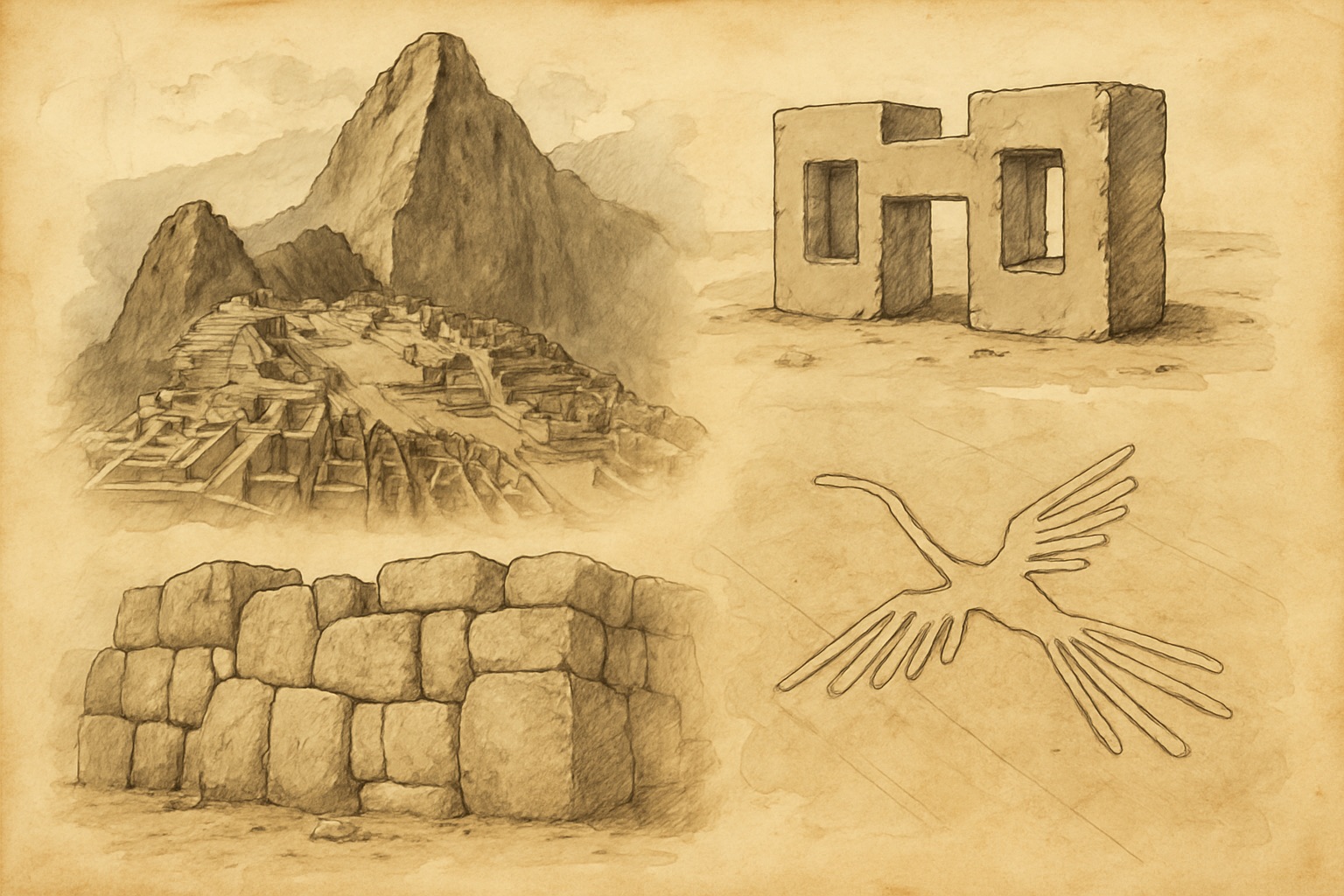
The Andes are home to some of the most improbable engineering in human history. The civilizations that rose and fell across this mountain spine — the Tiwanaku, the Wari, the Inca, and the cultures that preceded them all — built in stone at altitudes where the air is thin and the labor brutal. They had no iron tools, no wheeled vehicles, no draft animals capable of hauling multi-ton blocks. They had rope, wood, human muscle, and a level of organizational genius that still catches archaeologists off guard.
These five sites are the ones that Ancient Aliens keeps returning to — and you can feel why. Each one stops you mid-sentence and demands that you account for it. Stand in front of any of them and the easy explanations start to feel a little thin. Let's take the questions as seriously as the stones deserve.
1. Tiwanaku — Bolivia
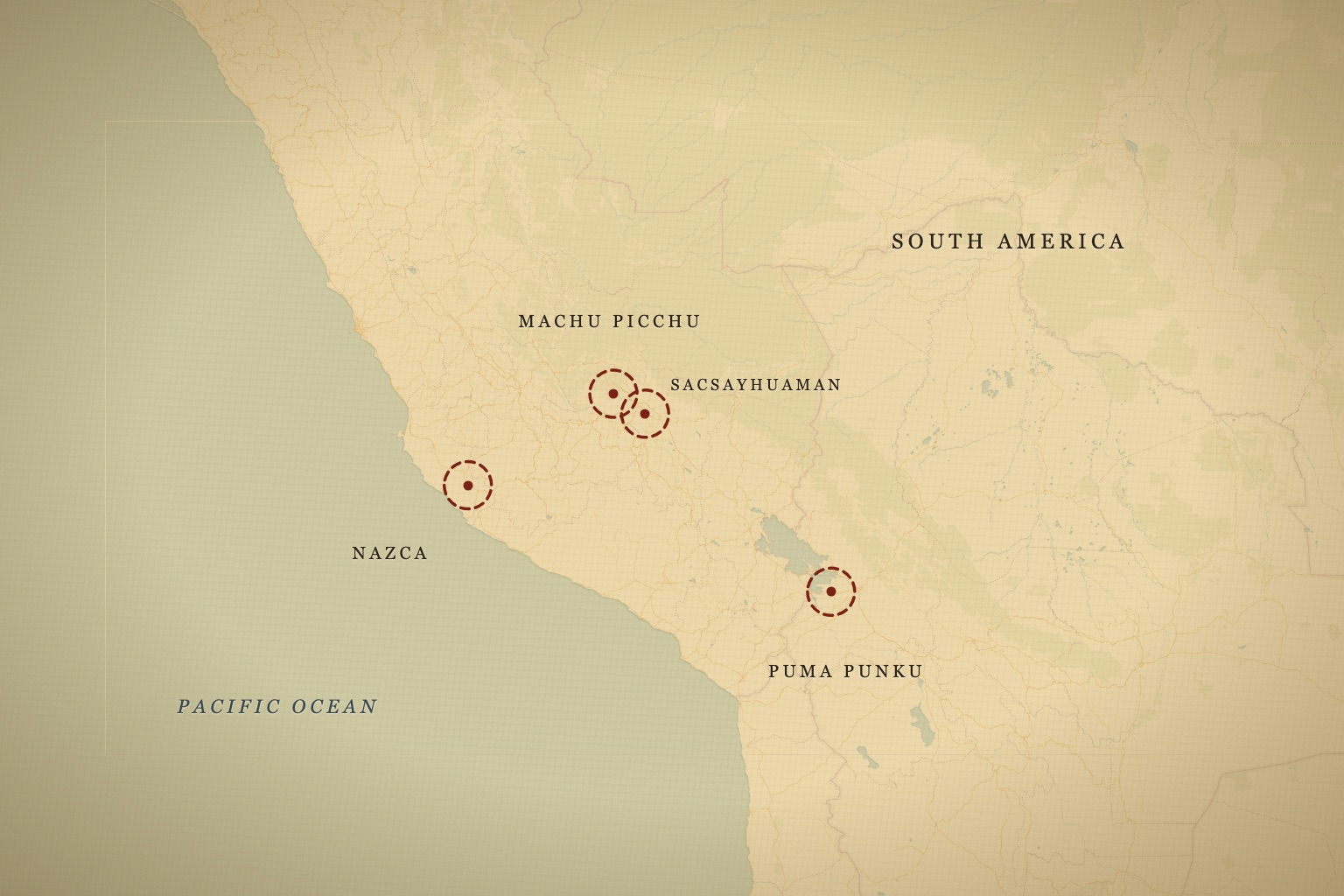
What it is: The capital of a pre-Inca empire that controlled much of the Andean world between 300 and 1000 AD, Tiwanaku sits at 12,500 feet above sea level on Bolivia's Altiplano, about 45 minutes from La Paz. The site includes the Akapana pyramid, the Kalasasaya temple, and the famous Gateway of the Sun — a 10-ton monolithic arch carved from a single block of andesite and covered with intricate iconography.
What the show claims: The Gateway of the Sun's central figure — generally identified as the solar deity Viracocha — is holding objects that Ancient Aliens (Seasons 1 and 4) interprets as alien technology: staffs that function as weapons or communication devices. The show also argues Tiwanaku may predate its accepted timeline by thousands of years, pointing to astronomical alignments that don't match the standard dating.
What archaeology says: The Gateway of the Sun's iconography threads back through documented Andean religious symbolism shared across multiple cultures — and that's its own kind of wonder. Archaeologist Alan Kolata of the University of Chicago spent years excavating at Tiwanaku and uncovered sophisticated raised-field agriculture, hydraulic engineering, and long-distance trade networks. The dating rests on radiocarbon analysis and stratigraphy. What that gives us isn't a debunk so much as a glimpse of a cosmology we still don't fully read: a people who encoded a whole worldview into a single arch of andesite, and meant it.
What still grips you: The scale of the stone transport. Some of the massive andesite blocks were quarried more than 60 kilometers away and ferried across Lake Titicaca on reed boats, then hauled up to the plateau. At 12,500 feet, with thin air and no iron, that's a supply chain that borders on the unbelievable — and they pulled it off. The how of it still isn't fully accounted for, and the longer you sit with it, the larger it gets.
2. Machu Picchu — Peru
What it is: The 15th-century Inca citadel built on a ridge between two Andean peaks at 7,970 feet above sea level, roughly 80 kilometers from Cusco. Built under the Inca emperor Pachacuti as a royal estate and religious retreat, it was abandoned after the Spanish conquest and remained known only to locals until Hiram Bingham described it to the outside world in 1911. It's now Peru's most-visited site, with a UNESCO designation and strict visitor limits.
What the show claims: The show (Season 17) focuses on the mortar-free stonework — blocks fitted so precisely that a knife blade can't pass between them — as evidence of alien construction techniques. Ground-penetrating radar anomalies beneath the site are presented as possible hidden chambers containing ancient technology. The Intihuatana stone, a carved granite pillar, is described as an alien astronomical instrument.
What archaeology says: The ashlar masonry that leaves visitors speechless turns up again and again across Inca construction — from Sacsayhuaman above Cusco to Ollantaytambo in the Sacred Valley. It uses no technology beyond careful shaping and fitting, and somehow that makes it more astonishing, not less: this is what human patience and skill alone can do. There's even a quiet genius to it — mortar-free construction flexes under seismic stress, and Machu Picchu sits squarely in an earthquake zone. The Intihuatana ("hitching post of the sun") is a solar calendar and ceremonial marker, a stone the Inca used to reach for the sky itself.
What still grips you: Who lived here, and why it was abandoned. Pachacuti built it as a royal retreat, but the actual occupants, their daily lives, and the political circumstances of its abandonment — and how complete that abandonment really was — are genuinely not fully understood. A city this perfect, walked away from. The silence around the answer is part of what keeps people climbing the ridge.
3. Sacsayhuaman — Peru
What it is: A massive ceremonial complex on the hillside above Cusco, built primarily in the 15th century under Inca rulers. Its most famous feature is a series of three parallel zigzag walls built from enormous limestone and andesite blocks, some weighing over 100 tons, fitted together without mortar. It sits at 12,142 feet and commands panoramic views of the Cusco valley below.
What the show claims: The show (Seasons 3 and 17) presents Sacsayhuaman's largest blocks as beyond the capacity of Inca engineering. Some theorists claim the stones appear to have been "softened" or "melted" — that the precision of fit suggests the rock was worked in a plastic state. The zigzag design, they argue, encoded alien knowledge.
What archaeology says: Spanish chronicles written during the conquest describe Inca construction methods in detail. Blocks were quarried, shaped with stone and bronze tools, moved on log rollers and earthen ramps by organized labor forces that could number in the thousands, then ground and fitted against each other until they matched. No evidence of vitrification or heat treatment has turned up. And yet knowing the method barely dents the awe — that a fit this exact was achieved by grinding 100-ton stones against one another, by hand, is almost harder to believe than the "melted rock" story it replaces.
What still grips you: The sheer organizational scale. Estimates suggest Sacsayhuaman required the labor of 20,000 or more workers over several decades. How the Inca coordinated that without writing — managing supply chains, feeding a massive workforce, holding a single architectural vision steady across multiple generations — is a real and open question. The mystery here isn't who lifted the stones. It's how a civilization with no written word marshaled a workforce the size of a city and never lost the thread. That kind of administrative genius is its own thing to marvel at.
4. Ollantaytambo — Peru
What it is: An Inca royal estate and fortress in the Sacred Valley, about 72 kilometers northwest of Cusco at 9,160 feet. Built by Emperor Pachacuti in the 15th century, it's one of the best-preserved Inca sites and one of the few where the Spanish were actually defeated in battle — Manco Inca held it against a Spanish assault in 1537. The modern town below the ruins is still laid out on the original Inca street grid.
What the show claims: The show (Season 3) highlights the Wall of Six Monoliths — massive pink granite blocks that form the Temple of the Sun — and the mystery of their transport from a quarry across the Urubamba River, several kilometres away. The stones had to cross a river valley and be hauled up a steep mountainside. The show claims the knobs or bosses visible on some blocks are remnants of anti-gravity lifting mechanisms.
What archaeology says: The "knobs" are a recurring feature of Andean stone-working — left on blocks as attachment points for ropes during transport and placement, then usually removed after installation. At Ollantaytambo, some were never removed, because the construction was never finished. And that unfinished quality is the gift: unfinished transport stones still lie scattered along the ancient route from the quarry to the site, a step-by-step record of exactly how it was done. You don't have to imagine the process. You can walk it.
What still grips you: The abandoned stones themselves. The work was interrupted — possibly by the death of Pachacuti, possibly by the Spanish invasion — and the half-transported blocks have been lying along the old route for 500 years. It's one of the most vivid scenes in all of archaeology: a project frozen at the exact moment it stopped, the workers seemingly about to return any minute. They never did. Standing among those stranded stones, you feel the pull of the day the music stopped — and no record tells you, with certainty, which day that was.
5. Marcahuasi — Peru
What it is: A remote plateau in the Andes at 13,000 feet, about 80 kilometers northeast of Lima. Covered with massive granite boulders shaped by millennia of wind and water erosion, the plateau became controversial in the 1950s when researcher Daniel Ruzo claimed to identify over 100 deliberately carved human faces, animals, and global symbols among the natural formations.
What the show claims: The show's early "Mysterious Places" episode (2010) presents Marcahuasi as evidence of a pre-Columbian global civilization with alien connections — the "carved" faces resemble African, Asian, and Andean features, suggesting contact between continents. Electromagnetic anomalies reported on the plateau are cited as evidence of unusual energy.
What archaeology says: Geologists attribute the formations to natural erosion — water, wind, and frost working granite over thousands of years into shapes the human brain, wired to find faces, reads as deliberate. The phenomenon is called pareidolia, and no carving tools, artifacts, or construction activity have ever been found on the plateau. So the faces weren't carved. But notice what that leaves standing: the impulse itself. Daniel Ruzo climbed to 13,000 feet and saw over 100 faces in the rock — African, Asian, Andean — and so does nearly everyone who follows him up. The deep human hunger to find ourselves looking back out of the stone is real, ancient, and not at all explained away by the word "erosion."
What still grips you: Marcahuasi is genuinely otherworldly, and the experience of standing among formations that look like faces and animals doesn't dissolve once you know the mechanism — if anything it sharpens. Why does this plateau, of all places, throw up so many of them? The altitude, the isolation, and the Andean sky at night make it one of the most haunting places on the continent. You go up half-knowing what you'll find, and the stone still meets your eyes.
The Thread That Connects Them
What these five sites share is something the easy answers never quite reach. The Andean world produced civilizations of extraordinary organizational complexity, working in some of the most inhospitable terrain on Earth — and at every site, the same thing happens. You learn the method, you read the chronicle, you trace the rope-knobs and the quarry route, and the wonder doesn't shrink. It moves. It slides from how did they lift it to how did they hold a vision steady for generations with no written word; from who carved these faces to why do we all see them; from what was this city to why did they leave it.
That's the thread. These places don't surrender their mystery when you study them — they trade a shallow mystery for a deeper one, and the deeper one is human. The people who raised these stones reached for something at the edge of the possible, in thin air, with their hands. Understanding how, and why, is work that will keep archaeologists busy for generations. And honestly, you hope it never fully runs out. Some questions are worth standing in front of with your head tilted back.
Covered On Screen
- The Lost City of PeruAncient Aliens · S17 E1
- Top Ten Mysterious SitesAncient Aliens · S17 E2
Track the 5 sites from this post on your map.
Free account · mark visited sites · build your bucket list.
Start tracking